Key Insights
After borrower-based measures (BBM) were introduced in Ireland in 2015, average house price growth expectations fell upon impact and remained stable over the following four to five years, even as price growth accelerated
The right tail of extreme growth expectations also dropped immediately upon policy introduction and stabilised until 2019, consistent with credit limits playing a role in stabilising more extreme or optimistic expectations that can be particularly important in credit bubble formation.
Our findings suggest macroprudential policies act as a "guardrail" that shifts forward-looking beliefs and contributes to macro-financial stability beyond the direct effects of these policies on the volume and riskiness of lending.
Introduction
Macroprudential policies in the mortgage market, often referred to as borrower-based measures (BBM), can operate through a range of distinct but complementary channels to achieve their broad objectives of macro-financial stabilisation (Aikman et al. 2021 (PDF 308.06KB)). Debt limits such as those on Loan-to-Income (LTI) and Loan-to-Value (LTV) ratios have direct effects on the volume and distribution of new lending and on the growth of house prices, which are now documented in a large and expanding literature.
In this Insight, we provide preliminary evidence consistent with the existence of an expectations channel of BBMs, operating as follows: once buyers, sellers, and lenders know that the possibility of unsustainable credit-price spirals has been curtailed by mortgage debt limits, this constraint feeds into house price expectations, which in turn influences housing market decisions on impact. In line with a large macro-finance literature focussed on the US housing boom-bust cycle around the Global Financial Crisis, expectations are a key channel through which feedback loops between house prices and credit can emerge. However, their influence is wider than through banks and borrowers: they can also influence behaviour of investors purchasing without mortgage finance, as well as brokers and other important agents in the housing market.
In support of the existence of a BBM expectations channel, we present three main facts from a unique survey of housing market professionals in Ireland which has been running since 2012, before the introduction of BBMs. To our knowledge this is the first study connecting house price expectations to BBMs conducted in Europe. Firstly, we document strong responses of average house prices to introduction of the measures in 2015, along with a weakening of the relationship between house price expectations and nominal house price growth up to 2019. Secondly, we study the full distribution of expectations, highlighting a particularly strong response in the right-tail, where extremely optimistic beliefs abruptly disappear in 2015 and do not re-emerge in the pre-pandemic period we study. Thirdly, and consistent with the second fact, we also provide evidence of less disagreement among survey participants, with dispersion of responses also being lower from 2015 to 2019 after a drop upon policy introduction.
Our analysis is descriptive in nature and cannot conclusively rule out a range of confounding factors such as mean reversion in the rapid recovery in the Irish housing market after the 2008 Global Financial Crisis (GFC). However, our evidence is consistent with the concept of BBMs as a "guardrail": regardless of the degree to which they directly limit borrowing, their presence shifts agents’ forward-looking beliefs, particularly in the right tail of optimistic expectations, which contributes to broad macro-financial stabilisation. Economic research has yet to fully tease out the way in which this expectation channel operates, the magnitude of its effect, or whether it operates predominantly through credit supply and demand, or directly through beliefs. In the next section, we briefly review what lessons can be drawn from relevant literature on asset prices and the housing cycle around the GFC, and how our work relates to the recent literature on macroprudential policies.
Related previous work
The existing body of work has identified two primary drivers of the housing market boom and bust since the Great Recession: credit conditions (Mian and Sufi 2009, 2017, 2018; Glaeser et al. 2012; Guerrieri and Uhlig 2016) and expectations (Shiller, 2016).
Adam et al. (2012) and Glaeser and Nathanson (2017) show that even when households behave almost perfectly rationally, uncertainty about the relationship between current house prices and economic fundamentals or extrapolation from past growth can generate significant momentum, resulting in boom-bust cycles in the housing market.Empirical work confirms the important role of expectations in driving market dynamics. Ben-David et al. (2025) find that unrealistically optimistic expectations both fuelled unprecedented price booms across U.S. states and accurately predicted the subsequent collapse. Similarly, in a model of the U.S. economy, Kaplan et al. (2020) assign a primary role to shifts in expectations, larger than the impact of relaxed credit standards.
Recent theoretical advances have further clarified how expectations propagate through credit cycles. Bordalo et al. (2018) propose that expectations formation is "diagnostic," with agents both extrapolating from incoming data and systematically underestimating risk, thus perpetuating momentum in booming markets. Greenwood et al. (forthcoming) develop a complementary framework emphasizing the "reflexivity" of sentiment: investors’ biased beliefs influence market outcomes, which then feed back to shape future biases, creating self-reinforcing cycles that match key features of credit booms and busts.
The Role of Macroprudential Policy
Despite their clear role in the literature on credit booms and housing cycles, expectations have played a less central or explicit role in debates on macroprudential policy, when compared to policy and research focus on the impact of BBMs on lending and house prices. Recent cross-country work also shows that policymaking institutions highlight housing market expectations less often than they cite borrower and bank resilience as key objectives of these policies (Committee on the Global Financial System, 2023). In this regard, the focus on feedback loops between credit and house prices that has been inherent to the Central Bank of Ireland’s mortgage measures since 2015, and which implicitly acknowledges the momentum-enhancing role that expectations can play in driving housing cycles, is noteworthy.
A limited evidence base on BBMs and expectations globally points to meaningful effects. Research from India and Hong Kong reveals associations between tighter macroprudential policies and reduced house price expectations. Rooj et al. (2024) show that changes in LTV stringency and risk weights affect housing inflation expectations in a large survey of urban Indian households, especially for one-year-ahead price forecasts. In a similar vein, Igan and Kang (2011) document how tighter LTI and LTV limits induce lower housing inflation expectations and prompt households who already own a property to postpone purchase, curbing speculative incentives. Experimental work from the UK reinforces these findings, documenting that these mechanisms operate in hypothetical survey settings (Kuang et al., 2023). These authors complement their survey evidence with a dynamic economic model in which the expectations channel amplifies the direct impacts of credit on house prices and consumption, consistent with the framework for BBM impact that we have outlined so far. Along the same lines, Clancy and Merola (2017) find – through the lens of a dynamic stochastic general equilibrium model calibrated on Irish data – that capital-based macroprudential policy can mitigate housing booms based on non-fundamental expectations.
Overall, while the existing literature provides compelling evidence that expectations matter for housing market dynamics, and initial evidence indicates that BBMs can influence these expectations, direct empirical documentation of the latter channel remains limited, motivating our analysis of the Irish experience in this Insight. The next sections introduce our data and main results.
Data
The CBI/SCSI Residential Property Price Survey (RPPS) is a sentiment-based survey of Society of Chartered Surveyors Ireland members, consisting mainly of real-estate agents, auctioneers and surveyors, operating across the country. The survey has been conducted quarterly since 2012:Q3. It uses a short questionnaire to gather professional opinions on the expected direction and extent of changes to national and local property prices across multiple time horizons and the factors driving these considerations, as well as views on affordability, stock levels, and overall market sentiment. The average sample size is approximately 50 respondents, closely aligned with other widely used professional panels that measure expectations of macroeconomic variables and their distribution, such as the Livingston Survey, or the Surveys of Professional Forecasters run by the Philadelphia Fed and the European Central Bank.As part of the recurrent section of the questionnaire, respondents indicate whether they believe that in the next 12 months residential property prices will increase, decrease or stay the same, and by what percentage. Direction and size are elicited in two separate questions with the latter being open ended, requiring respondents to provide a number independently.While the RPPS is not statistically representative of the entire housing market, it provides reliable indications of the prevailing sentiment and market intelligence from practitioners on the ground. In particular, participants are professionals engaged in day-to-day transactions, giving the survey direct insight into market activity; the methodology has been applied consistently for well over a decade and its nationwide coverage provides a broad sense of practitioner sentiment. The predictive validity of these expectations is illustrated in Figure 1, which plots survey-based measures – including median expectations and the share of respondents anticipating positive house price growth – against realised house price changes one year forward. The positive and statistically significant correlation indicates that our survey expectations capture meaningful market signals and have consistent forecasting power. This relationship reinforces the value of practitioner sentiment as a leading indicator, as those directly involved in transactions appear to incorporate information that subsequently materialises in actual price movements.
RPPS house price expectations are well correlated with realised house price growth
Figure 1: Expectations and realised housing inflation one year after
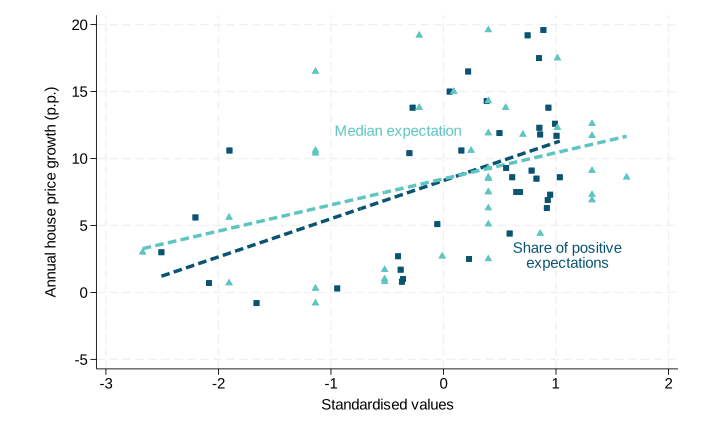
Source: Source: CBI/SCSI Residential Property Price Survey and CSO.
Note: Each data point represents a survey wave. The horizontal axis reports moments of nationwide expectations from waves one year prior, standardised for comparability. The vertical axis reports house price growth rates in the following 12 months. The dashed lines show the linear fit ( and for median and share of positive, respectively). Both regression coefficients are significant at conventional levels. Results don’t change qualitatively if house price growth one year prior is included as a control.
Accessibility: Get the data in accessible format. (CSV 0.24KB)
In terms of data treatment, we winsorise at the 1st and 99th percentile in each quarter to mitigate potential bias from outliers. This adjustment affects only 0.52 percent of the sample but significantly improves the reliability of results for higher-order statistical moments. An example of the resulting distributions for 2014:Q3 and 2016:Q3 is displayed in Figure 2.
Long-tail of extreme expectations disappears after the introduction of BBMs
Figure 2: House price expectations before and after introduction of BBMs (February 2015)

Source: CBI/SCSI Residential Property Price Survey.
Note: Estimated densities (Epanechnikov kernel function, bandwidth = 3) of expectations of house price growth at one year horizon for Ireland from 2014:Q3 (pre-BBM) and 2016:Q3 (post-BBM). Data winsorised at top and bottom 1%.
Accessibility: Get the data in accessible format. (CSV 0.3KB)
Evidence
We begin our analysis with a basic question: did the distribution of expectations shift after the introduction of the BBMs? In Figure 2 we compare the full distribution of expectations in 2014:Q3, before the announcement of the measures, with 2016:Q3, after which transitionary distortions in lending had passed through the housing market. We compare the same quarter in each year to address seasonality concerns. There is evidence of a leftward shift: expectations were lower in the period after the measures were introduced. However, the much more striking change is in the shape of the distribution. In 2014, when house prices were growing above 15 percent annually and no BBMs were in place, a long right tail of expectations, beyond 30 percent, existed. In 2016, this tail disappears completely, with no respondent expecting house price growth above 15 percent. It is noteworthy that the mode of both distributions is almost identical (around 6 percent), with the differences in the average driven almost entirely by the long tail of extreme expectations present in the pre-BBM period. These distributions do not offer conclusive evidence of a causal effect of the BBMs, given that all other relevant macro factors differing between 2014 and 2016 may have also exerted an impact, such as uncertainty related to the UK’s Brexit referendum decision.
Next, in Figure 3 we plot the simple average expectation across the quarterly time series from 2012 to 2020 (blue solid line), together with its sampling uncertainty band and the annual growth rate in the home-price index compiled by the CSO (turquoise dashed line). A number of important observations emerge. Firstly, consistent with the previous graph, average expectations fall from 8 to 5 percent during 2015, having risen from 0 to 8 percent from 2013 to that year. Average expectations match developments in nominal house price growth until 2017, at which point an important breakdown in the relationship follows: while nominal house price growth rose from 5 to 12 percent over 2016 to 2018, expectations never breached 7 percent, and began to decline a year before house prices fell in mid-2018.
While we cannot provide conclusive causal evidence of the underlying mechanisms at play, we interpret our evidence as being consistent with a decoupling of expectations from observed growth. In this interpretation, by making expectations less responsive to contemporaneous price movements, the BBMs may potentially have anchored beliefs around a more sustainable growth trajectory, in a mechanism similar to that of monetary policy on inflation expectations.
BBMs moderate expectations
Figure 3: Average house price growth expectations

Source: CBI/SCSI Residential Property Price Survey and CSO.
Note: The solid blue line shows the average expectation for house price growth in the next 12 months. The shaded area represents the 95% confidence interval. The turquoise dashed line reports the annual change in the Residential Property Price Index. Both series are in percentage points. Introduction of BBMs is set in 2014:Q4.
Accessibility: Get the data in accessible format. (CSV 0.53KB)
When considering macro-financial stability, it is possible that the right tail of expectations is in fact more important than the average. If a small share of agents have extreme beliefs in any housing market, there is a risk that they can drive market dynamics and influence the behaviour of other players with imperfect information. When housing supply is constrained, these effects can even be amplified through the bidding process.
With these channels in mind, we explore the 90th percentile of expectations in Figure 4. We again plot the series as the dark solid line, together with an uncertainty band and the growth in the home-price index (dashed line). The figure depicts again a pattern of immediate reduction followed by a five-year long period of stabilisation of forecasts. Our measure of the right tail had reached 15 percent by 2015, but fell on impact to 10 percent after the BBMs were introduced, and remained at exactly 10 percent until 2019.
BBMs moderate extreme expectations
Figure 4: Right tail of house price growth expectations
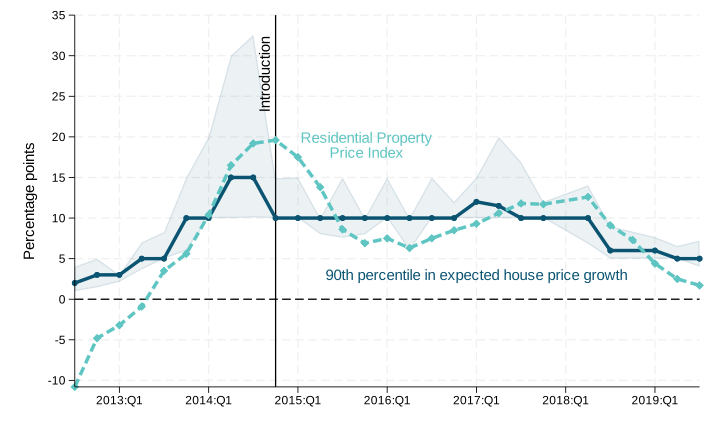
Source: CBI/SCSI Residential Property Price Survey and CSO
Note: The solid blue line shows the 90th percentile expectation of house price growth in the following 12 months, in percentage points. The shaded area represents the 95% conservative confidence interval for the empirical 90th percentile derived in Mood et al. (1974). The turquoise dashed line reports the annual change in the Residential Property Price Index. Both series are in percentage points. Introduction of BBMs is set in 2014:Q4.
Accessibility: Get the data in accessible format. (CSV 0.4KB)
Another way of considering the stabilising impact of BBMs is through a compression in the distribution of forecasts. Figure 5 depicts the quarterly standard deviation on house price expectations. From mid-2013 until the introduction of the BBMs, this dispersion had risen steadily; as with other measures presented in this paper, dispersion immediately reversed and then stayed within a stable range over the period up to 2020.
This is an important result in the light of theoretical research on market efficiency and informational frictions. The key insight from this literature is that when overly optimistic buyers determine the final sale price of homes – which then influences what other buyers expect to pay – the entire market can become overpriced and resources can be misallocated compared to the homogeneous benchmark (Miller 1977; Harrison and Kreps 1978). This problem is particularly acute in housing markets because of two key features: buyers often use heavy borrowing (leverage), and it is impractical for pessimistic investors to bet against rising prices (as opposed to financial markets, where short-selling is common). Recent research by Li et al. (2023) documents that wider heterogeneity in views on fundamentals makes forecasters place greater weight on their own market signals. Under these conditions, the most optimistic voices end up setting market prices. The result is a market that swings too far in response to news, creating an inefficient allocation of resources.
The compression in the distribution of expectations following the introduction of BBMs therefore represents a potentially important stabilising mechanism. By limiting the influence of the most optimistic market participants and reducing disagreement about future price trajectories, these measures may have enhanced market efficiency and reduced the likelihood of speculative bubbles forming.
BBMs reduce the disagreement of forecasts
Figure 5: Dispersion of house price growth expectations
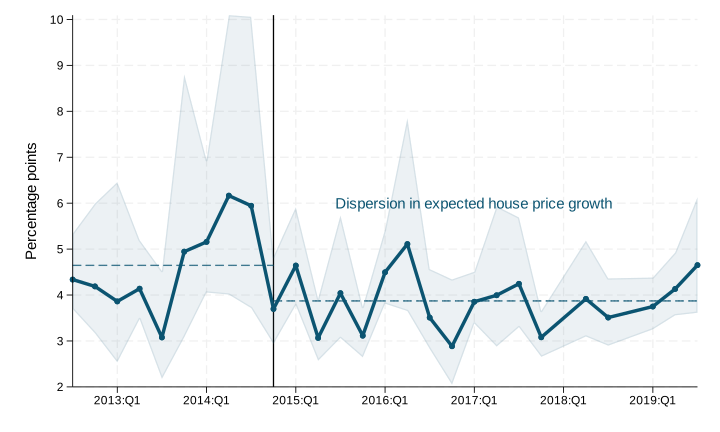
Source: CBI/SCSI Residential Property Price Survey.
Note: The solid blue line shows the standard deviation of expectations of house price growth in the following 12 months, in percentage points. The shaded area represents the 95% approximate confidence interval for the sample standard deviation derived in Bonett (2006). The dashed horizontal lines represent average dispersion before and after the introduction of BBMs (2014:Q4). The difference between the two lines is statistically significant at 5% level.
Accessibility: Get the data in accessible format. (CSV 0.33KB)
Conclusions
In this Insight, we have presented evidence on how house price expectations evolved in Ireland following the introduction of macroprudential mortgage measures in 2015. Using survey data from real-estate professionals, we show that the measures produced two immediate effects: a sharp reduction in average expected price growth and of extreme forecasts in the right tail of the distribution. These changes coincided with reduced dispersion of beliefs across market participants. In the medium run, our findings reveal that – despite sustained house price inflation between 2016 and 2018 – both average and right-tail expectations did not respond to observed price growth in the way they had before 2015.
The expectations mechanism we document aligns with established principles in monetary economics, where expectations and credible policy regimes play a central role in transmission to the real economy. The seminal work of Friedman (1968), Kydland and Prescott (1977) and Barro and Gordon (1983) shows that, if the public believes that the central bank will defend price stability, they adjust prices and wages accordingly, resulting in a self-reinforcing low inflation environment (the nominal anchor, Bernanke and Mishkin 1997). Our work provides suggestive evidence that BBMs could play a similar role in the housing market. In addition, as Adam et al. (2025) document, when homebuyers form irrational expectations, optimal monetary policy may need to expand beyond traditional inflation and employment targets to actively lean against house price movements. The potential for BBMs to stabilize sentiment in the housing market, as suggested in our Insight, would in this framework allow monetary policy makers to maintain focus on the inflation mandate while still achieving housing market stability through their macroprudential toolkit, rather than expanding their formal objectives.
We conclude that further empirical and theoretical insight is needed to develop a more comprehensive understanding of the relative importance of the various impact channels of BBM policies. In this Insight, we have introduced initial descriptive evidence on the possible importance of expectations as a transmission channel that may act as a basis for more formal and structured research to achieve this goal.
References
Adam, Klaus, P. Kuang, and A. Marcet. 2012. “House Price Booms and the Current Account.” NBER Macroeconomics Annual 26 (1): 77–122.
Adam, Klaus, O. Pfäuti, and T. Reinelt. 2025. “Subjective Housing Price Expectations, Falling Natural Rates, and the Optimal Inflation Target.” Journal of Monetary Economics 149: 103647.
Adam, Klaus, and M. Woodford. 2021. “Robustly Optimal Monetary Policy in a New Keynesian Model with Housing.” Journal of Economic Theory 198: 105352.
Aikman, David, R. Kelly, F. McCann, and F. Yao. 2021. The Macroeconomic Channels of Macroprudential Mortgage Policies. Financial Stability Notes 11/FS/21. Central Bank of Ireland.
Armona, Luis, A. Fuster, and B. Zafar. 2019. “Home Price Expectations and Behaviour: Evidence from a Randomized Information Experiment.” The Review of Economic Studies 86 (4): 1371–410.
Bailey, Michael, E. Dávila, T. Kuchler, and J. Stroebel. 2019. “House Price Beliefs and Mortgage Leverage Choice.” The Review of Economic Studies 86 (6): 2403–52.
Barro, Robert J., and D.B. Gordon. 1983. “A Positive Theory of Monetary Policy in a Natural Rate Model.” Journal of Political Economy 91 (4): 589–610.
Ben-David, Itzhak, P. Towbin, and S. Weber. 2025. “Inferring Expectations from Observables: Evidence from the Housing Market.” Review of Economics and Statistics, 1–17.
Bernanke, Ben S., and F.S. Mishkin. 1997. “Inflation Targeting: A New Framework for Monetary Policy?” Journal of Economic Perspectives 11 (2): 97–116.
Bonett, Douglas G. 2006. “Approximate Confidence Interval for Standard Deviation of Nonnormal Distributions.” Computational Statistics & Data Analysis 50 (3): 775–82.
Bordalo, Pedro, N. Gennaioli, and A. Shleifer. 2018. “Diagnostic Expectations and Credit Cycles.” The Journal of Finance 73 (1): 199–227.
Brandão-Marques, Luis, G. Gelos, D.J. Hofman, J. Otten, G. Kaur Pasricha, and Z. Strauss. 2023. “Do household expectations help predict inflation?” IMF Working Paper 2023/224. International Monetary Fund.
Burnside, Craig, M. Eichenbaum, and S. Rebelo. 2016. “Understanding Booms and Busts in Housing Markets.” Journal of Political Economy 124 (4): 1088–147.
Camous, Antoine, and A. Van der Ghote. 2025. Evaluating the Financial Instability Hypothesis: A Positive and Normative Analysis of Leveraged Risk-Taking and Extrapolative Expectations. Working Paper 1009. Banque de France.
Chodorow-Reich, Gabriel, A.M. Guren, and T.J. McQuade. 2024. “The 2000s Housing Cycle with 2020 Hindsight: A Neo-Kindlebergerian View.” Review of Economic Studies 91 (2): 785–816.
Clancy, Daragh, and R. Merola. 2017. “Countercyclical Capital Rules for Small Open Economies.” Journal of Macroeconomics 54: 332–51.
Coibion, Olivier, and Y. Gorodnichenko. 2012. “What Can Survey Forecasts Tell Us about Information Rigidities?” Journal of Political Economy 120 (1): 116–59.
Committee on the Global Financial System. 2023. Macroprudential Policies to Mitigate Housing Market Risks. CGFS Papers No. 69.
Croushore, Dean. 1997. “The Livingston Survey: Still Useful After All These Years.” Business Review-Federal Reserve Bank of Philadelphia 2: 1.
Croushore, Dean, T. Stark, et al. 2019. “Fifty Years of the Survey of Professional Forecasters.” Economic Insights 4 (4): 1–11.
De Stefani, Alessia. 2021. “House Price History, Biased Expectations, and Credit Cycles: The Role of Housing Investors.” Real Estate Economics 49 (4): 1238–66.
Dovern, Jonas, U. Fritsche, and Jiri Slacalek. 2012. “Disagreement Among Forecasters in G7 Countries.” Review of Economics and Statistics 94 (4): 1081–96.
Duca, John V, J. Muellbauer, and A. Murphy. 2021. “What Drives House Price Cycles? International Experience and Policy Issues.” Journal of Economic Literature 59 (3): 773–864.
Fofana, Salomé, P. Patzelt, and R. Reis. 2024. “Household Disagreement about Expected Inflation.” In Research Handbook of Inflation, edited by Guido Ascari and Riccardo Trezzi. Edward Elgar Publishing.
Friedman, Milton. 1968. “The Role of Monetary Policy.” The American Economic Review 58 (1): 1–17.
Fuster, Andreas, R. Perez-Truglia, M. Wiederholt, and B. Zafar. 2022. “Expectations with Endogenous Information Acquisition: An Experimental Investigation.” Review of Economics and Statistics 104 (5): 1059–78.
Gaffney, Ed, N. Hallissey, and F. McCann. Forthcoming. “Borrower-based mortgage measures: lessons from Ireland’s experience since 2015.” In Research Handbook of Macroprudential Policy, edited by David Aikman and Prasanna Gai. Edward Elgar Publishing.
Garcia, Juan Angel. 2003. An Introduction to the ECB’s Survey of Professional Forecasters. ECB Occasional Paper.
Glaeser, Edward L, J.D. Gottlieb, and J. Gyourko. 2012. “Can Cheap Credit Explain the Housing Boom?” In Housing and the Financial Crisis. University of Chicago Press.
Glaeser, Edward L, and C.G. Nathanson. 2017. “An Extrapolative Model of House Price Dynamics.” Journal of Financial Economics 126 (1): 147–70.
Greenwood, Robin, S.G. Hanson, and L.J. Jin. Forthcoming. “Reflexivity in Credit Markets.” Journal of Finance.
Guerrieri, Veronica, and H. Uhlig. 2016. “Housing and Credit Markets: Booms and Busts.” In Handbook of Macroeconomics, vol. 2. Elsevier.
Harrison, J Michael, and D.M. Kreps. 1978. “Speculative Investor Behavior in a Stock Market with Heterogeneous Expectations.” The Quarterly Journal of Economics 92 (2): 323–36.
Hodula, Martin, L. Pfeifer, and N. Anh Ngo. 2025. “Easing of Borrower-Based Measures: Evidence from Czech Loan-Level Data.” Journal of Banking & Finance 178: 107489.
Igan, Deniz O, and H. Kang. 2011. Do Loan-to-Value and Debt-to-Income Limits Work? Evidence from Korea. IMF Working Papers 2011/297. International Monetary Fund.
Kaplan, Greg, K. Mitman, and G.L. Violante. 2020. “The Housing Boom and Bust: Model Meets Evidence.” Journal of Political Economy 128 (9): 3285–345.
Kuang, Pei, K. Mitra, L. Tang, and S. Xie. 2023. Macroprudential Policy and Housing Market Expectations. Working paper.
Kuchler, Theresa, M. Piazzesi, and J. Stroebel. 2023. “Housing Market Expectations.” In Handbook of Economic Expectations. Elsevier.
Kydland, Finn E., and E.C. Prescott. 1977. “Rules Rather Than Discretion: The Inconsistency of Optimal Plans.” Journal of Political Economy 85 (3): 473–91.
Li, Zigang, S. Van Nieuwerburgh, and W. Renxuan. 2025. “Understanding Rationality and Disagreement in House Price Expectations”, The Review of Financial Studies.
Liu, Haoyang, and C. Palmer. 2025. “Implicit Extrapolation and the Beliefs Channel of Investment Demand.” Journal of Financial Economics 175.
Mankiw, N. Gregory, and R. Reis. 2018. “Friedman’s Presidential Address in the Evolution of Macroeconomic Thought.” Journal of Economic Perspectives 32 (1): 81–96.
Mian, Atif, and A. Sufi. 2009. “The Consequences of Mortgage Credit Expansion: Evidence from the US Mortgage Default Crisis.” The Quarterly Journal of Economics 124 (4): 1449–96.
Mian, Atif, and A. Sufi. 2017. “Household Debt and Defaults from 2000 to 2010: The Credit Supply View.” In Evidence and Innovation in Housing Law and Policy, edited by Lee Anne Fennell and Benjamin J.Editors Keys. Cambridge University Press.
Mian, Atif, and A. Sufi. 2018. “Finance and Business Cycles: The Credit-Driven Household Demand Channel.” Journal of Economic Perspectives 32 (3): 31–58.
Miller, Edward M. 1977. “Risk, Uncertainty, and Divergence of Opinion.” The Journal of Finance 32 (4): 1151–68.
Mood, Alexander McFarlane, F. A Graybill, and D.C. Boes. 1974. Introduction to the Theory of Statistics, 3rd Edition. McGraw-Hill.
Moretti, Laura, and L. Riva. 2025. “The Impact of Borrower-Based Measures: An International Comparison.” Central Bank of Ireland Staff Insights Vol. 6.
Piazzesi, Monika, and M. Schneider. 2009. “Momentum Traders in the Housing Market: Survey Evidence and a Search Model.” American Economic Review 99 (2): 406–11.
Reis, Ricardo. 2021. The People Versus the Markets: A Parsimonious Model of Inflation Expectations. CEPR Discussion Paper No. 15624. CEPR Press.
Rooj, Debasis, A. Banerjee, and R. Sengupta. 2024. “Impact of Macroprudential Policies on House Price Expectations- Evidence from Survey Data.” Economics Letters 236: 111612.
Shiller, Robert J. 2000. “Measuring Bubble Expectations and Investor Confidence.” The Journal of Psychology and Financial Markets 1 (1): 49–60.
Shiller, Robert J. 2016. Irrational Exuberance: Revised and Expanded Third Edition. Princeton University Press.
Singh, Anuj P., and F. Yao. 2025. Macroprudential Easing and Mortgage Borrower Outcomes: Evidence from Ireland. Central Bank of Ireland Research Technical Paper No. 13.
Zarnowitz, Victor, and L.A. Lambros. 1987. “Consensus and Uncertainty in Economic Prediction.” Journal of Political Economy 95 (3): 591–621.
Endnotes