Old Irish Coins
Pre-Decimal Coins
The Irish Free State government passed the Coinage Act in 1926 which empowered the Minister for Finance to make and issue silver, nickel and bronze coins. A committee was established to choose designs for these new Irish coins. This committee was headed by WB Yeats and it recommended that the coins feature a series of native animals because of their central importance to the mainly agricultural economy of Ireland.
Percy Metcalfe (1895-1970) was the winner of the design competition for the pre-decimal coins. The first Irish coin series consisted of eight coins: farthing, halfpenny, penny, threepence, sixpence, shilling, florin and half-crown. These coins were first issued on 12 December 1928.
|
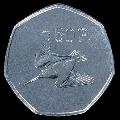
Denomination: 50p
Design: Woodcock
Diameter (mm): 30
Weight (g): 13.50
|
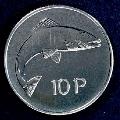
Denomination: 10p
Design: Salmon
Diameter (mm): 22
Weight (g): 5.45
|
|
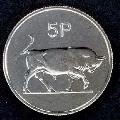
Denomination: 5 p
Design: Bull
Diameter (mm): 18.50
Weight (g): 3.25
|
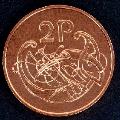
Denomination: 2p
Design: Ornamental bird detail
Diameter (mm): 25.91
Weight (g): 7.13
|
|
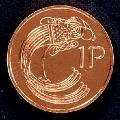
Denomination: 1p
Design: Ornamental bird detail
Diameter (mm): 20.32
Weight (g): 3.56
|
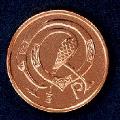
Denomination: 1/2p (half-penny)
Design: Ornamental bird detail
|
Obverse
The harp was chosen for the obverse of the coins, as it had been the heraldic emblem of Ireland for many centuries. The design of the harp featured on the coins is Metcalfe’s adaptation of the ‘Brian Ború Harp’, located in Trinity College Dublin.
The words ‘Saorstát Éireann’ (Irish Free State) appeared on the obverse of the coins from 1928 to 1939. In 1939 the word ‘Éire’ replaced ‘Saorstát Éireann’ and minor alterations were made to the horse, hen and harp.

In 1942 the composition of the sixpence and threepence was changed from nickel to cupro-nickel. From 1951 the half-crown, florin and shilling were struck in cupro-nickel.
Decimal Currency
This is a transcript of text in the video titled "Anniversary of Decimal Day"
The 15th of February is Decimal Day.
Did you know that in 1971 the Irish Punt currency system switched over from the old
system of florin, shillings and half-crown, to the decimal system?
This meant the withdrawal of the penny, threepence, sixpence and half-crown.
Gabriel Hayes, an Irish female artist and sculptor, designed the Irish punt decimal coins, of
which the halfpenny, penny and twopence are most notable.
Decimal coins were used until the euro came into circulation in 2002.
What we can see is three ornamental bird designs similar to those contained in old Irish
illuminated manuscripts, the most famous one being the Book of Kells.
We do not know where exactly Hayes got the designs from, but they blend in perfectly
with the rest of the designs created by Percy Metcalfe, which we’ve shown in previous
videos of our archival collection.
On 15 February 1971, Ireland’s currency was changed over to the decimal system. The Metcalfe designs were retained, apart from minor modifications, up to the demonetisation of the farthing and halfpenny in 1969. With the introduction of decimal currency in 1971, the penny, threepence, sixpence and half-crown were also withdrawn.
The shilling and florin coins were of equal value with the new 5p and 10p coins and the original designs were therefore adopted for these new coins. In addition, the woodcock design was adopted from the demonetised farthing to appear on the new 50p coin.
New designs were necessary for three decimal coins: the ½p, 1p and 2p. A noted Irish sculptor and artist, Gabriel Hayes (1909-1978), was commissioned to design these coins. The designs are based on ornamental details from Irish art illuminations contained in old manuscripts.
|
Denomination: 50p
Design: Woodcock
Diameter (mm): 30
Weight (g): 13.50
|
Denomination: 10p
Design: Salmon
Diameter (mm): 22
Weight (g): 5.45
|
|
Denomination: 5 p
Design: Bull
Diameter (mm): 18.50
Weight (g): 3.25
|
Denomination: 2p
Design: Ornamental bird detail
Diameter (mm): 25.91
Weight (g): 7.13
|
|
Denomination: 1p
Design: Ornamental bird detail
Diameter (mm): 20.32
Weight (g): 3.56
|
Denomination: 1/2p (half-penny)
Design: Ornamental bird detail
|
On 20 June 1990, Ireland issued its first pound coin. This was issued to replace the £1 note and was designed by Thomas Ryan. In keeping with the original Metcalf animal motifs, the red deer, which is native to Ireland, was chosen for the design of the £1 coin.
This is a transcript of text in the video titled "£1 Coin"
The Irish punt – or pound – coin was unique when it came into circulation in 1990. Until
then, only banknotes had been used for this denomination. Irish coins had a common
theme: native animals of Ireland.
We can see this theme represented on the pound coin, where the designer Thomas Ryan
portrayed the majestic red deer symbolising Ireland's wildlife and heritage. The animal is
represented on the front of the coin alongside the word "punt", which is Irish for "pound".
The back of the coin displays the Irish harp, which features on all Irish coins since 1928.
With the introduction of the euro in 2002, the pound coin was removed from circulation.
Production of Irish coins ceased in September 2000, and a Millennium pound coin was the
last national coin to be struck by the Irish mint.
Do you remember the pound coin?
Ireland officially adopted the euro as its currency on 1 January 1999. In advance of the euro changeover in 2002, the Irish Mint commenced full production of euro coins in August 1999. Production of IR£ ceased in September 2000 with the Millennium £1 circulating coin being the last national coin to be struck by the Irish Mint.
See also:
Apply to exchange old or damaged money.