Robert Kelly, Director of Economics & Statistics, Central Bank of Ireland
What is the outlook for the Irish economy?
The Irish economy experienced solid 5 per cent growth in 2025, driven by strong investment. But there are now signs of cooling, which means lower growth, averaging 2.8 per cent, over the coming years.
This reflects the normalisation of pharmaceutical exports after last year's exceptional growth, receding momentum outside of the multinational-dominated sectors, and – most of all – the conflict in the Middle East, which creates major
downside uncertainty for the economic outlook.
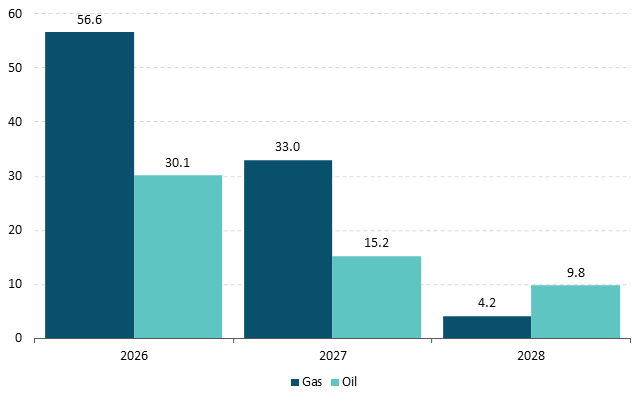
Energy prices have spiked. Compared to last quarter, future markets are now pricing oil an average of 30 per cent higher in 2026. As for gas, that jump is even bigger, at almost 60 per cent.
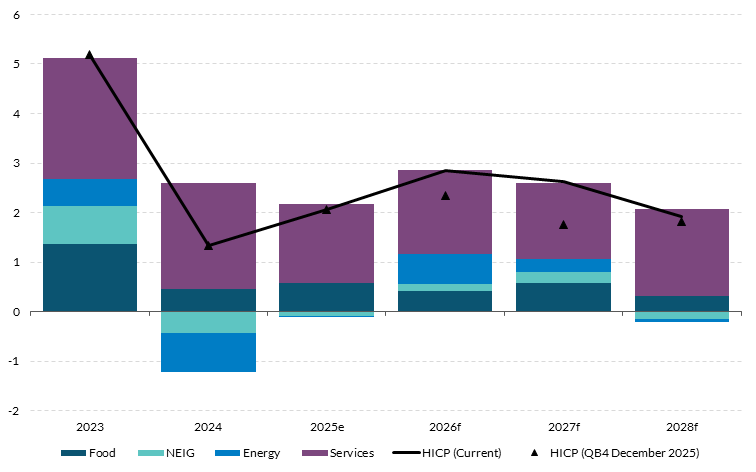
This pushes inflation to 2.9 per cent this year and keeps it elevated at 2.6 per cent in 2027.
In the event of further escalation and severely disrupted energy supplies, a more severe scenario shows inflation staying at 4 per cent through 2027. This would further squeeze household spending and demand for our exports.
How can policy build resilience?
Building resilience requires a multi-pronged approach.
We must seek to broaden our tax base, continue to focus on infrastructure needs, and use current windfall corporation taxes to build buffers to external shocks and known demographic cost pressures.
Beyond public spending, modernising our economy matters enormously. Our research shows one in seven Irish workers are exposed to the growth of AI.
However, significant gains await the Irish economy – but only if we drive forward our National Digital and AI Strategy by enabling firms to adopt AI and build digital skills across our workforce.
90 second video = <250 words
Comment
Recent developments in the Middle East present additional challenges for the Irish and European economies, which were already having to adapt to a shifting geopolitical situation. Higher oil and gas prices are expected to lead to lower growth and higher inflation than previously anticipated. The extent of these effects will depend on the intensity and duration of the conflict, as well as the scale of damage to critical infrastructure in the Middle East. These events underline the sensitivity of the Irish economy to global developments and the need to maintain and build resilience in the economy and public finances to less favourable geoeconomic realities than what has been the norm of recent decades, affecting trade, supply-chain security and cross-border investment.
Higher energy costs, already reflected to varying degrees across the price of different fuel types, are likely to have both direct and indirect effects on inflation facing both businesses and households. Recent events, coming as they do only four years after Russia’s invasion of Ukraine and the accompanying historic, sharp rise in gas, oil and food prices, naturally lend themselves to comparisons with that period. As of mid-March the scale of the initial energy price shock has not been as acute, with spot and futures gas and oil prices not persistently reaching the heights of 2022. But it is still material and, with Ireland being an energy importer, represents an adverse terms of trade shock with related consequences for national income.
Given the uncertainty around the outlook, conditional on the length and severity of the war in the Middle East, a range of possible scenarios are considered in this Bulletin relative to the baseline assumption of a somewhat short conflict and a quick restoration of supply-chains. In the baseline, domestic economic growth is marginally weaker than our previous forecasts for 2026 and 2027, with inflation remaining between 2.5 and 3 per cent in those years. A lengthier conflict with significantly more disruption could see inflation in Ireland being about 1 percentage point higher than that baseline on average over the next three years.
The higher than previously expected inflation rate leads to a less optimistic outlook for households’ purchasing power over the forecast horizon. As in the past, this is likely to be felt differently across the income distribution and influenced by the prevalence of energy and food products in each household’s consumption basket. It is understandable that policy adjusts where necessary to support the economy, and especially those who are most vulnerable. Central Bank staff analysis shows that the cost-of-living measures introduced in response to the inflationary shock in 2022 and 2023 did effectively maintain living standards on average (Boyd and McIndoe-Calder, 2026). However, the research also shows that income growth also contributed, especially for the upper half of the income distribution, and suggests that more effective targeting of such supports for those on lower incomes can achieve the same benefit to the economy in a more sustainable way for the public finances.
Indeed, reasonable growth in wages and household disposable income has been supported in recent years by the strength of the labour market. However, the pace of employment growth has been easing in recent quarters and unemployment has ticked up marginally. This easing of the exceptionally tight labour market conditions is coinciding with a slightly lower job-finding rate, especially for younger cohorts (Box E). Given that the most significant changes are in sectors with typically high youth employment but less exposed to tasks that can be done by AI (e.g. accommodation and food services), it is unlikely that the increased use of AI is the most prominent reason to date for the lower job-finding rate among younger people. More generally, the increased availability and use of AI can be expected to change the nature of the job market over time, and in ways not yet fully understood. There will likely be a role for policy measures to improve digital skills and occupational mobility for certain cohorts of the labour force (McIndoe-Calder and Yadav, 2026 (PDF 1.8MB)). Our baseline forecast is for employment growth to ease further, to below 2 per cent per annum out to 2028. This coincides with a slightly higher expectation for the unemployment rate, albeit that it is still close to 5 per cent. Since this rate reflects slightly less buoyant domestic demand conditions, it is also consistent with potentially lower second-round effects of the rise in energy costs than what was experienced after the Russian invasion of Ukraine.
While consumer spending may be more constrained considering the higher than previously expected inflation outlook, domestic investment is expected to grow at a steady pace. This reflects the expected delivery of public capital infrastructure, rising housing completions and slightly more momentum than previously forecast in business investment. However, should higher energy costs become persistent this would alter the relative returns and the viability of some capital expenditure over the forecast horizon. For housing, some of the benchmark indicators commonly used for forecasting output, such as commencements and PMIs, are less straight-forward to interpret than previously, and point to the potential for a less robust rise in housing output than in our current forecast (Box A).
Aside from higher housing output and the enabling infrastructure, machinery and technology investment being necessary to maintain and build resilience in living standards over the long-term, a rise in the domestic private-sector investment rate would likely correspond with a lower current account surplus on Ireland’s balance of payments (Box B). Interpreting the drivers and dynamics of Ireland’s external position is always complicated given the extent and nature of the activities of foreign-owned MNEs. However, looking beyond that issue, the domestic private sector has for some years now been a net lender of funds to the rest of the world and the rate of investment, especially by businesses, has been relatively low. Sustainably facilitating higher private sector investment can effectively contribute to building a more resilient economy, especially against a more fragmented global backdrop. Policy can play a part, including by enabling sufficient scale in markets which can encourage businesses to invest, increase productivity, and grow. Domestically, for example, ensuring sufficient zoned and serviced land is available and incentivised to be used in areas of high housing demand would help create sufficient scale for businesses to deliver that housing more efficiently. Within the EU, reducing remaining barriers to trade and deepening the Single Market in both goods and services opens opportunities to leverage the scale of a market covering 450 million people. Similarly, creating the necessary conditions to safely and securely leverage the benefits of innovation in finance can also unlock gains for Irish and other European citizens, with the potential introduction of a Digital euro and other innovations such as tokenisation being examples. Beyond the EU, working to both open and maintain secure trade and investment links with other markets also remains important. The recent Mercosur trade agreement and its provisional application by the EU Commission is an example of where such progress can be made for the overall benefit of the Irish and EU economies (Box C).
The conflict in the Middle East has made the outlook for inflation and growth for the euro area more uncertain, with upside risks for inflation and downside risks to growth. However, both realised inflation and inflation expectations have remained well anchored around the 2 per cent target in recent quarters, and the economy has displayed resilience. The ECB Governing Council decided at its March meeting to maintain the key policy rates at their existing levels, given their assessment of the outlook, incoming data, the dynamics of underlying inflation and the strength of monetary policy transmission. The incoming information in the period ahead will help the Governing Council assess how the war will affect the inflation outlook and the risks surrounding it. Given the data dependent and meeting-by-meeting approach to evaluating the appropriate stance, the Governing Council is well positioned to adjust policy rates as necessary to maintain euro area inflation at target over the medium term.
Sustainable fiscal policy also plays an important role in building resilience in the economy in facing both more immediate challenges and those that are longer-term in nature. That requires moving fiscal policy to a more balanced stance by purposefully reducing the underlying general government deficit (i.e., the balance excluding estimated excess corporation tax). Demands on the public finances are intensifying from climate change and the medium-to-longer term reality of an older population. In the near-term, working within a sustainable net expenditure path and maintaining the priority for efficient capital spending, any additional supports should be targeted solely at the most vulnerable. The conflict in the Middle East and its related negative economic impact follows two other recent large negative shocks – the pandemic and the Russia-Ukraine war. Since the response to both crises saw substantial increases in public spending, the fiscal policy space to sustainably respond to the economic impact of the current Middle-East conflict is more restrained. For the medium-to-longer term, addressing the sustainability of the relatively narrow revenue base and reducing concentration risk can enable the necessary sustainable growth in net government expenditure. Broadening the tax base could be considered through various avenues, including reform of tax reliefs, property and consumption taxes, and social insurance contributions. Putting the tax base on a more sustainable footing would also help create the economic space for necessary increases in public and private capital investment, as well as to fund the rise in the cost of maintaining existing public services over the longer-term.
Outlook for the Irish Economy
Recent Developments and Forecast Summary
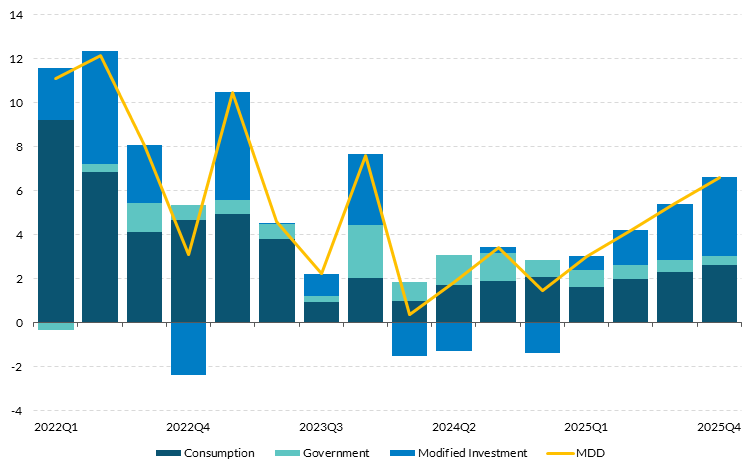
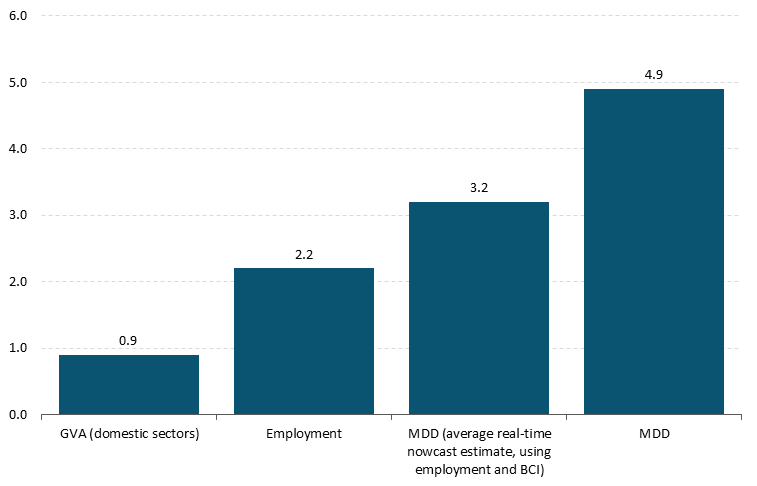
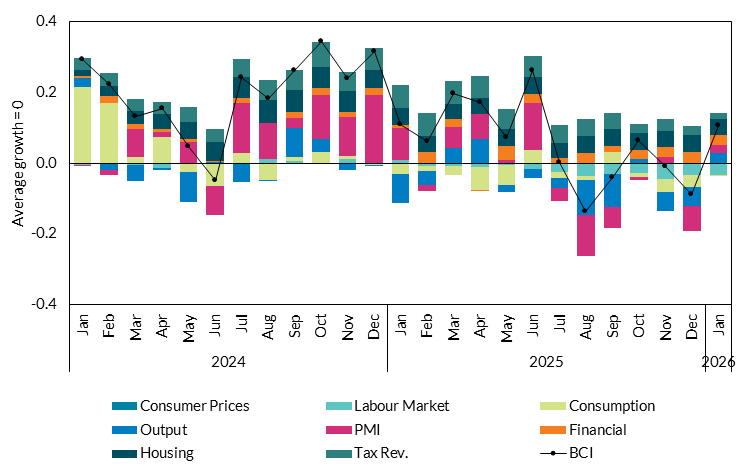
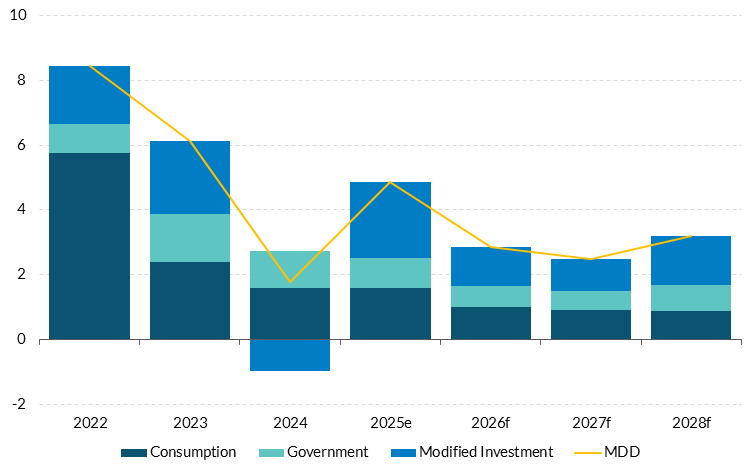
A large increase in investment underpinned growth in overall Modified Domestic Demand in 2025, but signs of a slowdown in economic activity are evident in some other indicators. Economic activity (Modified Domestic Demand) expanded by 6.7 per cent in Q4 2025 compared with the same quarter in 2024, resulting in overall growth of 4.9 per cent for the year as a whole. This marked an acceleration in the pace of growth from 2024 when MDD increased by 1.8 per cent (Figure 1 and Figure 6). The faster pace of growth in 2025 materialised largely as a result of a resurgence in modified investment, both multinational-dominated and more domestic components. Domestic building and construction investment increased by 9.1 per cent while multinational-dominated modified machinery and equipment – which contracted by 10 per cent in 2024 – rebounded to grow by 13 per cent in 2025. Continued growth in software and R&D spending by firms in Ireland provided a further boost to investment and overall MDD last year. More domestically oriented and less volatile indicators of growth in the Irish economy than those influenced by multinational investment also point to continued growth in 2025 but suggest that the pace of growth is slower than indicated by headline MDD (Figure 2). Jobs growth slowed to 2.2 per cent in 2025 from 2.7 in the previous year, output of the domestically-oriented sectors increased by just under 1 per cent and growth in non-corporation tax revenue slowed to 5.5 per cent from 7.3 per cent in 2024. The Central Bank’s Business Cycle Indicator (BCI) summarises the information from the latest high-frequency monthly data, separating out the underlying trend in activity from movements due to noise. The latest BCI estimates indicate that the economy continues to grow at around its average growth rate. Activity has been slightly weaker since around mid-2025, as prior to that the estimated BCI was consistent with growth in MDD slightly above its long-run average rate (Figure 3). The main negative contributions to the BCI over this period have been traditional sector output, PMIs and weaker labour market data.
Pace of MDD growth accelerated during 2025, driven by modified investment
Figure 1: Contributions to year-on-year change in Modified Domestic Demand (MDD), (p.p.)
Source: CSO. Chart data in accessible format. (XLSX 152.37KB)
MDD outturn for 2025 is at the upper end of estimates of domestic activity from other indicators
Figure 2: Estimates of growth in domestic activity in 2025, per cent change
Source: CSO and Central Bank of Ireland. Chart data in accessible format. (XLSX 152.37KB)
A large rise in exports of weight-loss related products up to Q3 2025 underpinned double-digit GDP growth in 2025, but quarterly outturns have been erratic with exports slowing sharply in the final quarter of the year. Overall cross-border merchandise exports grew by 17.5 per cent in 2025, with 95 per cent of this growth accounted for by a single product group – polypeptide hormones. While medium-term demand for these exports is expected to be strong, continued volatility is likely over the short term, influenced by management of stocks and the particular production cycles of the small number of multinational firms manufacturing these products in Ireland. Non-pharmaceutical exports (accounting for 46 per cent of overall goods exports) saw a slight decline in 2025 (1.1 per cent). ICT services exports grew by over 10 per cent in 2025 but overall services exports were flat – largely due to the impact of a once-off transaction in 2024 that dropped out of the annual comparison for 2025. The combined performance of goods and services resulted in growth of just under 10 per cent in overall exports in 2025 in real terms, with GDP rising by 12.3 per cent.
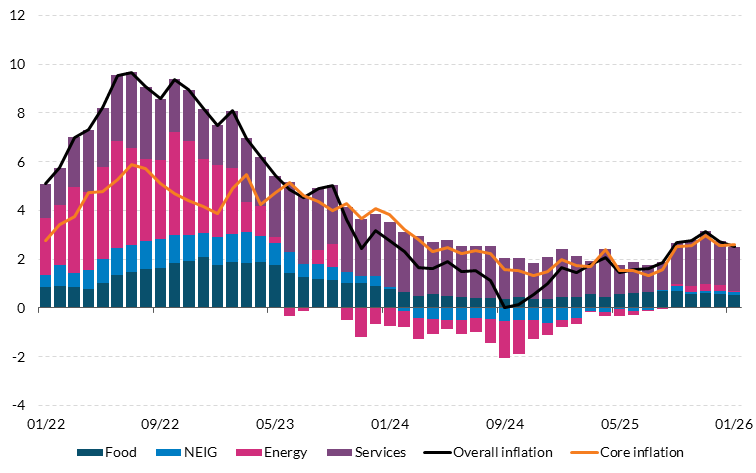
Headline and core inflation have risen in recent months, with both domestically-driven services and more externally-influenced price pressures edging higher. Headline HICP increased, on a year-on-year basis, to 2.6 per cent in January with core inflation rising to 2.7 per cent (Figure 4). Services inflation remains the main contributor to headline inflation in 2025, though easing relative to 2024, whilst food, energy and NEIG pressures have gained momentum. Underlying inflation measures have also edged upwards, with all indicators above 2 per cent and pre-pandemic levels.
The BCI weakened in the second half of 2025
Figure 3: Business Cycle Indicator and Contributions, Average growth = 0
Source: Central Bank of Ireland. Chart data in accessible format. (XLSX 152.37KB)
Note: Details on the methodology underpinning the BCI available in Economic Letter Vol. 2020, No.7 (PDF 790.91KB). The zero axis corresponds to the long-run average historical growth rate in realised MDD. Deviations above or below zero therefore signify that activity is growing faster/slower than its historical average rate.
Headline inflation has risen with an uptick in services prices
Figure 4: Contributions to headline inflation (year-on-year per cent change)
Source: CSO and Central Bank of Ireland. Chart data in accessible format. (XLSX 152.37KB)
Middle East conflict prompts sharp upward revision to baseline energy price assumptions since the December 2025 Projections
Figure 5: Percentage change in technical energy price assumptions, QB1 2026 (March) versus QB4 2025 (December 2025)
Source: ECB. Chart data in accessible format. (XLSX 152.37KB)
There is solid underlying momentum in economic activity from domestic demand and net exports that is consistent with steady growth, but the severity and duration of the conflict in the Middle East hangs over the outlook for inflation and growth. The central forecast is based on an assumed path for oil and gas futures prices as of mid-March 2026. These assumptions capture some of the initial impact of the war on energy prices, with oil and gas prices 30 and 57 per cent higher on average in 2026 respectively than assumed in the December 2025 Bulletin forecasts (Figure 5). Driven by higher energy costs, projected inflation has been revised upwards to 2.9 per cent in 2026 and 2.6 per cent in 2027, representing a cumulative revision from the December forecasts of 1.4 percentage points over the next two years (Figure 7). Higher inflation has prompted knock-on downward revisions to households’ real disposable income and consumption from 2026 to 2028. Working in the opposite direction, the outlook for modified investment has improved on the strength of double digit, broad-based growth in 2025 and upward revisions to Government investment. The more positive outlook for investment is most prominent in 2026 and helps to partially offset the negative impact of higher inflation on incomes and consumption in that year. This results in the forecast for overall MDD being revised down marginally in 2026, but with a larger downward revisions for 2027 (Table 1). Overall MDD is forecast to grow by 2.8 per cent per annum on average from 2026 to 2028, around half the observed annual average growth rate of 5.9 per cent in the 5 years up to 2025 (Figure 6). The central projections are sensitive to the assumed path of energy prices. An escalation of the conflict resulting in higher energy prices, and for a more prolonged period than assumed in the central forecast, would lead to higher inflation and weaker growth– see Balance of Risks to the Outlook.
Volatility in goods exports is likely to continue in 2026, but overall net trade is projected to contribute positively to economic activity out to 2028. More modest growth in merchandise exports is expected in 2026 following an exceptional rise of 17.5 per cent in 2025. The latter was affected in part by frontloading of exports of certain pharmaceutical products particularly in the first half of 2025. This suggests that exports could be weaker in 2026 as large existing stockpiles are diminished. Stripping out continued volatility owing to these effects in 2026, solid global demand for the main outputs of the pharma sector in Ireland over the medium term along with the expected opening of new manufacturing capacity should underpin growth in merchandise trade out to 2028. With services exports – led by ICT – also forecast to grow, overall net exports of goods and services produced in Ireland is forecast to make a positive contribution to growth out to 2028. Combined with the outlook for domestic demand, this underpins the forecast for growth in real modified national income (GNI*) of 3 per cent per annum from 2026 to 2028, slightly above the average expected growth in MDD over the same period (Table 1).
Risks to the growth outlook are more decisively to the downside than in the December forecasts, as the ongoing Middle-East conflict could result in larger negative effects on the global economy and Ireland than assumed in the current central forecast. The Balance of Risks to the Outlook outlines the impact on growth and inflation of two alternative higher paths for international energy prices than those assumed in the central forecast. The scenarios differ based on the assumed severity of the rise in energy prices in 2026 and the duration of elevated prices thereafter. In the most severe of the two scenarios, over one percentage point would be added to headline inflation in both 2026 and 2027. This would bring headline inflation to 4.2 per cent in 2026 and just under 4 per cent in 2027, compared with 2.9 per cent and 2.6 per cent in 2026 and 2027 respectively in the baseline. Higher inflation would result in slower growth in real incomes and consumption, reducing overall MDD growth by around ½ a percentage point per annum on average in both 2026 and 2027, relative to the central forecast. With higher energy prices also lowering growth in Ireland’s key trading partners, exports would be weaker, adding to the drag on the economy.
Table 1: QB1 March 2026 Forecast Summary and Revisions from December 2025 Baseline Projections
| | 2024 | 2025e | 2026f | 2027f | 2028f |
|---|
Constant Prices | | | | | |
| Modified Domestic Demand | 1.8 | 4.9 | 2.9 | 2.5 | 3.2 |
| Modified Gross National Income (GNI*) | 4.8 | 4.7 | 2.4 | 2.8 | 3.4 |
| Gross Domestic Product | 2.6 | 12.3 | 1.3 | 4.3 | 5.2 |
| Total Employment | 2.7 | 2.2 | 1.9 | 1.8 | 1.8 |
| Unemployment Rate | 4.3 | 4.7 | 4.9 | 5.1 | 5.1 |
| Harmonised Index of Consumer Prices (HICP) | 1.3 | 2.1 | 2.9 | 2.6 | 1.9 |
| HICP Excluding Food and Energy (Core HICP) | 2.3 | 2.0 | 2.4 | 2.4 | 2.2 |
Revisions from previous Quarterly Bulletin, p.p. | | | | | |
| Modified Domestic Demand | 0.0 | 0.9 | -0.1 | -0.3 | 0.4 |
| Gross Domestic Product | 0.0 | -0.4 | -1.8 | 1.0 | 1.9 |
| HICP | 0.0 | 0.0 | 0.6 | 0.8 | 0.0 |
| Core HICP | 0.0 | 0.0 | 0.0 | 0.5 | 0.1 |
MDD growth expected to slow gradually in 2026 and 2027
Figure 6: Contributions to annual change in MDD (per cent)
Source: CSO, Author’s Calculations. Chart data in accessible format. (XLSX 152.37KB)
Higher energy prices prompt an upward revision to headline inflation from the previous forecast
Figure 7: Contributions to annual change in headline inflation (per cent)
Source: CSO and Central Bank of Ireland. Chart data in accessible format. (XLSX 152.37KB)
Forecast Detail
External Environment
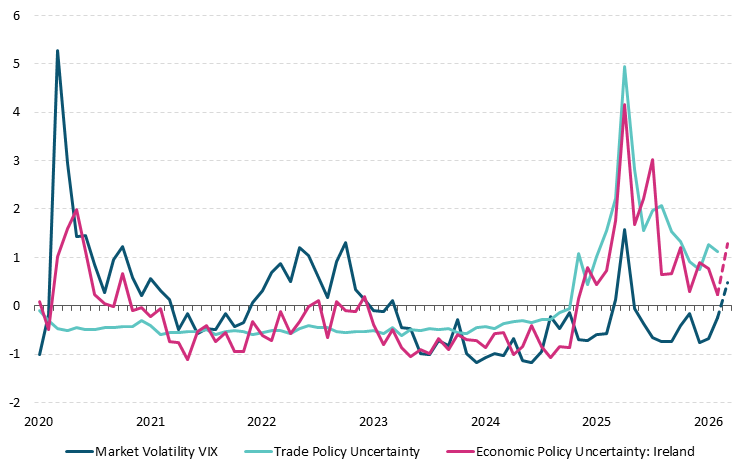
A rekindling of global conflicts is inflicting fresh shocks to the world economy, with major uncertainty regarding their duration and impact. Renewed and broadened conflict in the Middle East has sparked volatility and uncertainty in energy markets, and large price spikes in oil and gas, which if prolonged could have more significant inflationary effects while also reducing growth. Europe and Asia are the regions that stand to be the most affected if this were to happen. A renewed energy price shock would reignite inflationary pressures and may influence several major central banks’ monetary policy decisions in the medium term, resurfacing concerns about sovereign debt sustainability and stretched financial asset valuations. Already, measures of economic policy uncertainty have begun to increase again, having only recently declined in the wake of the Russia-Ukraine war (Figure 8). On international trade, the recent US Supreme Court judgement that some of the US administration’s tariffs were imposed illegally has renewed trade uncertainty, as new US tariffs may now be applied under different legal frameworks, each with different implications for different countries and sectors, and separately from trade deals already agreed.
Uncertainty has begun to increase again in 2026, having only recently declined from tariff-related highs recorded in early 2025
Figure 8: Standardised measures of uncertainty (number of standard deviations)
Source: Federal Reserve Economic Data (FRED), Rice, J. (2023), Caldara et al. (2019) and Central Bank of Ireland calculations. Chart data in accessible format. (XLSX 152.37KB)
Notes: Series are standardised and March estimates are shown in dashed lines based on observed daily data from 1 to 11 March.
While the world economy has ended the past year in a relatively robust position despite several risks and shocks, the medium-term outlook is increasingly uncertain, with risks broadly negative. The US recorded GDP growth of 2.1 per cent in 2025; although this was a deceleration from 2.8 in 2024, it was well above initial predictions upon the imposition of tariffs in the spring of 2025. Headwinds from relative weakness in the labour market and above-target inflation, partly sustained by the tariffs, were offset by AI-fuelled optimism, and in particular strong investment, as well as robust growth in personal consumption and an improving trade balance. The euro area grew at a rate of 1.4 per cent in 2025 in the face of multiple shocks and elevated levels of uncertainty. In January 2026, the euro area unemployment rate reached a historic low of 6.1 per cent, and inflation has been consistent with the ECB target of 2 per cent for well over a year. Despite the resilience demonstrated recently, the euro area economy remains particularly vulnerable to energy shocks, as well as continued weakness in international trade and erosion in competitiveness. The growth target for the Chinese economy in 2026 has been set to a range of 4.5 to 5 per cent (compared to 5 per cent in 2025, which was met exactly), the lowest since 1991 and indicative of decelerating Government stimulus, as the country is battling with weak domestic demand, deflationary forces, and a continued deep property downturn. That is being partly offset by continued reliance on external demand as a source of growth, with the trade surplus hitting a record $1.2 trillion in 2025 despite US tariffs.
Table 2: International Economic Outlook
| | 2024 | 2025e | 2026f | 2027f | 2028f |
|---|
| World | 3.3 | 3.3 | 3.3 | 3.2 | 3.2 |
| Euro area (March 2026 BMPE) | 0.9 | 1.4 | 0.9 | 1.3 | 1.4 |
| US | 2.8 | 2.1 | 2.4 | 2.0 | 2.0 |
| UK | 1.1 | 1.4 | 1.3 | 1.5 | 1.5 |
| Japan | 0.1 | 1.1 | 0.7 | 0.6 | 0.6 |
| China | 5.0 | 5.0 | 4.5 | 4.0 | 4.0 |
| Emerging economies | 4.3 | 4.3 | 4.1 | 4.1 | 4.1 |
| Weighted global demand for Irish exports | 2.2 | 3.6 | 1.7 | 2.8 | 3.0 |
Notes: Table shows projections for annual GDP growth for major global economies. Forecasts for the euro area and for weighted global demand for Irish exports are from the Eurosystem Staff Macroeconomic Projections, March 2026. Forecasts for the remainder are from the January 2026 IMF WEO.
Staff macroeconomic projections for the euro area (March 2026) saw inflation forecasts revised up and growth revised down. This is the case in particular for the current year. ECB staff now expect HICP inflation to average 2.6 per cent in 2026 (revised upward from 1.9), and 2.0 and 2.1 per cent in 2027 and 2028. GDP growth is seen as decelerating to 0.9 per cent in 2026 (from 1.4 in 2025, and a previous 2026 forecast of 1.2), picking up again in 2027 and 2028 to 1.3 and 1.4 per cent, respectively. Private consumption and investment are seen contributing most of the growth, although by less than previously anticipated as the energy price shock leads to losses in real purchasing power and increased uncertainty. Meanwhile, the contribution of international trade is set to be negative in 2026 (-0.3 per cent) and essentially null in 2027 and 2028. Uncertainty around these forecasts is especially high due to the rapidly evolving situation; the March macroeconomic projections also include adverse and severe scenarios (based on different assumed magnitudes and persistence of the energy price shocks) in which the inflationary and output impacts of the conflict in the Middle East would be even larger and longer-lasting (see Balance of Risks to the Outlook).
Economic Activity
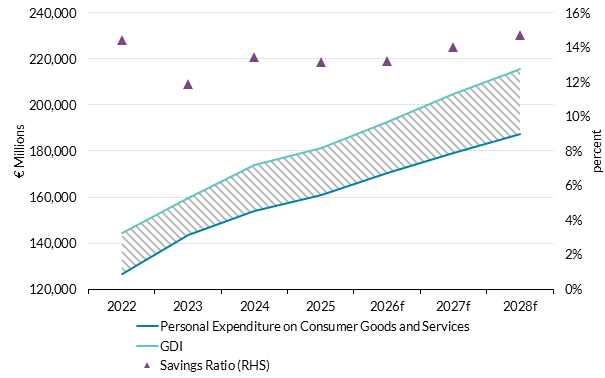
The forecast for consumption has been revised down from the projections in December 2025, as higher inflation than expected at the time of the last Bulletin has resulted in a weaker projection for real incomes. Consumption is forecast to grow by 1.9 per cent in 2026 and at 1.7 per cent in 2027 and 2028. This would mark a continuation of the slowdown in consumption growth from the observed annual average rate of 6.1 per cent between 2022 to 2024. The forecast for a moderation in the pace of growth in consumption is based on the expectation of more modest increases in employment and incomes from 2026 to 2028, compared to recent outturns. With inflation revised higher compared with Quarterly Bulletin 4 2025, real household disposable income is expected to grow more slowly than previously forecast out to 2028, prompting downward revisions to consumption out to the end of the horizon. The projections for consumption and incomes imply a slightly lower savings rate than in the previous projections. It is still expected to rise gradually out to 2028 and to remain high compared to historical levels – averaging 14 per cent per annum from 2026 to 2028 (Figure 9). The long-run average household savings rate from 1995 to 2019 was just under 11 per cent. Research shows that structural factors, including an ageing population and an increased propensity to save for housing among younger cohorts, alongside higher levels of uncertainty and precautionary savings motives have supported a gradual upward drift in the household savings ratio over recent years (Boyd, Byrne and McIndoe Calder, 2025) (PDF 1.05MB).
Forward-looking survey indicators of consumption suggest that consumers are increasingly pessimistic about their income expectations for 2026. Data from the ECB Consumer Expectations Survey shows that on average, 12-month ahead income expectations declined over the latter half of 2025 to their lowest level in almost three years. This decline coincided with a small decrease in the growth rates of employment and disposable income. The percentage of households who consider themselves liquidity constrained declined gradually from an average of 37 per cent in 2022 to 26 per cent in the final quarter of 2024 and has remained at that level through 2025. The upward revision to the inflation projections in this Bulletin over the next three years suggests further dampening of household real incomes, resulting in a more subdued forecast for consumption growth over the forecast horizon.
Consumption growth projected to slow with a gradual rise in the savings rate
Figure 9: Consumption, disposable income and the savings rate
Source: CSO and Central Bank of Ireland. Chart data in accessible format. (XLSX 152.37KB)
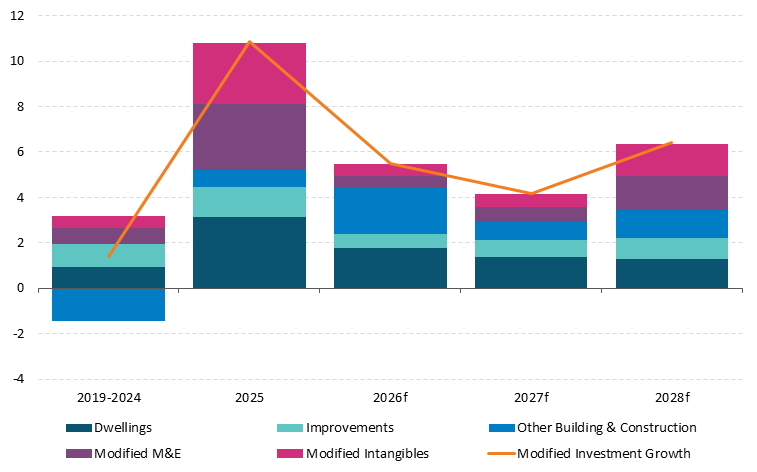
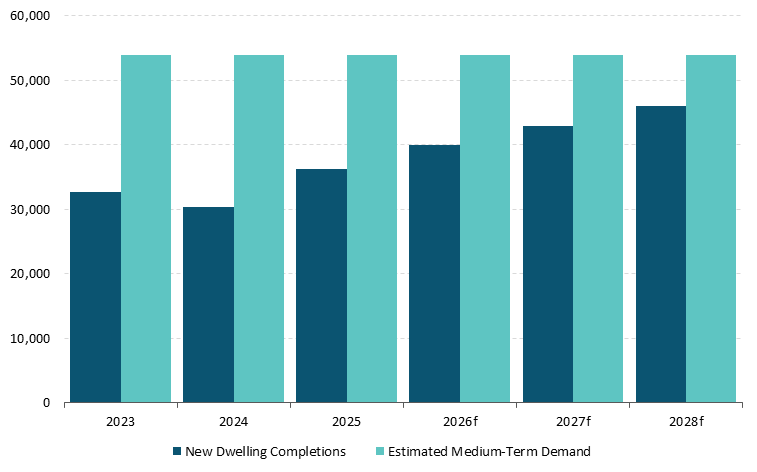
The outlook for modified investment has improved since the last Bulletin on the back of broadly-based growth in 2025. Overall, forecasts for modified investment, at an average of 5.4 per cent over the forecast horizon, have been revised upwards from the previous Bulletin (Figure 10). A higher than anticipated outturn for housing output last year has resulted in a higher base and a more positive outlook over the forecast horizon. Housing completions are forecast to number 40,000, 43,000 and 46,000 in 2026, 2027 and 2028. The projections imply a pick-up in housing output bringing annual supply closer to estimated structural demand in 2028 (Figure 11). These forecasts remain conditional on improvements in enabling infrastructure in water, energy and transport, as discussed in recent Bulletins. Following revised projections published in the Government’s Medium-Term Fiscal and Structural Plan (MTFS), public investment is expected to contribute more positively to overall modified investment, particularly towards the end of the horizon. This results in higher forecasts for non-residential construction than in the previous projection (December 2025). Recent monthly data on imports of specialised machinery and equipment (M&E) suggest that investment in M&E has picked up, influenced by significant increases in IT-related spending (Figure 13). This accords with the substantial increase in spending on modified intangibles in the latest National Accounts, particularly software. Despite significant uncertainty in the external environment and shifting US policy in particular, these multinational-dominated components of investment (machinery and equipment and modified intangibles) surprised on the upside in 2025 and this resilience has prompted a small upward revision to modified investment across the forecast horizon. Nevertheless, these components remain volatile and dependent on the activities of a small number of large foreign-owned firms (see Balance of Risks to the Outlook).
Housing investment performed better than expected in 2025, but further progress is needed to confirm a sustained pickup in activity.New dwellings numbered 36,300 for 2025 as a whole, compared to a forecast of 33,500 in QB4 2025. The annual outturn for 2025 was boosted by a particularly large increase in completions in the final quarter of the year, with the number of completed units increasing by 38 per cent in that quarter compared with the same quarter in 2024. Along with other factors used as inputs to the forecast for housing investment, the higher outturn (base) for 2025 contributes to higher level estimates for completions over the forecast horizon. As previously noted, the surge in housing commencements in 2024 (linked to the expiry of energy and water connection waivers) has introduced greater uncertainty into the forecast for housing completions. Moreover, the recent outturns for housing completions - in particular the surge in activity in Q4 - was somewhat at odds with high frequency indicators of activity based on PMIs, which had signalled weaker output in the second half of the year (see Box A). Taken together, this means that while the 2025 outturn was positive and justifies an upward revision to the outlook, further evidence is needed to confirm that a sustained pick up in housing output is materialising. In turn, the latter remains contingent on timely implementation of reforms to speed up the delivery of key national infrastructure, including those in the Accelerating Infrastructure and Action Plan.
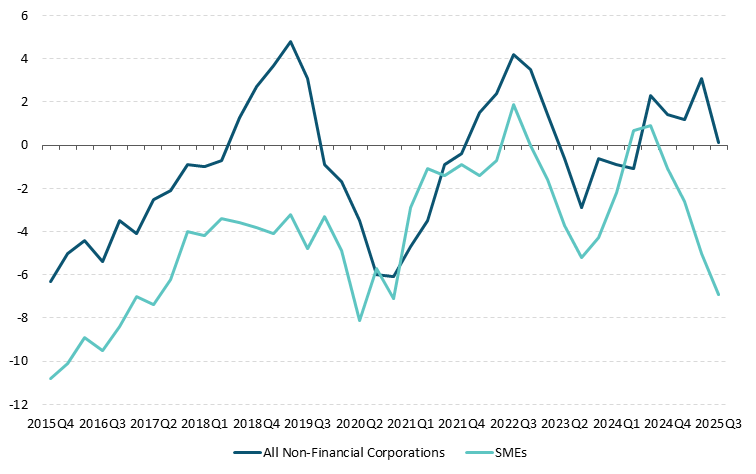
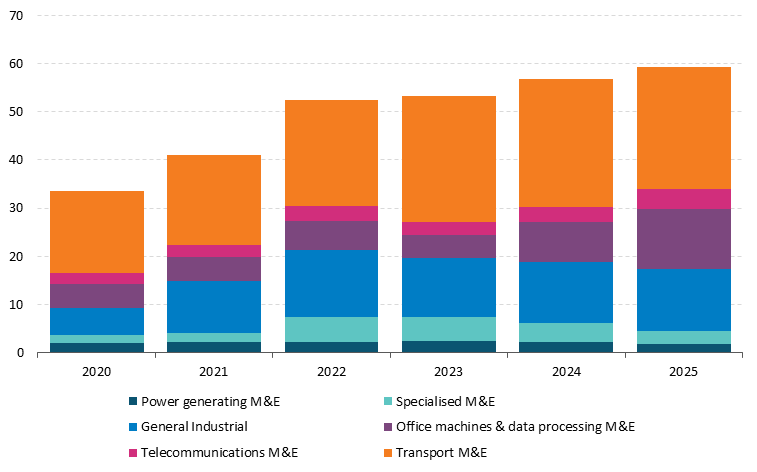
Investment in modified machinery and equipment performed better than expected in 2025. Realised data for Q4 2025 indicate that overall modified M&E investment increased by 13 per cent in 2025, bringing the level to 43 per cent above that observed in 2019. This development is mirrored by substantial increases in modified intangibles, including spending on software. The latter increased by 13.8 per cent in 2025 and could be affected by the high level of investment in data centres that has taken place in recent years. Imports of machinery and equipment increased by 30.7 per cent year-on-year in Q4 2025, driven by an increase in office machines and data processing equipment (up 94 per cent year-on-year) and telecommunications equipment (up 63 per cent year-on-year) (Figure 13). Higher imports of these goods usually signal increases in investment in later quarters. On credit developments, the pace of growth in net lending by banks to Non-Financial Corporations (NFCs) slowed in Q3 2025 to just 0.1 per cent year-on-year, while the decline in net lending to SMEs continued in Q3 2025, standing at 6.9 per cent year-on-year (Figure 12). Non-bank new lending to Irish enterprises was €910mn in Q2 2025, down from €972mn in Q2 2024. SMEs received new loans from non-banks worth €684mn in Q2 2025, while new loans to larger companies was significantly lower and stood at €226mn in the same quarter.
Broad-based growth in modified investment in 2025 expected to continue out to 2028
Figure 10: Contributions to year-on-year change (p.p.)
Source: CSO and Central Bank of Ireland. Chart data in accessible format. (XLSX 152.37KB)
House completions forecast to rise but to remain below estimated structural demand
Figure 11: Annual number of dwellings
Source: Estimated Medium-Term Demand is taken from Central Bank of Ireland, 2024 (PDF 1.09MB). Outturns for dwelling completions are from CSO. Chart data in accessible format. (XLSX 152.37KB)
Growth in overall bank lending to firms has slowed
Figure 12: Annual change in net lending, per cent
Source: Central Bank of Ireland. Chart data in accessible format. (XLSX 152.37KB)
Notes: Chart shows the annual rate of change in net lending by banks to NFCs and SMEs, excluding financial intermediation, from Table A14 and Table A14.1 in Central Bank SME and Large Enterprise Credit Statistics.
Imports of office machines and data processing equipment rise in 2025
Figure 13: M&E Imports, € billion
Source: CSO. Chart data in accessible format. (XLSX 152.37KB)
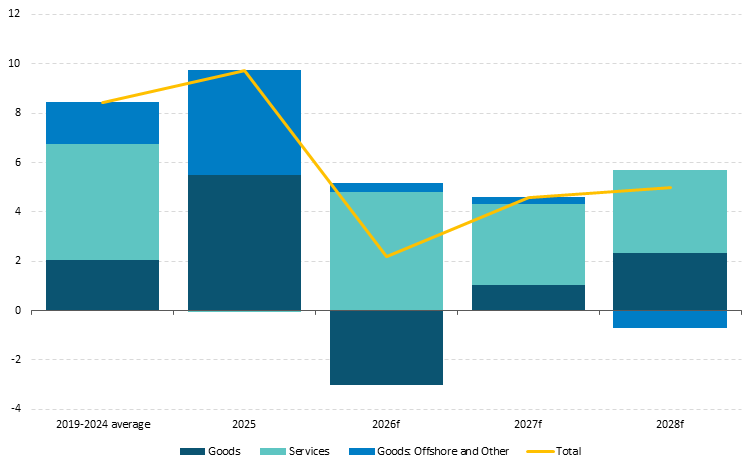
The pace of growth in overall exports is forecast to slow from 2026 to 2028, with a more balanced contribution from goods and services than was observed in 2025. Exports are projected to grow over the medium term, with weight-loss-related products and ICT services expected to play a prominent role (Figure 14). Exports of polypeptide hormones – which rose sharply in 2025 and accounted for 95 per cent of the increase in overall goods exports – could remain subdued into the first half of 2026 due to excess US inventory built up from tariff-related stockpiling in early 2025. The medium-term demand for these products globally appears solid and increased production capacity in Ireland is due to materialise later in 2026, such that weight-loss related products are expected to remain a significant export component. Imports are projected to grow at a modest 3.2 to 3.5 per cent annually through 2028, consistent with the outlook for exports and final demand.
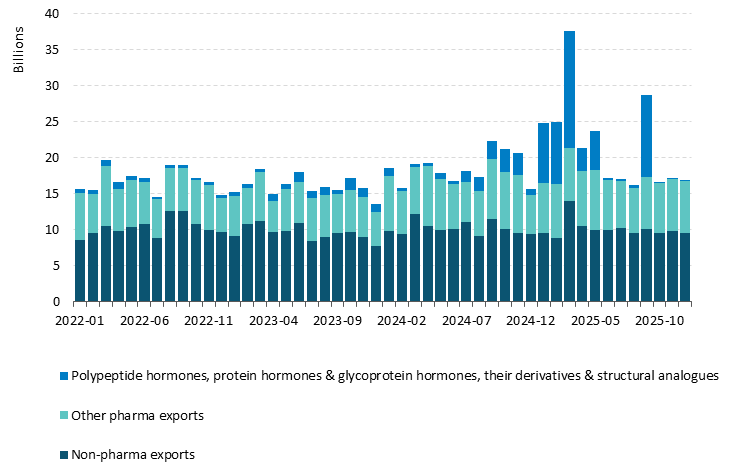
Strong, though erratic, growth in pharma exports underpinned a solid overall external trade performance for the Irish economy in 2025.Overall goods exports increased by 23 per cent in 2025 in real terms, while services exports were flat. Growth in cross-border goods exports was heavily concentrated in medical and pharmaceutical products, which surged 41 per cent (in value terms) and represented over half of total exports. The exceptional performance was driven primarily by polypeptide hormones (diabetes and obesity treatment inputs), which accounted for 95 per cent of all merchandise export growth in the year. However, the profile of polypeptide exports was somewhat erratic with a large increase in exports in Q1 and a further spike in September, followed by a weak final quarter when exports declined to very low levels (Figure 15). It is highly likely that the Q4 drop in exports was linked to stockpiling earlier in the year, rather than to any underlying decline in demand for these products. Estimates suggest that surplus US inventories of Irish-imported polypeptide hormones could last until Q3 2026, and therefore a continuation of subdued exports into the first half of 2026 is possible. Over the medium-term, global demand for these goods is expected to be strong. Excluding polypeptide volatility, underlying exports remained relatively stable, with other pharmaceutical goods growing modestly and non-pharmaceutical exports declining slightly in value terms. ICT services accounted for 62 per cent of overall services exports in 2025 and grew by 10.4 per cent in 2025. The remainder of services exports fell slightly in 2025. This reflected the impact of a large once-off transaction which boosted services exports in Q2 2024, but did not reoccur in 2025, weighing down the annual growth rate.
Ireland's external position is expected to remain in surplus, though with changing dynamics. The modified current account surplus reached €25 billion in 2024 (7.8 per cent of GNI*), providing a clearer picture of Ireland’s external position than the headline figure of €91 billion, which is distorted by globalisation-related flows. The latest data up to Q4 2025 show a headline current account surplus of €52 billion, lower than in 2024. This reflected a larger merchandise surplus offset by higher income and services outflows. Looking ahead, the modified surplus is expected to remain elevated in 2025 (a first official estimate of CA* will be available in June 2026) due to the large merchandise trade surplus and strong ICT services exports. From 2026 onwards, the modified surplus is projected to increase steadily in line with forecast growth in net exports, remaining in surplus throughout the forecast horizon. Nevertheless, the saving-investment position of domestic sectors – which can facilitate a better assessment of the fundamental drivers of Ireland’s external position – points a gradual moderation of net savings of those sectors in recent years (see Box B).
More balanced contribution from goods and services to overall export growth expected from 2027
Figure 14: Per cent
Source: CSO and Central Bank of Ireland. Chart data in accessible format. (XLSX 152.37KB)
Large increases in goods exports in 2025 driven by polypeptides, but monthly profile is erratic
Figure 15: monthly value of goods exports by product, € Billions
Source: Eurostat. Chart data in accessible format. (XLSX 152.37KB)
Inflation
Headline HICP inflation forecasts are notably higher than those in the last Bulletin. HICP inflation is projected at 2.9 per cent in 2026 with forecasts of 2.6 per cent and 1.9 per cent for 2027 and 2028, respectively (Figure 7 and Table 4). The upward revisions are driven primarily by higher energy price assumptions, particularly for gas and oil, which have risen markedly since the last Bulletin (Table 3 and Figure 5). Services inflation continues to exert persistent upward pressure, partly reflecting the reversal of temporary reductions in third-level education tuition fees and by base effects arising from notably weak price outturns in summer 2025 (Figure 7). Methodological adjustments to non-energy industrial goods (NEIG) will result in a level shift in NEIG prices effective from January 2026 (see Box D). Higher food prices than in the December 2025 forecast are expected across both processed and unprocessed subcomponents. This primarily arises because international food price commodity assumptions have been revised higher since the last forecast.
Table 3: Changes in key technical assumptions
| | QB1 2026 | QB4 2025 |
|---|
| | 2025 | 2026 | 2027 | 2028 | 2025 | 2026 | 2027 | 2028 |
|---|
| Oil (USD/barrel) | 69.13 | 81.28 | 72.14 | 70.23 | 69.4 | 63.70 | 64.0 | 65.2 |
| Natural gas (EUR/MWh) | 36.25 | 46.37 | 36.61 | 26.07 | 36.7 | 30.93 | 28.85 | 26.02 |
| Wholesale electricity (EUR/MWh) | 83.58 | 87.66 | 77.88 | 65.21 | 82.01 | 76.21 | 74.27 | 72.15 |
| Non-energy commodities (USD, per cent change*) | 6.19 | -1.48 | 0.78 | -0.14 | 6.43 | 2.03 | 0.32 | 0.05 |
| EUR/USD | 1.13 | 1.19 | 1.19 | 1.19 | 1.13 | 1.16 | 1.16 | 1.16 |
| EUR/GBP | 0.86 | 0.87 | 0.87 | 0.87 | 0.86 | 0.88 | 0.88 | 0.88 |
Source: ECB, Refinitiv. Notes: *Annual percent change. Cut-off date: March 11
There have been substantial upward revisions to technical assumptions underlying the inflation forecasts. Since the last Bulletin, oil prices have been revised upwards through to 2027, with a 30 per cent average increase expected in 2026 compared with the assumptions for 2026 that were available in December last year. The equivalent upward revision to gas price assumptions for 2026 since the December 2025 Bulletin is almost 60 per cent (Figure 5). Food price assumptions have been revised upwards by 6.9 per cent, with meat price assumptions in particular now higher. The euro exchange rate is assumed to appreciate slightly against the USD, whilst depreciating modestly against GBP. The Balance of Risks to the Outlook examines the impact on growth and inflation of alternative (higher) assumptions for energy prices than those underpinning the baseline forecast (Table 3).
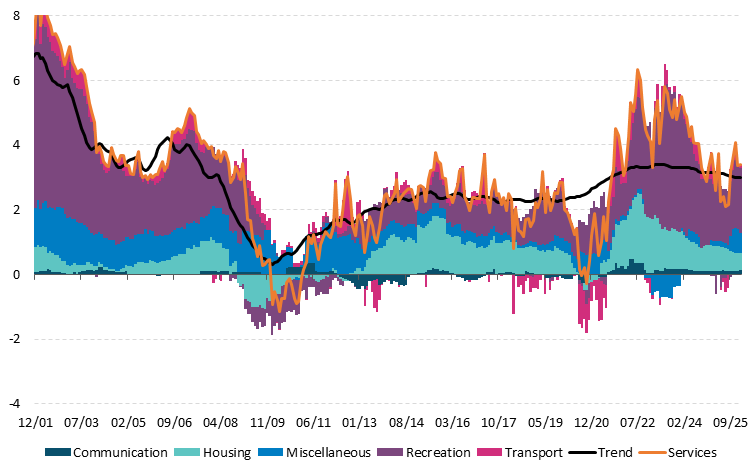
Headline inflation averaged 2.1 per cent in 2025. Services inflation exerted a strong influence on headline inflation last year, although it moderated over the summer due to surprises to the downside from transport by air and package holidays (Figure 16). All energy components saw higher prices in 2025Q4. There were modest increases in liquid fuels and electricity prices—the components with largest weights in the energy basket—due to base effects. A stronger euro helped contain price momentum in processed food, though unprocessed food recorded a substantial increase of 4.2 per cent during 2025. The latest HICP reading (January 2026) shows year-on-year headline inflation of 2.6 per cent. While various measures of underlying inflation have increased marginally of late, they remain close to 2 per cent (Figure 17).
Trend services inflation steady at 3 per cent but remains well above pre-pandemic level
Figure 16: Contributions to services inflation (year-on-year per cent change)
Source: CSO. Chart data in accessible format. (XLSX 152.37KB)
Underlying inflation measures have registered a modest increase recently, hovering just above 2 per cent
Figure 17: Underlying measures of inflation - Year-on-year per cent change
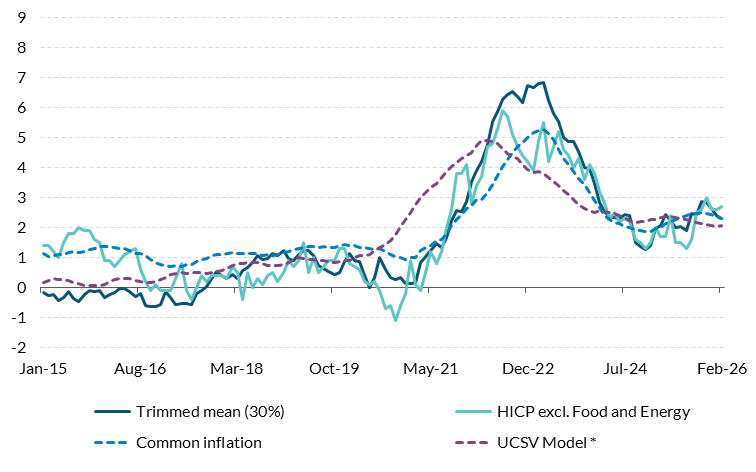
Source: Eurostat, Central Bank of Ireland calculations. Chart data in accessible format. (XLSX 152.37KB)
Note: UCSV Model stands for unobserved components model with stochastic volatility.
Table 4: Inflation Projections
| | 2024 | 2025 | 2026 | 2027 | 2028 |
|---|
| HICP | 1.3 | 2.1 | 2.9 | 2.6 | 1.9 |
| Goods | -1.5 | 1.0 | 2.4 | 2.2 | 0.3 |
| Energy | -7.8 | -0.3 | 6.4 | 2.7 | -0.5 |
| Food | 3.0 | 3.7 | 2.4 | 3.4 | 2.0 |
| Non-Energy Industrial Goods | -1.9 | 0.4 | 0.6 | 1.0 | -0.7 |
| Services | 4.1 | 3.0 | 3.2 | 3.0 | 3.4 |
| HICP ex Energy | 2.4 | 2.3 | 2.5 | 2.6 | 2.2 |
| HICP ex Food & Energy (Core) | 2.3 | 2.0 | 2.4 | 2.4 | 2.2 |
Source: CSO, Central Bank of Ireland
Labour Market and Earnings
Employment growth moderated in 2025 and slower jobs growth is projected out to 2028 as the labour market cools. Employment growth slowed from 2.7 per cent in 2024 to 2.2 per cent in 2025. Annual growth is forecast to average 1.8 per cent per year out to 2028 as labour demand eases in line with the forecast for MDD. The unemployment rate is projected to increase to 4.9 per cent in 2026 and gradually rise further to 5.1 per cent in 2028. The projected increase in unemployment reflects a combination of weaker expected labour demand and an increase in labour supply through demographic effects. The latter arises because of a particularly large increase in the number of younger workers due to enter the labour force in the coming years. Overall, these conditions are expected to exert gradual downward pressure on wage growth, with nominal wage growth averaging 3.8 per cent over the forecast horizon.
Employment has continued to rise, though at a slower pace than in previous years. Employment reached a new peak of 2.83 million in Q4 2025, a year-on-year increase of 2 per cent (+56,700 persons). Employment growth in 2025 was primarily driven by industry, construction and the public-dominated sectors (Figure 18). High consumer-facing sectors have had broadly flat employment over the past two years, with job churn data pointing to a recent decline in hiring activity. Firms in these sectors will see increased labour costs in 2026 due to the higher national minimum wage and the introduction of the pension auto-enrolment scheme. Job posting levels from the Indeed.ie website for February 2026 are 7.6 per cent lower than twelve months previously. The labour force increased by 2.4 per cent (or 68,800 persons) year-on-year in Q4 2025, split between a positive demographic effect of 44,000 persons –consistent with continued net inward migration – and a smaller participation effect of 24,800 persons. The increase in labour force participation in 2025 was mostly concentrated in the over 55 years age groups.
Industry and the public sector accounted for the bulk of employment growth in 2025
Figure 18: Sectoral decomposition of employment growth (2023-2025)
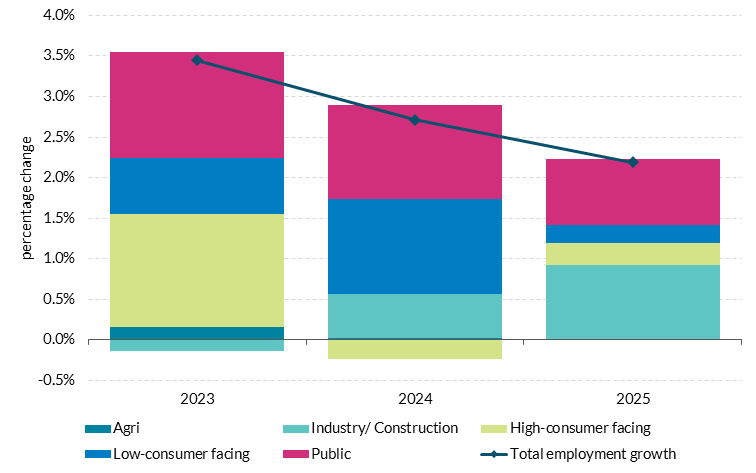
Source: CSO. Chart data in accessible format. (XLSX 152.37KB)
Note: High consumer-facing sectors include Retail, Accom, Transport, Admin and Other services. Low consumer-facing sectors includes ICT, Finance and Professional services. Public includes Public Admin, Education and Health.
The unemployment rate increased slightly from 4.3 per cent in 2024 to 4.7 per cent in 2025, with wider measures of labour market slack also rising. On a quarterly basis, the ILO unemployment rate for persons aged 15-74 years stood at 4.4 per cent in Q4 2025, down from 5.3 per cent in the previous quarter. This largely reflects seasonal movements among younger cohorts (aged 15-24 years) returning to full-time education in the autumn months. Beyond this seasonal influence, the slowdown in the Retail and Accommodation sectors is contributing to an increase in the youth unemployment rate, given the typically higher sectoral concentration of younger workers in these roles. The contribution of both lower hiring levels and the 15–24-year-old cohort’s greater sensitivity to cyclical developments toward the increase in unemployment is considered in Box E. Other measures, such as the size of the potential additional labour force and the number of part-time underemployed, point to a gradually increasing labour underutilisation rate (Figure 19). The simultaneous increase in unemployment and the job vacancy rate in 2025 saw the Beveridge curve relationship shift to the right, though there is now a divergence between the total economy and the private sector. The change in aggregate vacancies entirely reflects developments in the public sector whereas the private sector Beveridge curve shows a more conventional downward-sloping relationship between vacancies and unemployment since 2023, consistent with a cyclical easing in labour demand (Figure 20).
The labour underutilisation rate has increased slowly in recent years
Figure 19: Labour underutilisation rate and components
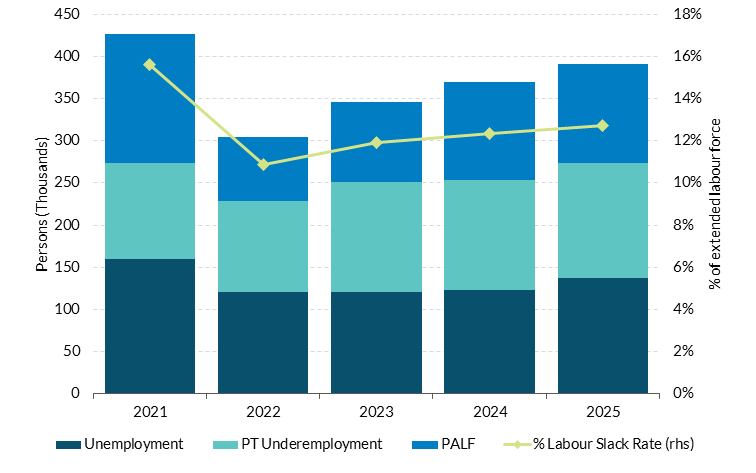
Source: CSO. Chart data in accessible format. (XLSX 152.37KB)
Note: The Labour Underutilisation Rate refers to the number of persons classified as unemployed, plus those part-time under employed who wish to work additional hours and are available to do so, plus those outside the labour force who are available for work but not seeking work as a percentage share of the extended labour force. See U6 definition.
Private sector labour demand weaker than whole-economy average as public sector diverges
Figure 20: Beveridge Curve (Total Economy and Private Sector)
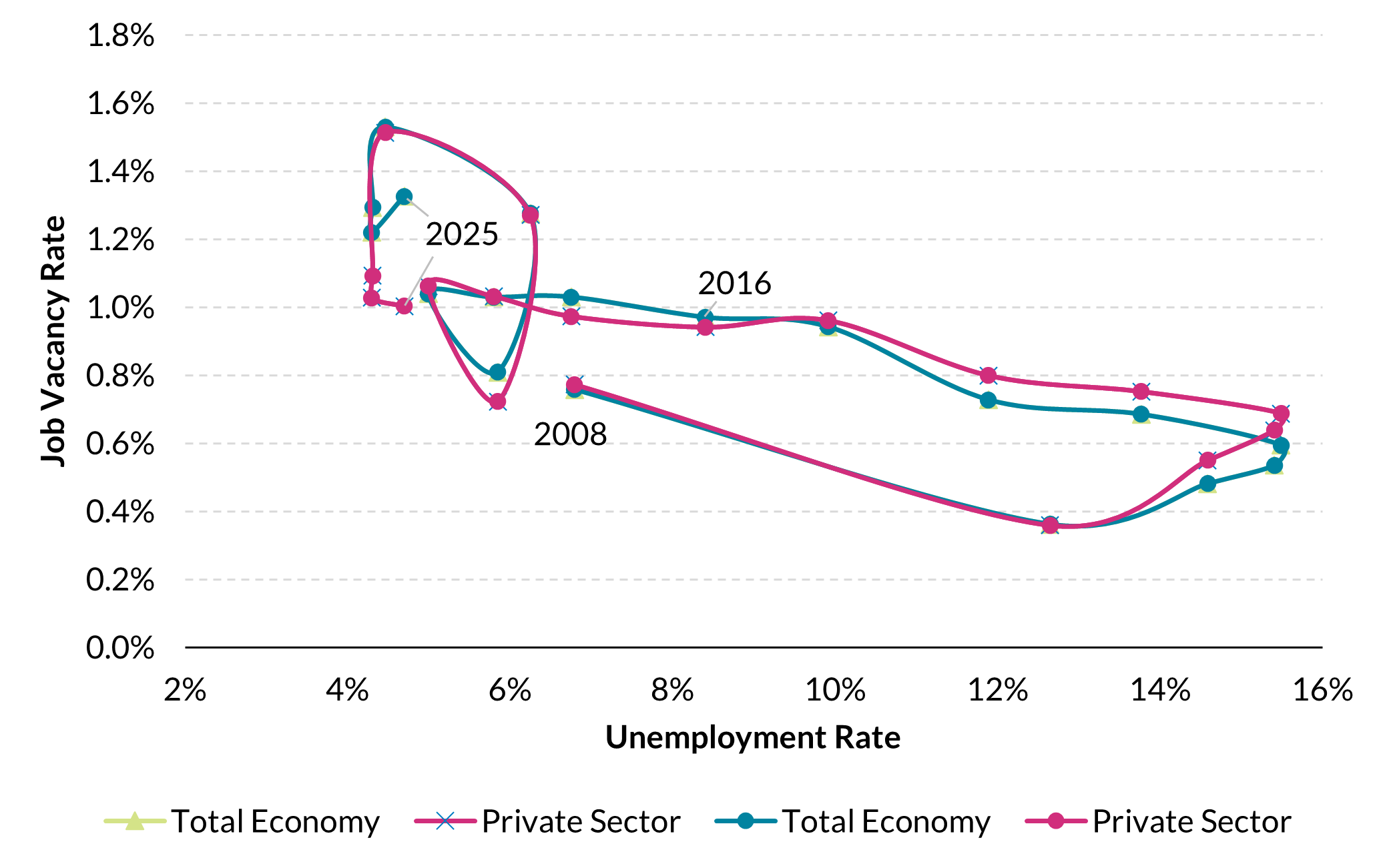
Source: CSO. Chart data in accessible format. (XLSX 152.37KB)
Note: The Beveridge Curve illustrates the inverse relationship between the unemployment rate and the job vacancy rate. Data are calculated on a four-quarter moving average.
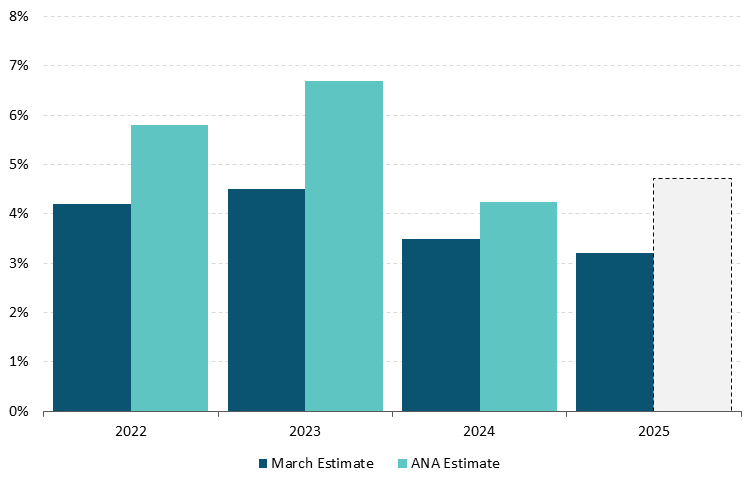
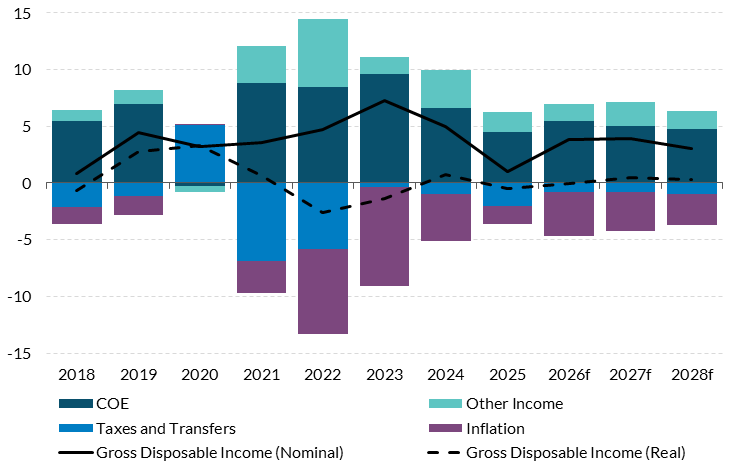
Real compensation per employee growth is expected to remain positive over the forecast horizon, supporting consumption growth. Nominal compensation per employee decreased by 1.1 per cent in Q4 2025, notably below the average growth of 4.6 per cent between Q1 and Q3. In recent years, Annual National Account releases have included upward revisions to employee compensation, as additional information becomes available beyond the Quarterly figures (Figure 21). As such, the latest outturn may partly reflect incomplete information at this part of the data cycle. The low Q4 2025 outturn mechanically lowers average nominal growth for the year as a whole to 3.1 per cent, or 1.6 per cent in real terms. Based on the expectation of future revisions to the 2025 data, the relatively weak outturn in the current data has not materially altered the projected path for wage growth over the forecast horizon compared with the December forecast. Nominal CPE is expected to grow by 4 per cent in 2026 before slowing to 3.5 per cent in 2028 (Figure 22). The gradual slowdown in nominal wage growth reflects a modest increase in unemployment alongside a continued easing in labour demand. Gross Disposable Income per household is projected to grow by an annual average of 0.1 per cent in real terms over the forecast horizon to 2028, down from 0.3 per cent annual average growth in QB4 2025. The more subdued real income outlook results from the higher expected inflation profile out to 2028 than in the previous forecast in December. Although earnings growth is projected to remain positive in real terms, further reductions in labour market mobility, together with rising unemployment, are likely to weigh on worker wage bargaining power and moderate wage growth. The public sector pay agreement expires in June 2026 with negotiations yet to take place on a new deal.
Upward revisions to nominal compensation per employee have been recorded in recent years in the annual National Accounts
Figure 21: Nominal Compensation per Employee growth (per cent)
Source: CSO and Central Bank of Ireland. Chart data in accessible format. (XLSX 152.37KB)
Note: The 2025 ANA Estimate adds the average upward revision observed in recent years to the QNA outturn from March.
Lower projected growth in real gross disposable income per household as inflation is revised higher
Figure 22: Year-on year growth in gross disposable income per household and underlying components (per cent)
Source: CSO and Central Bank of Ireland calculations. Chart data in accessible format. (XLSX 152.37KB)
Table 5: Labour Market Forecasts
| | 2024 | 2025f | 2026f | 2027f | 2028f |
|---|
| Employment (000s) | 2,757
| 2,818
| 2,871
| 2,923
| 2,975
|
| % change | 2.7 | 2.2 | 1.9 | 1.8 | 1.8 |
| Labour Force (000s) | 2,880 | 2,955 | 3,018 | 3,079 | 3,136 |
| % change | 2.7 | 2.6 | 2.2 | 2.0 | 1.9 |
| Participation Rate (% of Working Age Population) | 65.8 | 66.1 | 66.3 | 66.4 | 66.5 |
| Unemployment (000s) | 123 | 137 | 148 | 156 | 161 |
| Unemployment (% of Labour Force) | 4.3 | 4.7 | 4.9 | 5.1 | 5.1 |
Public Finances
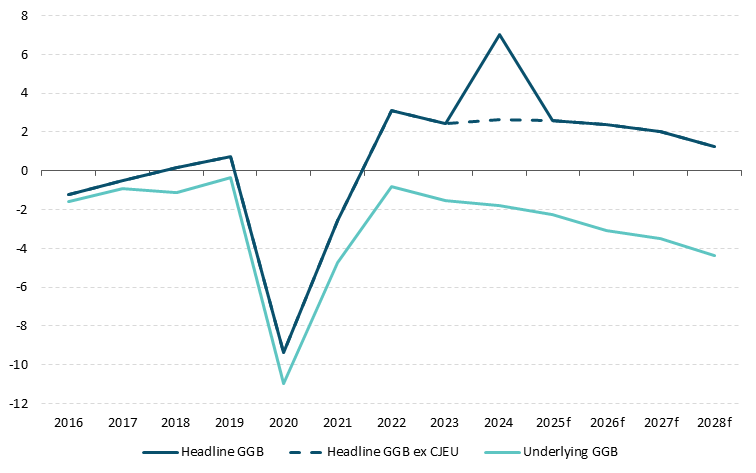
The underlying budget deficit, which excludes estimated excess corporation tax (CT) and receipts from the Apple state aid case, is projected to increase over the forecast horizon as general government expenditure growth exceeds that of revenue. Annual underlying revenue growth is forecast at 6 per cent on average over the 2026-2028 period, while average annual expenditure growth is expected to rise by 7.8 per cent (Table 6). As a result, the underlying budget deficit is projected to double from 2.2 per cent of GNI* in 2025 to 4.4 per cent in 2028 (Figure 23). The headline budget balance is forecast to remain in surplus, driven by strong corporation tax growth, but the surplus is still forecast to decline over the forecast horizon to 1.3 per cent of GNI* in 2028. The implementation of the Minimum Tax Directive this year is expected to significantly boost corporation tax receipts. Growth will slow subsequently in 2027 and 2028 but is still projected to average close to 8 per cent over these years.
Table 6: Key Fiscal Indicators, 2024-2028
| | 2025(e) | 2026(f) | 2027(f) | 2028(f) |
|---|
| GG Balance (€bn) | 8.8 | 8.6 | 7.7 | 5.2 |
| GG Balance (% GNI*) | 2.6 | 2.4 | 2.0 | 1.3 |
| GG Balance (% GDP) | 1.4 | 1.3 | 1.1 | 0.7 |
| GG Debt (€bn) | 212.1 | 203.7 | 204.5 | 208.2 |
| GG Debt (% GNI*) | 62.1 | 55.8 | 52.9 | 50.7 |
| GG Debt (% GDP) | 33.2 | 30.7 | 28.7 | 27.2 |
| Excess CT (€bn) | 16.5 | 19.9 | 21.3 | 23.1 |
| Underlying GGB (€bn) | -7.6 | -11.3 | -13.6 | -17.9 |
| Underlying GGB (% GNI*) | -2.2 | -3.1 | -3.5 | -4.4 |
Source: Central Bank of Ireland Projections
Note: Underlying GGB excludes estimates of excess CT and receipts from the Apple state aid case; (e) is for estimate; (f) is forecast
Underlying GG deficit is projected to deteriorate over the forecast horizon
Figure 23: per cent of GNI*
Source: CSO, Central Bank of Ireland. Chart data in accessible format (XLSX 152.37KB)
Note: Underlying GGB excludes Central Bank estimates of excess corporation tax receipts and receipts from Apple State aid case; CJEU is Court of Justice of EU ruling on Apple state aid case.
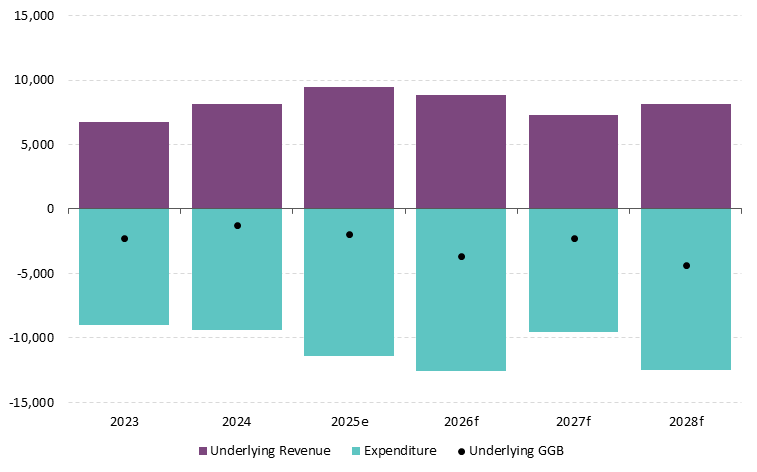
The larger underlying budget deficit out to 2028 than forecast in the last Bulletin is primarily due to a sizeable upward revision to expenditure growth, particularly in 2028. This revision arises mainly because of new spending information contained in December’s Medium-Term Fiscal & Structural Plan (MTFSP). It provides the first set of medium-term government spending targets in over a year - and since the publication of the updated National Development Plan - and indicates larger capital and intermediate consumption expenditure in 2028 than was anticipated previously. The annual change in government spending is now expected to exceed the change in underlying revenue by around €4bn in 2028 (Figure 24). The forecast for a persistent underlying budget deficit is also a reflection of slower expected revenue growth as domestic activity and employment growth moderates over the medium term. The outlook for the public finances is surrounded by a considerable level of uncertainty. There remains the risk of further expenditure increases, particularly with upward revisions to Government spending having been a persistent occurrence in recent years, a trend that continued in 2025 (Figure 25). With regard to capital spending, the profile of expenditure will ultimately depend on the final timing of projects. On the revenue side, while there is broad expectation that the Minimum Tax Directive will have a positive impact on corporation tax receipts, the precise impact remains unclear. Risks are discussed in further detail in the Balance of Risks below.
Government expenditure growth is expected to exceed that of underlying revenue over the medium term
Figure 24: Annual change, €mn
Sources: CSO and Central Bank of Ireland. Chart data in accessible format. (XLSX 152.37KB)
Note: Underlying revenue excludes excess corporation tax receipts. Bars show both the annual rise in underlying revenue from the previous year and the rise in expenditure (shown here as a negative entry as it reduces the GGB). The black dot indicates the decline in the underlying GGB from these revenue and expenditure changes.
The outturn for Gross voted Exchequer spending in 2025 exceeded initial Budget projections after several within-year upward revisions
Figure 25: € billion
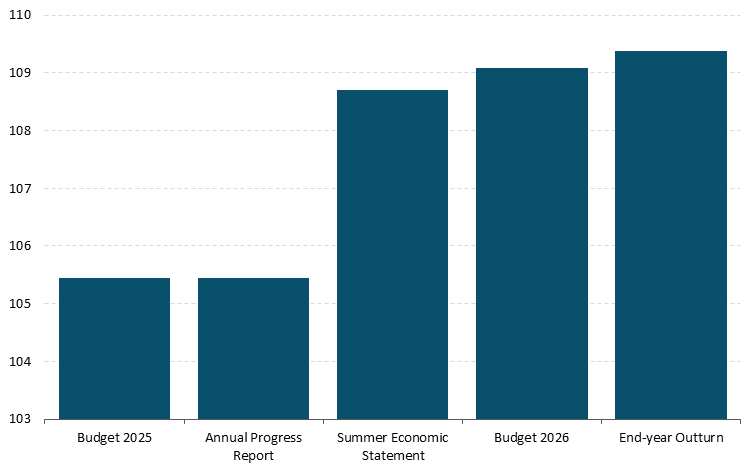
Source: Department of Finance and Department of Public Expenditure, Infrastructure, Public Service Reform and Digitalisation. Chart data in accessible format. (XLSX 152.37KB)
The General Government debt (GGD)-to-GNI* ratio is expected to continue falling over the forecast horizon, to stand at 50 per cent by 2028 (Figure 26). This reflects a combination of projected headline primary surpluses (averaging 3 per cent of GNI* over 2026-2028) and the expectation of a continuing favourable interest rate-growth rate differential (Figure 27). Nominal GNI* growth is expected to average 6.3 per cent per annum over the period, well above the projected average effective interest rate on government debt of 1.8 per cent. The National Treasury Management Agency (NTMA) plans to issue between €10bn and €14bn in government bonds this year with €5bn having been raised by the sale of a 10-year benchmark bond in January. Cash and liquid balances, inclusive of receipts from the Apple state aid case, remain high (at €39bn or 6 per cent of GDP at end-2025). A significant portion of these cash balances are expected to be used to finance the Exchequer’s funding needs for this year.
Debt ratio is projected to fall below 60 per cent of GNI* this year
Figure 26: per cent of GNI*, €billion
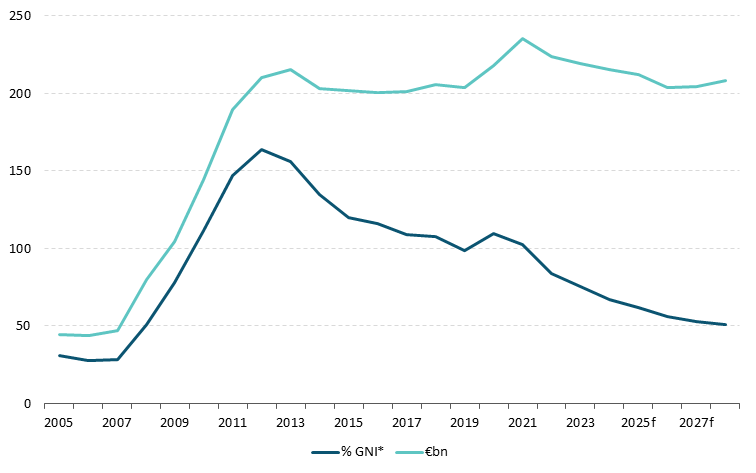
Sources: CSO, Central Bank of Ireland. Chart data in accessible format. (XLSX 152.37KB)
Projected headline budget surpluses and nominal growth imply continued fall in the public debt ratio out to 2028
Figure 27: per cent of GNI*
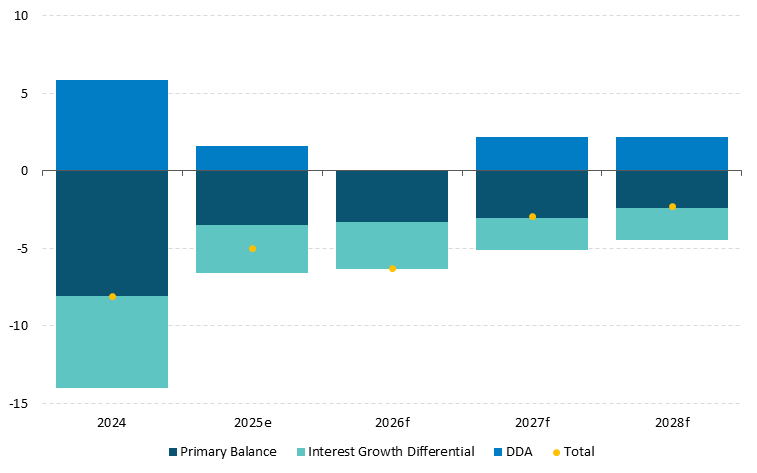
Source: Central Bank of Ireland. Chart data in accessible format. (XLSX 152.37KB)
Notes: DDA is deficit debt adjustment.
Balance of Risks to the Outlook
The balance of risks to the overall outlook for economic activity is firmly tilted to the downside, with inflation risks clearly to the upside. The central forecasts incorporate significantly higher energy price assumptions compared to those which underpinned the previous projection in December 2025. However, at the time of writing, the conflict in the Middle East is ongoing and there is considerable uncertainty as to how long the current disruption to the Strait of Hormuz shipping lanes – vital for the transportation of oil and gas from the Persian Gulf – is likely to persist. Depending on the course the conflict takes, there is a risk that energy prices could be higher than assumed in the central forecasts. Given this uncertainty, two stylised scenarios are considered. In the adverse scenario, global oil and gas prices rise by 23 and 49 per cent, respectively, above the baseline in 2026, with prices falling back to baseline levels in early 2027. In the severe scenario, the equivalent increases in oil and gas prices in 2026 are 47 and 86 per cent, respectively. In this scenario energy prices begin to decline in 2027 but remain persistently elevated out to 2028 with oil and gas prices still almost 50 per cent and 80 per cent above baseline by the end of the period (Figure 28 and Figure 29). Comparing these scenario assumptions to the observed path of energy prices following Russia’s invasion of Ukraine, gas prices peak at a significantly lower level in both scenarios, as the Ukraine conflict saw a collapse in gas supply to Europe, driving prices sharply higher. For oil prices, the assumed peak in 2026 in the adverse scenario is similar to that observed in 2022. In the severe scenario, oil prices are assumed to average around $120 per barrel in 2026, close to 20 per cent higher than the peak observed since the outset of the Russia-Ukraine war.
Higher energy prices relative to baseline assumptions would increase inflation and reduce growth in Ireland relative to the central forecast. In the adverse scenario, inflation would increase by 0.7 percentage points and MDD growth would be 0.2 percentage points lower in 2026 than in the baseline (Figure 30 and Figure 31). In the severe scenario, involving more significant and persistent increases in energy prices, inflation would rise by 1.3 percentage points in 2026 and MDD growth would be 0.3 percentage points lower than in the baseline projections. International energy prices are assumed to remain persistently high out to 2028 In the severe scenario. As a result, an estimated further 1.2 percentage points would be added to inflation in 2027, with MDD growth 0.6 percentage points lower. Applying these estimated impacts from the severe scenario to the central forecasts, HICP inflation would stand at 4.2 per cent and 3.8 per cent in 2026 and 2027 respectively. MDD growth would be reduced to 2.6 per cent in 2026 and 1.9 per cent in 2027. MDD growth would reduce further in 2028 in the severe scenario with growth 0.8 percentage points below baseline. Higher global energy prices would reduce economic activity in Ireland’s main trading partners, thereby lowering external demand for the traded sector of the economy. This results in a decline in exports and activity this sector which, over time, spills over to investment and the broader domestic economy, further reducing MDD and contributing to a decline in overall output, relative to the baseline projection.
Scenario assumptions of a potential escalation of the Middle East conflict
Figure 28: Oil prices (level), $ per barrel
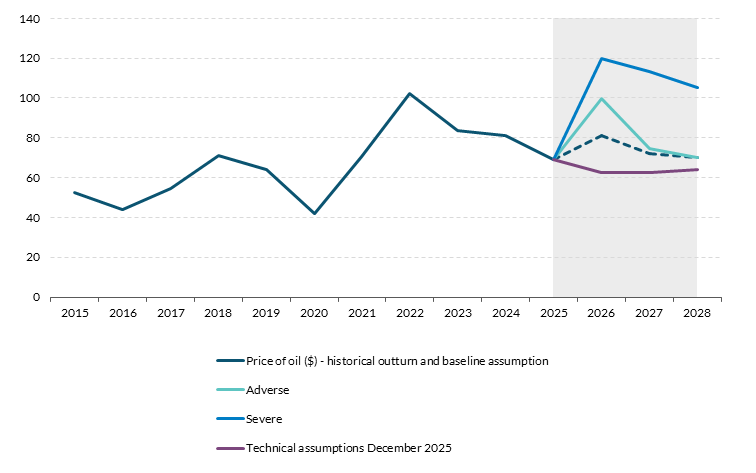
Source: ECB. Chart data in accessible format. (XLSX 152.37KB)
Figure 29: Gas prices (level), € per MWh
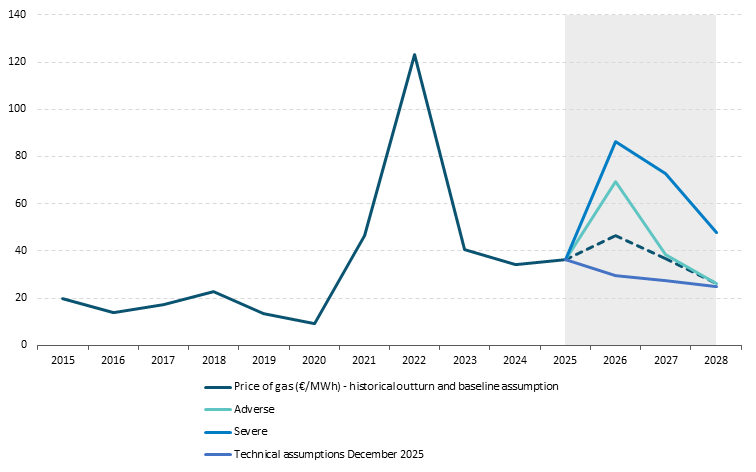
Source: ECB. Chart data in accessible format. (XLSX 152.37KB)
Energy price scenarios would see higher inflation and weaker growth than in the baseline
Figure 30: Inflation, p.p. deviation from baseline
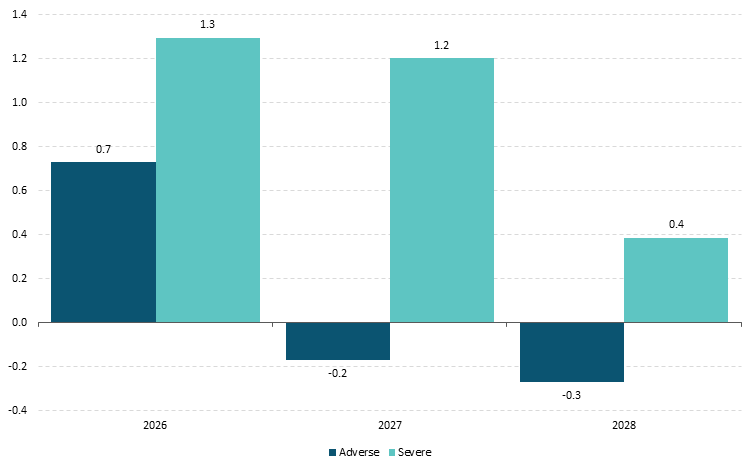
Source: Central Bank of Ireland. Chart data in accessible format. (XLSX 152.37KB)
Figure 31: MDD growth, p.p. deviation from baseline
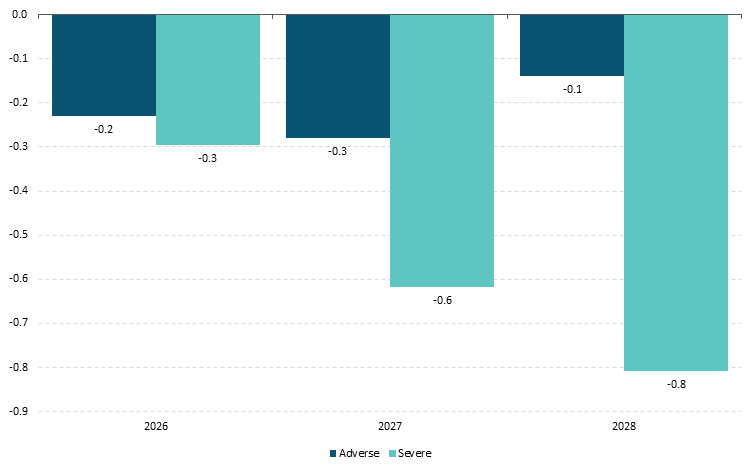
Source: Central Bank of Ireland. Chart data in accessible format. (XLSX 152.37KB)
These scenarios are partial and likely underestimate the impact on growth and inflation of any further surges in energy prices. The scenarios provide estimates of the sensitivity of baseline inflation and growth forecasts to a change in assumptions on energy prices but there are caveats that should be considered in interpreting the results. First, the scenarios consider the impact of increases in energy prices in isolation. If further energy price rises were accompanied by increases in other international non-energy commodity prices or other changes in the wider economic environment, then the impact on inflation and growth could be larger than reported here. Relatedly, increases in energy prices such as those considered in both scenarios could be accompanied by other negative developments including a rise in uncertainty, tighter financial conditions and a deterioration in financial markets. If these effects were included in the modelling scenarios, they would amplify the negative effect on energy-intensive manufacturing sectors and on overall output.
Beyond the risks posed by developments in the Middle East, there is a risk that capacity constraints could become worse if progress on alleviating infrastructure gaps in the economy is delayed or inadequate. This risk could arise even if a slowdown in the pace of economic growth transpires. Planned expenditure under the National Development Plan is designed to address shortages of critical infrastructure in water and waste water, energy, transport and housing. Reforms such as those in the Accelerating Infrastructure Report and Action Plan are designed to reduce delays in the delivery of large national infrastructure projects. Delayed progress resulting in persistent deficits in basic infrastructure represent a downside risk to the projections for investment. If this materialised, lower investment would act as a drag on long-term growth and productivity. Over the short run, this could result in higher and more persistent inflation triggered by domestic pressures and, with competitiveness impaired, weaker economic growth occurring over the longer term. Domestic capacity constraints and inflationary pressures – and the associated negative implications for long-term growth – would be aggravated if the pattern of procyclical budgetary policy persists.
The balance of risks to the export forecast is to the downside given the ongoing volatile stance of US trade policy and the high level of concentration in pharma and ICT exports. The baseline forecasts assume a subdued performance by polypeptide hormone exports in the first half of 2026 with a recovery thereafter. A more persistent fall back in polypeptide hormone exports than projected in the baseline would materially lower headline exports and GDP, given the outsized contribution of this product category to Irish exports. Over the medium term, there are downside risks to Irish exports and corporation tax receipts if US companies actively reduce the volume and value of their activity in Ireland. Changes in US corporate tax or industrial policy could affect the location of intangible assets and production, with knock on effects for goods and services trade, investment and corporation tax receipts. On the upside, if global demand for diabetes and obesity treatments continues to rise rapidly, pharma exports could remain higher for longer than assumed in the baseline. Furthermore, services exports could outperform if higher global investment in ICT and AI translates into stronger exports of computer and business services from Ireland and if the adoption of AI technologies yields productivity improvements. This could also result in higher domestic investment than in the baseline forecasts. On the negative side, it is possible that a large correction in equity prices arising from adverse developments in the business models of AI-related companies could result in lower exports, investment, employment and tax revenue in Ireland. Firms in the services sector differ from their counterparts in the manufacturing sector as the required sunk investments in Ireland tend to be lower. As a result, the activity and employment arising from the MNE-dominated parts of the services sector is likely to be more footloose, and vulnerable to negative shocks.
Detailed Forecast Table
Table 7: Baseline Macroeconomic Projections for the Irish Economy
(annual percentage changes unless stated)
| | 2024 | 2025e | 2026f | 2027f | 2028f |
|---|
Constant Prices | | | | | |
| Modified Domestic Demand | 1.8 | 4.9 | 2.9 | 2.5 | 3.2 |
| Modified Gross National Income (GNI*) | 4.8 | 4.7 | 2.2 | 2.7 | 3.4 |
| Gross Domestic Product | 2.6 | 12.3 | 1.3 | 4.3 | 5.2 |
| Final Consumer Expenditure | 3.0 | 2.9 | 1.9 | 1.7 | 1.7 |
| Public Consumption | 4.8 | 3.9 | 2.6 | 2.5 | 3.3 |
| Gross Fixed Capital Formation | -28.5 | 42.6 | 3.0 | 2.5 | 3.6 |
| Modified Gross Fixed Capital Formation | -4.2 | 10.9 | 5.4 | 4.2 | 6.4 |
| Exports of Goods and Services | 8.6 | 9.7 | 2.2 | 4.6 | 5.0 |
| Imports of Goods and Services | 2.7 | 9.5 | 3.2 | 3.4 | 3.5 |
| Total Employment | 2.7 | 2.2 | 1.9 | 1.8 | 1.8 |
| Unemployment Rate | 4.3 | 4.7 | 4.9 | 5.1 | 5.1 |
| Harmonised Index of Consumer Prices (HICP) | 1.3 | 2.1 | 2.9 | 2.6 | 1.9 |
| HICP Excluding Food and Energy (Core HICP) | 2.3 | 2.0 | 2.4 | 2.4 | 2.2 |
| Compensation per Employee | 4.3 | 3.1 | 4.0 | 3.8 | 3.5 |
| General Government Balance (% of GNI*) | 7.0 | 2.6 | 2.4 | 2 | 1.3 |
| ‘Underlying’ General Government Balance (% of GNI*) | -1.8 | -2.2 | -3.1 | -3.5 | -4.4 |
| General Government Gross Debt (% of GNI*) | 67.1 | 62.1 | 55.8 | 52.9 | 50.7 |
| Modified Investment (% of Nominal GNI*) | 19.2 | 20.7 | 21.0 | 21.1 | 21.5 |
Revisions from previous Quarterly Bulletin, p.p | | | | | |
| Modified Domestic Demand | 0.0 | 0.9 | -0.1 | -0.3 | 0.4 |
| Gross Domestic Product | 0.0 | -0.4 | -1.8 | 1.0 | 1.9 |
| HICP | 0.0 | 0.0 | 0.6 | 0.8 | 0.0 |
| Core HICP | 0.0 | 0.0 | 0.0 | 0.5 | 0.1 |
Quarterly Bulletin No. 1 2026: Boxes
The housing sub-component of the construction Purchasing Managers’ Index pointed to a contraction in activity for the last nine consecutive months (Figure 1). This contrasts with a reported increase in new dwellings construction of over
23 per cent in 2025 (Figure 2). This Box examines whether the housing sub-component of the construction PMI is a useful indicator of current and future housing construction activity.
Survey indicators of construction activity
The construction PMI is a monthly economic indicator that tracks the performance and health of the Irish construction sector. It is compiled by S&P Global based on original monthly survey data collected from a representative panel of around
150 construction companies in Ireland. It is a diffusion index that measures the month-on-month change in the volume of construction activity, where a level above 50 signals expansion and
a level below 50 signals contraction. S&P Global produce an aggregate construction index and activity indices for the housing, commercial and civil engineering sub-sectors, as well as other potential leading indicators such as new orders and expectations
for future activity.
The literature on PMIs suggest they are effective in forecasting current levels of activity (nowcasting), but their predictive power varies by sector and over time. Since National Accounts data
lag the PMI releases, these indicators may provide valuable forecasting tools. This Box considers the effectiveness of the Irish construction PMI in forecasting current and future levels of housing output.
Housing PMIs signal a contraction in activity since mid-2025, while new dwellings completions increased throughout the year
Figure 1: AIB Construction and housing sub-indices PMIs
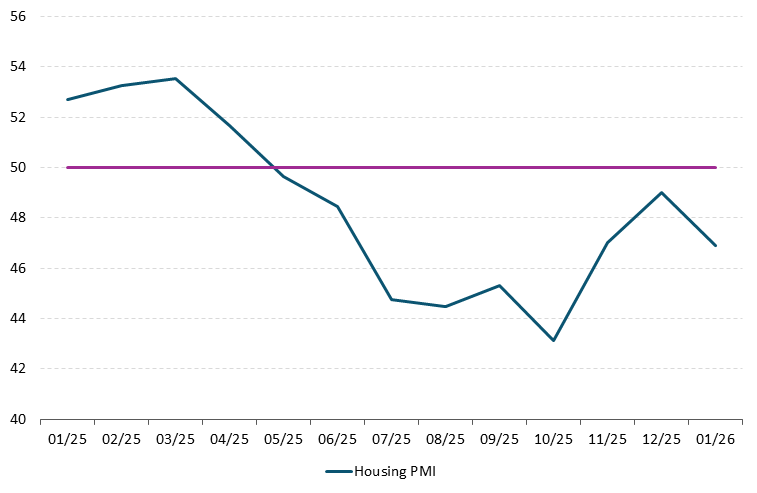
Source: AIB Ireland Construction PMI. Chart data in accessible format.
Figure 2: Annualised New Completions in 2025, units
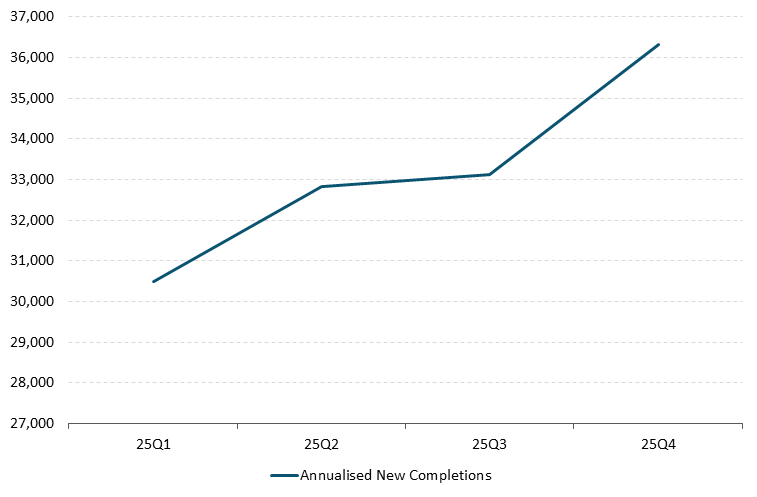
Source: CSO. Chart data in accessible format
A housing model: to include PMIs?
Central Bank of Ireland forecast models for housing completions include a range of housing-related indicators such as new home loans, commencements, planning permissions, and new house price and cost data. In addition, the construction PMI housing activity
is also used to forecast future activity levels. Generally, these indicators provide a good in-sample fit to actual completions (Figure 3). The inclusion of the housing PMI adds to the overall in-sample fit of the model and the coefficient is positive
and statistically significant (Figure 4), indicating an intuitive finding that higher PMIs are associated with higher housing output.
Housing PMIs improve the in-sample fit of the model and are significant and positively associated with housing completions
Figure 3: Housing Model with PMI, Year-on-year per cent change
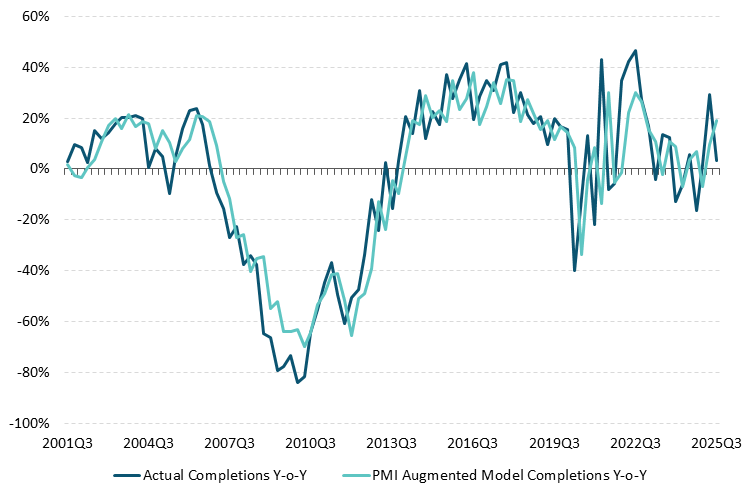
Source: Internal estimates. Chart data in accessible format
Notes: this model includes the log-difference of lagged completions, new home loans, planning permissions, a new house price to cost index and the housing PMI.
Figure 4: Housing PMI Coefficient statistically significant
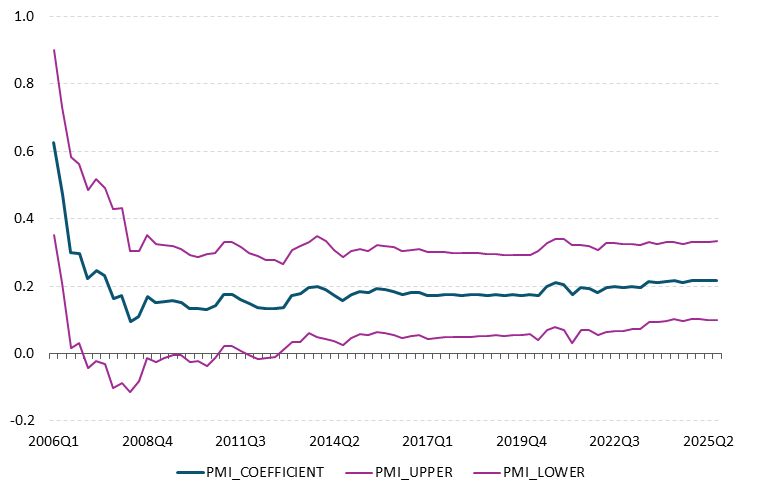
Source: Internal estimates.Chart data in accessible format
Notes: recursive estimates of the coefficient of the lag of the log-difference
of the housing PMI in a model with lagged completions, planning permissions, new home loans, a price-cost index and the housing PMI estimated quarterly from 2000 to 2025.
However, a high in-sample fit does not necessarily lead to good out-of-sample forecasting. Conducting a one-year pseudo out-of-sample forecasting exercise with the housing PMI included in the model compared to the baseline (the same model without the
housing PMIs) yields varying and inconclusive results. On average over the period 2017 to 2025 period, the model excluding the housing PMI performed marginally better than one inclusive of the PMI. For four out of the nine years,
the PMI-inclusive model performed better than the baseline model, while the baseline outperformed the PMI-inclusive model for the other five years (see Table 1). This suggests that the performance of the housing PMI may be state dependent.
Table 1. Sometimes the PMI inclusion results in more accurate 1-year ahead forecasts
| Year |
Baseline Model RMSE |
PMI inc. Model RMSE |
Completions Forecast Baseline |
Completions Forecast PMI Model |
Completions Actual |
| 2017 |
0.245 |
0.141 |
11,112 |
12,634 |
14,267 |
| 2018 |
0.230 |
0.233 |
20,775 |
20,813 |
17,861 |
| 2019 |
0.087 |
0.191 |
22,338 |
24,221 |
21,097 |
| 2020 |
0.321 |
0.303 |
24,661 |
23,803 |
20,533 |
| 2021 |
0.236 |
0.273 |
18,824 |
19,452 |
20,516 |
| 2022 |
0.380 |
0.506 |
21,132 |
18,496 |
29,726 |
| 2023 |
0.249 |
0.222 |
39,720 |
38,825 |
32,695 |
| 2024 |
0.157 |
0.219 |
33,812 |
35,917 |
30,396 |
| 2025 |
0.181 |
0.1507 |
30,983 |
32,955 |
36,331 |
Notes: RMSE refers to the root mean squared error and is a measure of forecast accuracy, with lower numbers indicating greater forecast accuracy. Model forecasts are not necessarily the final forecast used in the Quarterly Bulletin, which may also
incorporate expert judgement.
To test whether PMI effectiveness in forecasting depends on market conditions, we employ a Markov switching model identifying two distinct regimes (Figure 5). Regime 1 is the contraction phase where housing output is declining and would have prevailed
from 2008 to 2012 as well as during the more acute phases of the COVID pandemic. In this case, the coefficient on the PMI variable is negative and insignificant. This would suggest that in Regime 1, once the housing market enters a contractionary
state, the PMI loses predictive power. In such a period, the relationship between "how builders feel" and "what is actually built" disconnects. This is likely because, in a downturn, output is determined by the structural variables (clearing out old
planning permissions or finishing homes where loans were already drawn down) rather than new sentiment. Regime 2 in the Markov switching model represents a state of growth and expansion. In this state of the housing market, the coefficient on the
PMI is positive and significant. In this regime, when the Irish housing market is in a growth-oriented state, the construction PMI is a reliable leading indicator with a 2-quarter lag. A 1 per cent change in the PMI today translates to a
0.21 per cent change in housing output growth in two quarters. This suggests that during "good times" builders’ sentiment is an early indicator for actual housing completions.
Markov-switching model indicates that we are likely in a regime where housing PMIs can be significant predictors of future housing output
Figure 5: Housing market regimes as identified using the Markov Switching model, per cent
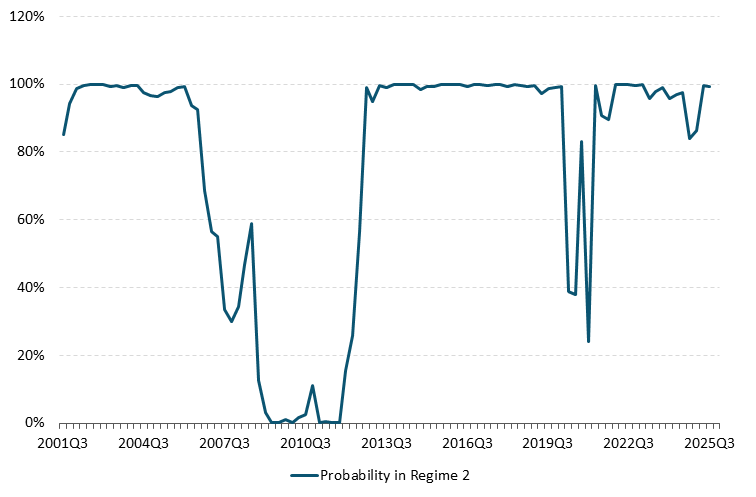
Source: Central Bank of Ireland estimates. Chart data in accessible format
Notes: A probability of 80 per cent of being in Regime 2 implies a probabilty of 20 per cent of being in Regime 1.
In terms of the current negative readings for the housing PMI with increasing completion figures, the model’s prediction of Regime 2 is likely due to the lagged effect of housing production and the timing of the survey. The model uses the two-quarter
lag of the housing PMI. This means it is comparing increasing housing output against PMIs from six months ago. Completions during 2025 reflect decisions from 12-24 months earlier. The model
uses a two-quarter PMI lag, matching early 2024's positive PMIs to 2025's higher completions. Output is currently rising because of a wave of construction that started in 2024 due to temporary government fee waivers. The model does, however, provide
an early warning of a downside risk to future housing output coming from the PMI decline in 2025.
It is also noted that the more forward-looking elements of the construction PMI are less negative than the sector-specific ones (Figure 6). Notably, the new orders and expectation sub-indices point to a more optimistic outcome – but these relate
to the aggregate building and construction sector and have less explanatory power for the residential sector as they include both the commercial and civil-engineering sectors.
Forward-looking components of the construction PMI point to more positive activity but relate to the broader construction sector
Figure 6: Forward-looking elements of the construction PMI
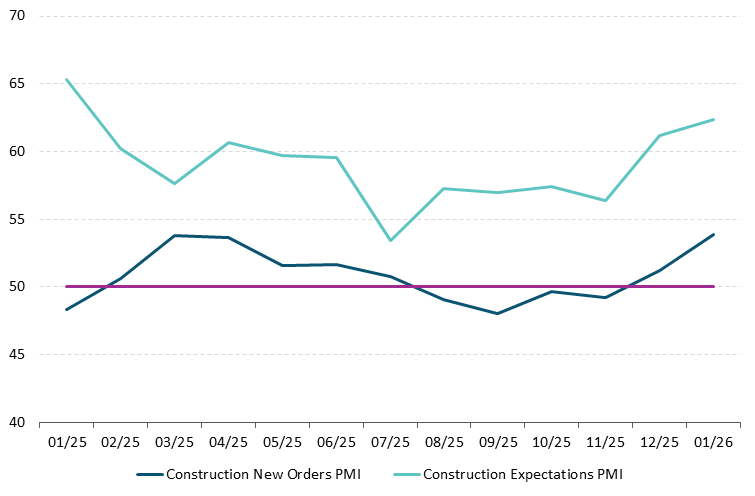
Source: AIB Ireland construction PMI. Chart data in accessible format
Notes: A value below 50 signals a contraction while a value above 50 signals an expansion.
Overall, we find that the housing PMI is a market-dependent indicator with varying effectiveness for forecasting purposes. During expansions, the PMI leads output by two quarters. This relationship weakens during contractions (e.g., 2020-21). The current
divergence between PMI readings and housing completions reflects production lags and the 2024 commencement surge. While the PMI loses predictive power during sustained downturns, current negative readings warrant monitoring as potential signals of
a turning point. Forecasters should weigh PMI data alongside structural indicators when assessing future output.
The current account (CA) of the balance of payments is a key indicator of a country’s external position, reflecting the extent of its trade and income flows with the rest of the world, and whether the country is a net lender (CA surplus) or net
borrower (CA deficit) of funds.Recently there has been increased attention paid at a global level to the extent and persistence of external imbalances. At various stages
of the economic cycle or of economic development, alongside more structural characteristics such as demographic change, it is reasonable for countries to have either a CA deficit or a surplus . However, large and persistent imbalances may indicate
unsustainable economic conditions or risks to macrofinancial stability. This Box examines the dynamics of Ireland’s CA balance in recent years and some of its underlying drivers.
Ireland’s headline CA has been in surplus since 2021, peaking at 16.2 per cent of GDP in 2024 before moderating to an estimated 8.2 per cent in 2025. This is largely influenced by the highly globalised nature of the economy. The CSO also publishes
a modified CA balance (CA*) annually which removes some of the more distortionary effects of MNE activity for Ireland. As a percentage of GNI*, CA* stood at 7.8 per cent in 2024,
is estimated to have eased to 6.7 per cent in 2025, and has been in surplus for a decade.
This modified approach does not lend itself easily to an assessment of the more fundamental drivers and sustainability of the economy’s external position as it does not fully map back to the economic realities and choices of Irish households and
businesses. An alternative perspective is to consider the national accounting identity that the current account balance (CA) is equal to the difference between the economy’s own savings (S) and investment (I). Savings represent national income
not used for households’ consumption, by businesses in the production of goods and services (intermediate consumption), and by net general government spending (excluding capital expenditure). Investment refers to additions to the economy’s
capital stock - housing, commercial buildings, public infrastructure, machinery and equipment and intellectual property products. These are the non-financial assets that add to the productive capacity of the economy over time.
The CA = S – I identity can be disaggregated by sector: households, government, non-financial and financial businesses, with businesses further split between domestically and foreign-owned entities. Examining the CA = S-I identity across these dimensions
can provide a more meaningful economic interpretation of the Irish CA balance to inform policy by linking developments back to the economic decisions made by Irish businesses and households.
Looking at the distinction between domestic and foreign-owned S-I balances, headline developments have been dominated by the activities of foreign-owned non-financial corporations (Figure 1). These include the activities of FDI-based multinationals, re-domiciled
PLCs and the estimated excess corporation tax receipts accruing from the activities of those companies that are less directly linked to their activities in the State. Such activities reflect the production and value chain decisions of large MNEs,
driven by factors that make Ireland a significant domicile and export hub for pharmaceuticals, medtech, and ICT. These factors are not only Irish-specific but also interact with the tax and industrial policy of these companies’ home and export
markets. Outturns can also be quite variable from year-to-year. For example, significant on-shoring of intellectual property (IP) assets in 2019 led to a large excess of investment over savings for the foreign-owned NFC sector that year. In contrast,
a large export of IP in 2024 led to the opposite occurring.
Shifts in the headline current account balance is dominated by developments in savings-investment balances of foreign-owned entities
Figure 1: Savings - Investment balance and current account balance, % GDP (2013-2025)
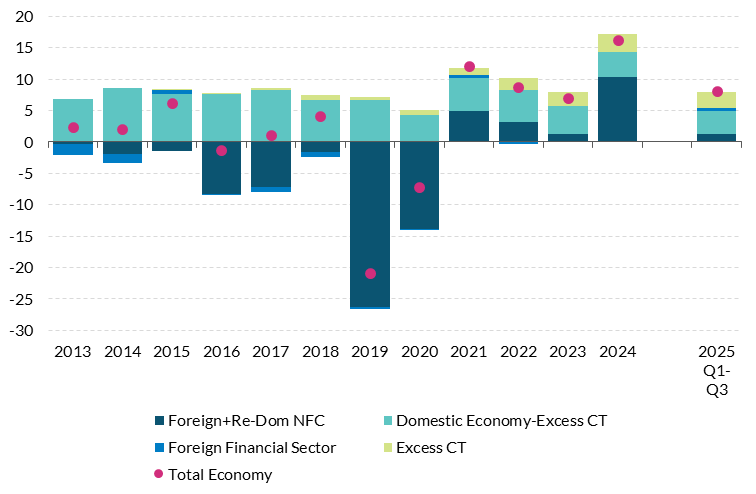
Source: CSO and Central Bank of Ireland estimates. Chart data in accessible format.
Notes: Sectoral breakdown for 2025 are Central Bank estimates.
While Ireland’s headline CA balance is driven by foreign-owned entities, the domestic economy has long maintained an external surplus, averaging 10 per cent of GNI* since 2013, albeit with more moderate balances in recent years (including the estimate
of 5.6 per cent in 2025) (Figure 2). This results from two diverging influences – first, the underlying deficit in the general government balance (excluding estimated excess CT), which only partially offsets the second factor - excess of savings
over investment in the domestic private sector, both households and businesses.
An excess of saving over investment by households and domestic businesses underpins the positive external position for the domestic economy
Figure 2: Savings - Investment balance domestic sectors, % GNI* (2013-2025)
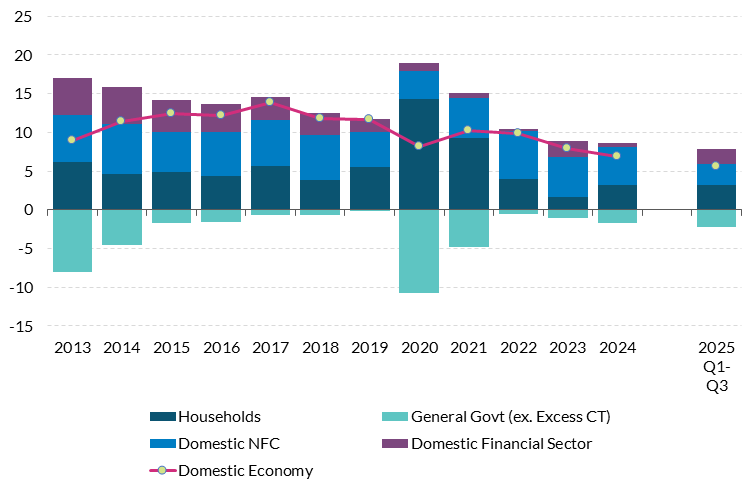
Source: CSO and Central Bank of Ireland estimates. Chart data in accessible format.
Notes: Sectoral breakdown for 2025 are Central Bank estimates.
Savings in excess of investment in the household sector likely reflects housing market developments. The main non-financial asset households can invest in is housing, be those new builds or repairing/retrofitting older properties. The economy currently
delivers approximately 35-40,000 new housing units per annum, with the estimates for underlying demand due to demographic and other factors being between 50-55,000 per annum (Central Bank of Ireland, 2024).
At the same time, the household savings rate is relatively high by historical standards at around 15 per cent of disposable income. However, Central Bank staff analysis finds that this level of savings is not necessarily out of line with economic
fundamentals given the demographic profile and the need to save for housing investment (Boyd, Byrne & McIndoe-Calder, 2025).
These findings suggest that the gap between current supply and underlying demand for housing is a key reason why the household investment rate remains subdued. If housing output was closer to 55,000 units per annum, the household investment rate would
be reaching approximately 14 per cent all else equal, significantly reducing the sector’s S-I balance (Figure 3).
Household’s investment rate has been constrained by the relative under-supply of new housing
Figure 3: Annual household savings and investment rates, % of disposable income (1995-2025)
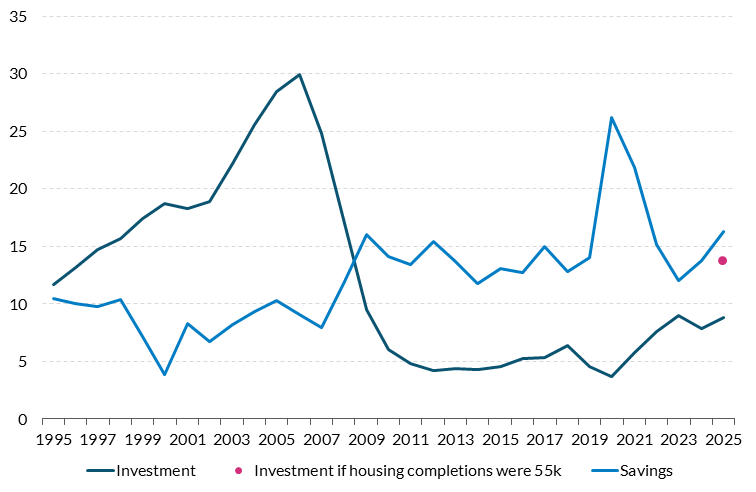
Source: CSO and Central Bank of Ireland estimates. Chart data in accessible format
The investment rate of domestic NFCs has also been relatively low, contributing to the positive S-I balance for that sector and approximately half of the domestic economy’s positive external balance over the past decade (Figure 4). Headline business
investment in Ireland is flattered by the activity of foreign-owned MNEs, but the investment rate of domestic businesses here is only three-fifths of NFCs in the euro area. This low rate of business investment constrains future growth and potentially
limits the scope for productivity gains in the domestic economy. The relatively low level of investment in the capital stock of the construction sector (machinery and equipment, intellectual property and new technologies) has contributed to the challenges
in scaling activity in housing and infrastructure (Central Bank of Ireland, 2024).
Evidence shows that businesses in Ireland have been investing less on a per employee basis than European peers, at about three-quarters the rate of the EU average (€7.6k vs €10.3k), and less than half the rate of other small, open economies
in northern Europe (€7.6k vs €15.6k). Higher investment rates approaching European norms would reduce the sector's positive external position and its contribution to the
domestic economy’s overall positive CA balance.
Domestic NFCs investment rate below the euro area average
Figure 4: NFC investment rate, % GVA (1999-2025)
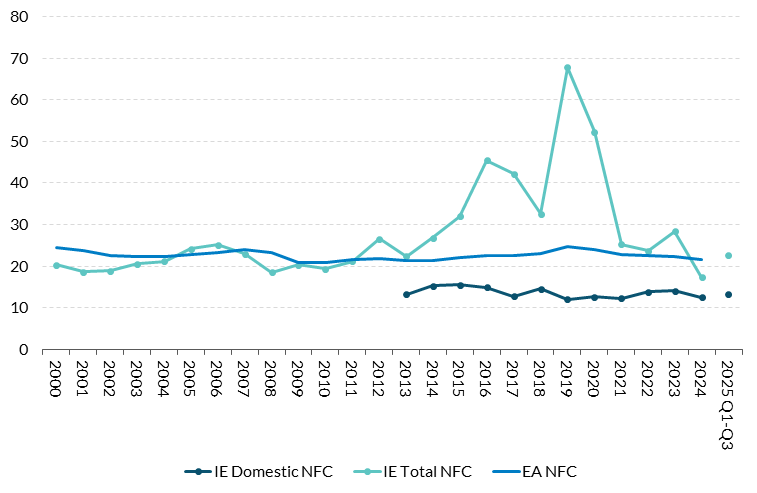
Source: CSO, Eurostat and Central Bank of Ireland estimates. Chart data in accessible format
The relatively low level of investment by households (housing) and domestic businesses in Ireland presents challenges to current and prospective growth and productivity, causes the domestic economy to be a net lender of funds to the rest of the world
and a long-standing positive CA balance to arise for the domestic private sector. Sustainably enabling higher investment could see a change in that position. If housing output reached 55,000 units per annum and the domestic NFC investment rate approached
the euro area average, the positive CA balance for the domestic private-sector of almost 6 per cent of GNI* in 2025 would be reduced to less than 1 per cent. Sustainably achieving a higher investment rate could be supported by a range of actions.
These would include an appropriately financed public capital investment programme and enabling reforms to crowd-in private investment and generate sufficient market scale. While public investment is increasing, the overall fiscal stance needs to be
carefully managed to avoid excessively stimulating demand and inflationary pressures. Public policy has taken some steps with the revised National Development Plan and the Accelerating Infrastructure Action Plan. An increase in investment activity
in the rest of the decade is necessary to promote sustainable growth in living standards over the longer-term, and would likely have the secondary effect of reducing the domestic economy’s current account surplus.
Following 25 years of negotiation, the EU and the four countries that comprise the Mercosur trade bloc – Argentina, Brazil, Paraguay and Uruguay – signed a trade agreement on 17 January 2026.
The agreement was approved by the EU Council on 9 January, but on 21 January the European Parliament referred the agreement to the European Court of Justice for a legal opinion on
its compatibility with EU treaties. The European Commission (EC) announced on 27 February that it will proceed with provisional application of the agreement while the ratification
process continues. The agreement aims to achieve more integrated and frictionless trade between the two blocs with a combined population of 770 million people and whose total GDP amounts to around one quarter of global output. Ireland is a small open
economy in the EU and one of the most trade-dependent countries on the globe. At a time when global trade has become more fragmented and trade tensions remain high, an agreement which reduces frictions between two populous markets holds out the opportunity
for higher trade, output, incomes and employment in the EU and in Ireland. This Box summarises the main elements of the EU-Mercosur agreement and outlines some of the likely implications of the agreement for the EU and Irish economies.
Existing trade linkages with Mercosur
Based on the most recent data (for 2023 and 2024), around 1.9 per cent of EU exports were sold to Mercosur countries with Mercosur accounting for 2.1 per cent of EU imports (Figure 1). For Mercosur countries, the EU is a significant trading partner, accounting
for just under 17 per cent of Mercosur’s total trade (goods and services) in 2023. Ireland-Mercosur trade linkages are more modest than is the case for the EU as a whole. Around 0.3 per cent of Ireland’s total exports went to Mercosur
in 2024 with imports from Mercosur making up 0.4 per cent of the total (Figure 1). While trade flows are small in absolute terms and as a proportion of Ireland’s overall trade, linkages have deepened considerably, with Ireland's exports to Mercosur
increasing nearly threefold in value since 2010.
Irish merchandise exports and imports with Mercosur are concentrated in a narrow set of sectors. Chemicals and pharmaceuticals and machinery and transport equipment account for the bulk of exports, while food, crude materials and chemicals make up the
majority of Irish imports from Mercosur (Figure 2).
Current euro area and Ireland-Mercosur trade flows are small
Figure 1: Per cent of total trade, 2024.
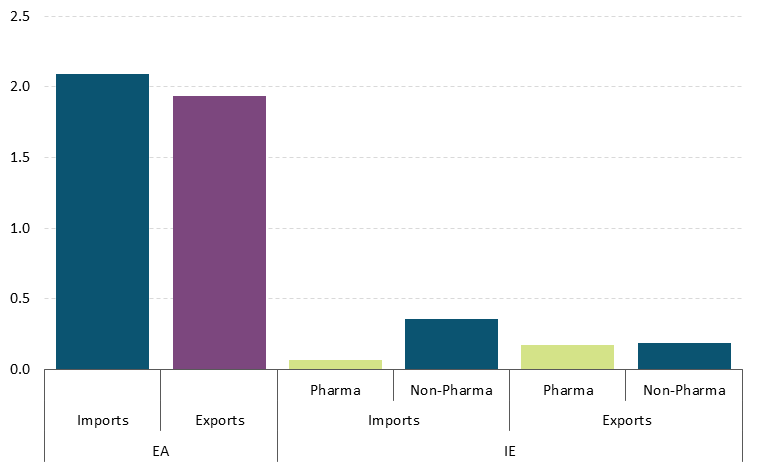
Source: Eurostat. Chart data in accessible format
Notes: Columns show the proportion of exports (imports) to (from) Mercosur (Ireland) as a share of total exports (imports).
Irish exports to Mercosur are concentrated in chemicals, pharmaceuticals, and machinery, with food the largest share of imports
Figure 2: Irish Imports and Exports Decomposition with Mercosur Countries, €Billions
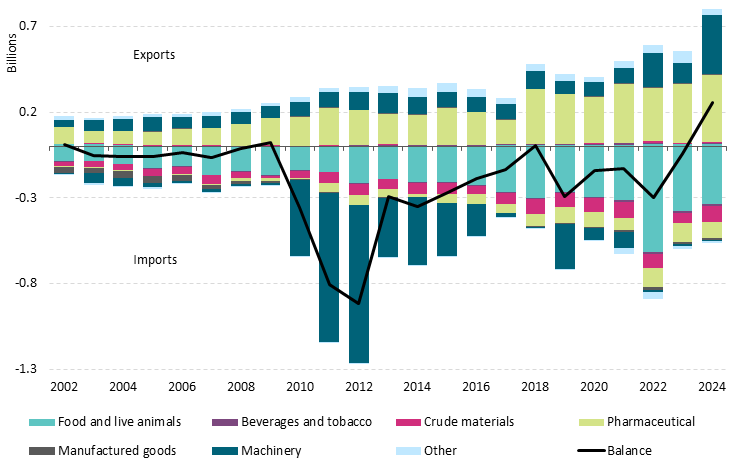
Source: Eurostat. Chart data in accessible format
The EU-Mercosur Agreement
Currently, trade between the EU and Mercosur countries is subject to a high level of tariff-related and other restrictions. This means that market access is still shaped largely by Most Favoured Nation (MFN) tariffs, quotas and non-tariff barriers, rather
than preferential terms. The EU applies a trade-weighted average tariff of 4 per cent on imports from Mercosur, though this masks significant sectoral variation. Mercosur applies a considerably more restrictive trade-weighted average tariff of approximately
11 per cent on EU imports, reflecting higher protection for both its agricultural and manufacturing sectors, including pharmaceuticals. Beyond tariffs, both regions maintain substantial non-tariff barriers, including complex customs procedures, regulatory
and market access approval processes for agri-food products, service provision requirements, and restricted access to public procurement markets. Mercosur countries notably remain outside the WTO Government Procurement Agreement all of which can prevent
meaningful participation by foreign firms in public contracting.
A reduction in effective tariff barriers will liberalise trade with the EU
Figure 3: EU-Mercosur Effective Tariff Rates Pre and Post Agreement, per cent
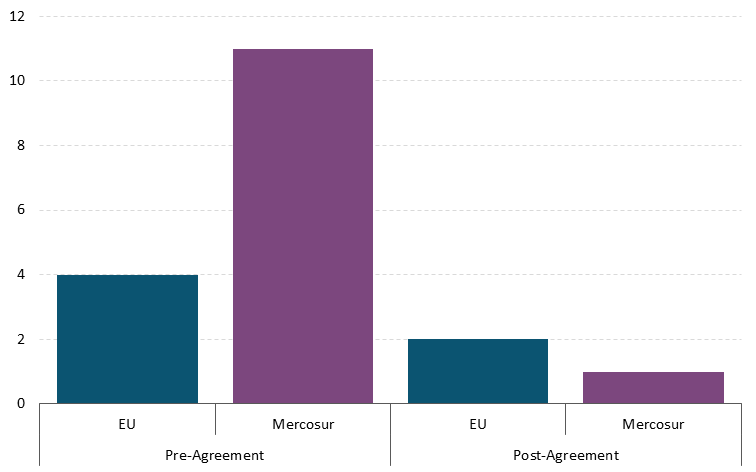
Source: Banco de España, 2026. Chart data in accessible format
The agreement represents a substantial liberalisation of bilateral trade through reductions in average effective tariffs on over 90 per cent of bilateral trade over a phased implementation period extending up to 15 years.
For Mercosur, the trade-weighted average tariff is projected to decline from 11 per cent to 1 per cent upon full implementation, whilst the EU's effective tariff on Mercosur imports will fall from 4 to 2 per cent (Figure 3). The agreement eliminates tariffs entirely across most manufacturing sectors, with particularly significant reductions arising in automotive, machinery and equipment and chemicals. For Mercosur exporters, the reduction of EU tariffs on agricultural
products improves market access for one of Mercosur’s key sectors.
Table 1: EU-Mercosur Headline Tariffs Pre- and Post-Agreement
| Sector | Sector share of overall exports to Mercosur, % | Sector share of total exports, % | Current tariff (%) | Post-Mercosur Tariff |
|---|
| Chemicals and pharmaceuticals | 48.1 | 67.7 | 14–18 | 0.0 |
| Machinery and Transport equipment | 42.5 | 13.5 | 14–20 | 0.0* |
| Food and Beverages | 2.4 | 7.2 | 27–55 | 0.0* |
| Other | 7.0 | 11.6 | 0–23 | 0.0* |
Notes: Asterisks (*) denote products subject to phased tariff elimination over implementation periods extending up to 15 years. For certain sensitive products, tariff-rate quotas (TRQs) apply, permitting reduced-tariff access up to specified volumes,
with out-of-quota rates maintained at current levels.
The Agreement contains significant reductions in tariffs on products which account for the bulk of Ireland’s current exports to Mercosur (Figure 2). Chemicals and pharmaceuticals, medical devices and machinery and transport equipment account for
91 per cent of Ireland’s exports to Mercosur and currently face headline tariffs of 14 to 20 per cent. Under the agreement, tariffs in these three product groups will be substantially reduced and phased out for most products, with full elimination
expected over implementation periods of up to 15 years (Table 1). Agri-food exports currently face prohibitively high tariffs of up to 55 per cent when selling to Mercosur but the agreement would deliver substantial reductions for many products, with
dairy and spirit drinks among the Irish export sectors likely to benefit most, along with beef, dairy, and cereals, with the latter facing zero tariffs.
In relation to services – which account for half of Ireland’s overall exports – the trade agreement opens up Mercosur’s services market further in key sectors such as financial services, telecommunications, transport and digital
trade. The agreement includes provisions to improve market access for EU services firms in those sectors and to ensure a level-playing field for EU services firms operating in Mercosur markets. The agreement includes provisions to boost e-commerce
and digital trade by promoting the use of electronic contracts and prohibiting customs duties on electronic transmissions. Intangible intellectual property (IP) assets underpin a significant proportion of Ireland’s knowledge-intensive trade
in both goods and services. The Mercosur agreement includes a dedicated chapter that establishes a rules-based framework for protecting intellectual property, including reinforcing protections for trademarks and patents.
Macroeconomic Implications
The EU-Mercosur agreement would be expected to affect the Irish economy through two main channels. By reducing trade frictions, the agreement should directly boost Ireland-Mercosur trade. EU trade and economic activity is also likely to be supported in
the same way, and the Irish economy would benefit from the positive spillover effects from higher growth in the EU as a result of the agreement. In relation to direct effects, to the extent that the agreement reduces or eliminates tariffs and other
trade costs, the largest proportional effects would be expected in those sectors where Ireland has already established a strong presence. The Mercosur agreement entails substantial reductions in tariffs for two sectors – chemicals and pharmaceuticals
and machinery and transport equipment – which have an existing large-scale, export-based manufacturing presence in Ireland. These sectors together account for 79 per cent of overall exports and 3 per cent of employment. The reductions in trade
barriers for these sectors – whose trade with Mercosur has already been on a steady upward trend – can support additional export activity and facilitate greater market diversification over time.
For services trade, the impact of reductions in non-tariff barriers as a result of the agreement is more uncertain and more difficult to quantify than the effect of lower tariffs on goods. Using estimates from the literature, EC (2025) assume that the agreement results in an ad-valorem equivalent (AVE) reduction in barriers to services trade of 3 per cent. Although direct Ireland-Mercosur trade in services is currently a small share of the total, the overall services sector is a
major engine of growth in the Irish economy, accounting for around half of value added and exports and 77 per cent of employment. Improved market access under Mercosur should allow for incremental increases in activity in the sector over time.
For the EU, model-based estimates indicate that lower trade costs as a result of the agreement could increase overall EU GDP by around 0.05 per cent by 2040. The results point to the
largest export gains occurring in high‑value manufacturing – motor vehicles, machinery and equipment, chemicals, pharmaceuticals and electrical equipment. These sectors should gain from lower tariffs and clearer market access. For Ireland, the
increase in EU demand should support higher intermediate exports to EU manufacturing firms. Overall, the sectoral profile of expected gains is consistent with the comparative strengths of key sectors of the Irish economy currently – namely high-value
manufacturing and services. This implies the potential for economic gains for Ireland through direct market opportunities as well as deeper participation in global value chains. The Department of Enterprise, Trade and Employment published an impact
assessment of the Mercosur Agreement in June 2021, undertaken by independent consultants. The research found that the Mercosur agreement would boost Irish trade leading to an increase
in overall output of just over 0.1 per cent after 10 years, a slightly larger increase than the estimated gain for the EU overall.
Sectoral Considerations – Agriculture
The agri-food sector accounts for around 6 per cent of national income (GNI*) and a similar share of employment in Ireland. Agri-food exports represented around 8 per cent of overall goods exports in 2025. Within this, dairy made up 35 per cent of Irish
food exports, beef 17 per cent and cereals 3 per cent. The sector is heavily reliant on global trade with up to 90 per cent of beef, sheep meat and dairy produce exported annually. Trade in agricultural products between the EU and Mercosur is currently subject to a high level of restriction. The trade-weighted EU tariff on dairy imports from Mercosur currently stands at just under 17 per cent; the Mercosur tariff on EU dairy
imports is just over 20 per cent. For beef, the EU applies a tariff of over 32 per cent with Mercosur charging a 7 per cent tariff on EU imports.
The EU-Mercosur agreement envisages significant reductions in tariffs and trade barriers on agricultural produce, but some restrictions will remain. Under the agreement, both EU and Mercosur import tariffs on products such as dairy, beef and other meats,
fish and beverages are substantially reduced. For the dairy sector in Ireland which accounts for the largest share of food exports and is globally competitive, reduced tariffs provide opportunities to increase exports to Mercosur.
The agreement does not allow for full liberalisation of beef imports. Instead, EU beef imports from Mercosur will be limited by two tariff-rate quotas together amounting to 99,000 tonnes, corresponding to 1.6 per cent of EU beef consumption (6 million
tonnes). Moreover, the size of the additional quotas (99,000 tonnes) likely overstates the impact of the agreement. This is because Mercosur exporters already successfully export significant quantities of fresh beef to the EU while paying the full
MFN duty – known as over quota exports. With the Mercosur agreement in place, there is likely to be a substitution of these currently over quota exports for exports under the new EU-Mercosur tariff rate quota. Taking these details into account, existing external analysis indicates that the impact of the agreement on beef prices and farmers’ incomes in aggregate is likely to be marginal. Moreover, on 5 March 2026, the EU Council adopted the bilateral safeguard clauses of the EU-Mercosur Agreement. This regulation contains a safeguard mechanism to protect farmers
and producers in the event of market disruption caused by a surge in imports as a result of the agreement. For sensitive products such as beef, poultry and dairy products, the regulation allows the Commission to act quickly to temporarily withdraw
tariff preferences if evidence is found of injury, or a threat of injury, to EU producers.
It is worth noting that the agri-food sector should see indirect benefits from the increase in economic activity and incomes stimulated by the overall effect of the agreement across all sectors of the economy in Ireland and the EU. At present, Ireland’s
imports from Mercosur are concentrated in food and live animals, dominated by imports of animal feed. As a result, Irish consumers could benefit from lower tariffs and expanded quotas under the agreement.
The EU-Mercosur agreement is underpinned by strengthened EU health and safety measures, including reinforced import controls and audits at EU borders, higher audit activity for non-EU countries and EU Border Control Posts and a broader commitment to align
production standards where feasible. This is further supported by a proposed €6.3 billion safety net in the long-term EU budget to cushion potential agricultural market impacts. The EU Sanitary and Phytosanitary (SPS) framework applies to any
product sold in the EU and does not change as a result of the Mercosur agreement. The EU SPS framework applies on imported food, animal and plant products, while maintaining the precautionary principle and independent safety criteria for products
entering the EU.
Conclusion
For both the EU and Ireland, the relatively small share of overall current trade with Mercosur economies means that the gains from the new agreement, when implemented, are likely to be modest and will take time to materialise. Nevertheless, for Ireland's
trade-dependent economy, the agreement provides gains for key export sectors – including pharmaceuticals and services – that would see current high tariffs and other trade barriers progressively reduced and in some cases eliminated. This
has the potential to support higher trade flows, output, incomes and employment. Importantly, given that global trade fragmentation poses an ongoing risk to Ireland's export-dependent economy, the agreement offers Irish firms new market diversification
opportunities within the EU's expanding preferential trading network. Over time, this could help to at least partially counter potential vulnerabilities from shifting US policy.
As of January 2026, two significant methodological changes have been introduced to Ireland’s consumer price statistics. First, the classification system underpinning the Harmonised Index of Consumer Prices (HICP) has been upgraded from the European
Classification of Individual Consumption According to Purpose (ECOICOP) to ECOICOP version 2, which is aligned with the internationally agreed UN COICOP 2018 standard. Second, the
Central Statistics Office (CSO) has revised its quality adjustment approach for some non-energy industrial goods (NEIG). The revised methodology corrects a previously identified downward bias in measuring price changes for specific product categories.
This
Box explains the nature of these changes and implications for Irish consumer prices.
Transition to ECOICOP version 2
Both the Consumer Price Index (CPI) and the HICP are compiled by the CSO. While the CPI serves as Ireland’s national inflation measure, the HICP provides the framework for comparable inflation measurement across the euro area which allows for consistent
assessment of price developments across Member States. From January 2026, both indices are compiled according to ECOICOP version 2, which will replace the ECOICOP classification that had been in use since the mid-1990s. This update reflects the substantial
evolution in consumption patterns that have occurred over the past three decades. In addition to the ongoing changes, the HICP index reference period has been updated from 2015=100 to 2025=100. This is a routine rescaling exercise that occurs every
ten years and improves readability without affecting published inflation rates.
The update reflects the evolution of the consumption basket that has occurred since the original COICOP classification was adopted in 1999. The rapid expansion of digital services, the emergence of subscription-based consumption models, and the convergence
of traditionally distinct product categories such as smartphones and computers, or telecommunications and media services have created classification challenges that the existing framework could not accommodate consistently.
ECOICOP version 2 addresses these structural challenges through several important refinements. The revised classification provides a clearer separation of goods and services throughout the framework by introducing new subclasses for services categories
such as repair, maintenance, installation, and rental. Divisions 08 (Information and communication) and 09 (Recreation, sport and culture) have been extensively restructured to reflect more up to date consumption patterns. Games of chance are now
included in the HICP under Division 09 (Recreation, sport and culture), following the publication of Eurostat’s harmonised methodology for their treatment in December 2024. The transition to the new classification framework has been carefully
designed to maintain continuity. The all-items HICP and CPI remain unchanged for any historical month, up to the second decimal place.
A notable change is the classification of delivery fees, which are now classified under Division 07 (Transport) rather than being embedded within the prices of delivered goods. Additionally, a new Division 13 (Personal care, social protection and miscellaneous
goods and services) has been introduced, to consolidate items previously scattered across other divisions. A significant change specific to Ireland concerns the treatment of electricity and natural gas within the consumer price classification framework.
Until December 2025, the CSO classified electricity and natural gas as services, whilst Eurostat classified them as goods. From January 2026, the CSO has aligned with the Eurostat classification, which now categorises both electricity and natural
gas as goods in both the CPI and HICP. This reclassification affects the composition of the Goods and Services Special Aggregates, which have been revised back to 1996.
Quality adjustments to non-energy industrial goods
Alongside the classification framework updates, the CSO has implemented a revised quality adjustment methodology for 46 items distributed across six COICOP categories within non-energy industrial goods. These items collectively account for approximately
2.6 per cent of the CPI basket and 2.8 per cent of the HICP basket.
Quality adjustment has been a persistent methodological challenge in consumer price measurement. When a specific product in the CPI sample is discontinued, the CSO must select a replacement product and determine how to compare prices between the old and
new item. Two principal methods are used: direct comparison, which treats the full price difference between the old and new product as genuine price change; and bridged overlap, which excludes the price difference between the two products on the assumption
that any price difference reflects a quality change rather than a pure price change.
Quality Adjustment in NEIG: Bicycle example
Figure 1: Price and Index
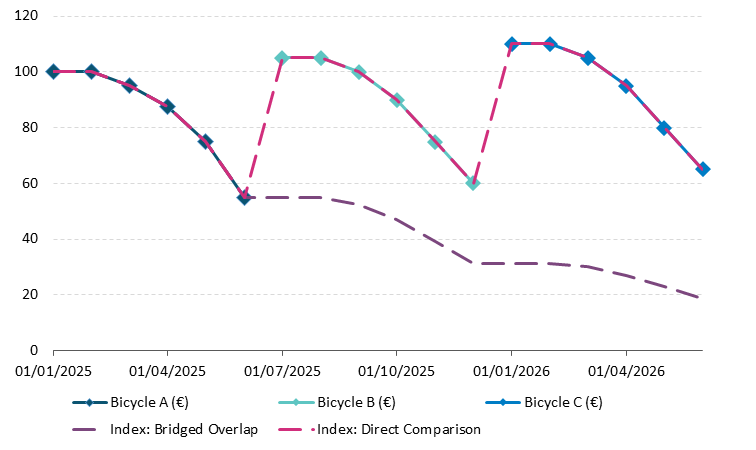
Source: Central Bank of Ireland. Chart data in accessible format
The challenge identified by the CSO relates to a particular pricing pattern which is common with the 46 items undergoing the methodological revision. Figure 1 shows the direct comparison and bridged overlap methods using the example of a bicycle to show
how different treatments of replacement products diverge over time. Products such as furniture, household textiles, and glassware tend to be introduced to the market at their full price and subsequently discounted over their sales period, where they
often exit the market at a substantially reduced sale price. Upon discontinuation, these products are replaced in the sample by new items priced at full retail value. Under the bridged overlap method, the transition from a discounted old product to
a full-price replacement is excluded from the index calculation. However, since this pattern repeats with each replacement cycle, the systematic exclusion of these upward price movements can introduce a persistent downward bias in the measured index.
Prior to January 2026, direct comparison was applied to approximately 40 per cent of all replacements for these items in December 2025 while the bridged overlap approach was applied in the remaining 60 per cent of cases. Under the revised methodology,
the CSO has introduced a structured categorisation system for products within each affected COICOP class. Replacement products are now selected from within the same category as defined by characteristics such as branding, composition and capacity
for items like teapots, or branding, composition and thread count for bed linen. This approach uses direct comparison for most replacements, which the CSO anticipates will exceed 90 per cent. In the residual cases where a replacement is deemed non-comparable,
a modified form of bridged overlap is applied using the pre-sale price of the outgoing product, rather than its last observed (potentially discounted) price. Both approaches address the downward bias by ensuring that the transition from a sale price
to a full price is appropriately captured in the index.
Irish NEIG inflation has been markedly different from the Euro area benchmark
Figure 2: Year-over-Year rate
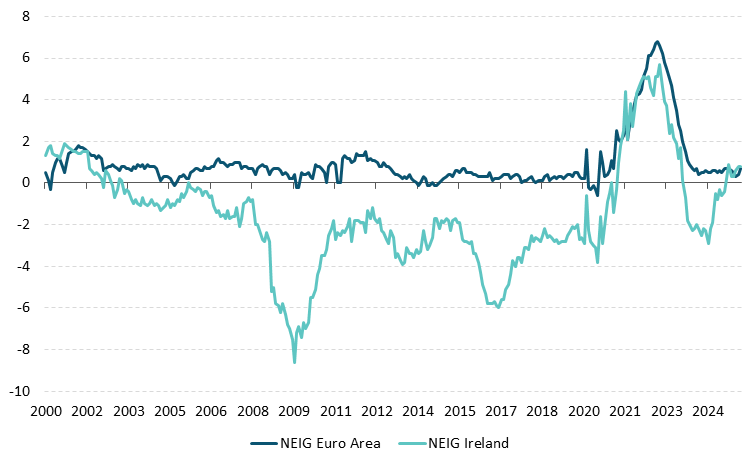
Source: Eurostat. Chart data in accessible format
CSO simulations suggest that, had the revised methodology been in place over the two years to December 2025, the overall HICP would have been 0.3 percentage points higher. The effects of the methodological revision are most pronounced for household and
furniture and furnishings which are both categories where the sale-to-full-price replacement pattern is particularly prevalent. Over the past two decades, Irish NEIG inflation has been persistently lower than the Euro area benchmark, with episodes
of divergent cyclical dynamics between the two (Figure 2). Looking ahead, methodological improvements to Irish NEIG components may lead to a narrowing of the spread with respect to the Euro Area average.
Implications for the interpretation of inflation data
These changes should be understood in the context of broader efforts across the euro area to improve the accuracy, comparability, and relevance of consumer price measurement. At the European level, Eurostat’s assessment of the ECOICOP transition
found that the impact on the all-items HICP was practically negligible for European aggregates. This finding provides reassurance regarding the overall robustness of the transition at the aggregate level. For users of Irish inflation data, several
practical points are worth noting. First, the all-items CPI and HICP remain unchanged for all historical periods, which ensures that long-run comparisons remain valid and unaffected by the methodological changes. Second, whilst the level of sub-indices
for the affected NEIG categories may shift upward relative to what would have been observed under the previous methodology, this reflects a correction of a previously identified bias rather than an acceleration in underlying price pressures. It is
worth mentioning that this distortion is transitory, once this adjustment in the methodology has been in place for twelve months comparisons with previous calendar year will be benchmarked against a consistent baseline. Third, the reclassification
of electricity and natural gas from services to goods in the CPI will alter the composition of the Goods and Services Special Aggregates, which may affect sectoral decompositions used in analytical work.
Looking ahead, the revised classification framework should improve the granularity and consistency of inflation analysis, while the quality adjustment changes ensure that the measurement of NEIG prices more accurately reflects consumers’ experience
of price changes in categories where product turnover is frequent and sale-price dynamics are prevalent. These improvements align with international best practice and support the continued usefulness of Ireland’s consumer price statistics for
both domestic policy analysis and euro area comparisons. While these updates address specific known biases, it remains to be seen whether further adjustments for other items might follow throughout the year
Following several years of strong labour market performance, employment growth has slowed from an annual average of 4.4 per cent between 2022 and 2024 to 2.2 per cent in 2025. Labour demand indicators such as job postings have fallen from previously
elevated levels with a slight rise in the unemployment rate to 4.7 per cent in 2025. Although unemployment remains low by historical standards, these developments suggest that the recent period of labour market tightness is easing. To better understand
these changes in the labour market, this Box assesses administrative firm data on hiring and turnover levels (job churn) alongside Labour Force Survey data on how individuals are moving between labour market states (transition rates). Taken
together, these indicators outline that much of the recent increase in unemployment has been driven by lower hiring and job-finding rates. Looking ahead, population projections show an expected increase in the size of the 15-to-24-year population
over the coming decade, providing a boost to labour supply.
CSO job churn data use Revenue PAYE modernisation (PMOD) returns to measure the total turnover of jobs in the economy, with turnover inclusive of hirings, separations, job creation and job destruction. In recent years, there has been a gradual slowdown in the level of job churn, both at the aggregate level and in each of its underlying components (Figure 1). Churn as a share of total employments has slowed from a peak value of 14.4 per cent in 2022
to 12 per cent in 2025. The average level of hirings decreased by 2.9 per cent in 2025 to 306,000 workers, with consumer-facing sectors such as Retail and Accommodation among the largest declines (-4 per cent). Job separations declined by 0.8 per
cent to 291,000 persons over the same period implying that firms are recruiting more cautiously rather than implementing widescale layoffs. As a result, the share of workers remaining
in the same job as the previous period has risen by 0.6pp to 89.4 per cent in 2025, suggesting workers having a preference for security in a period of economic uncertainty.
Lower job turnover in firms with decreased hiring levels coupled with lower job separations
Figure 1: Average levels of job churn and underlying components (2021-2025)
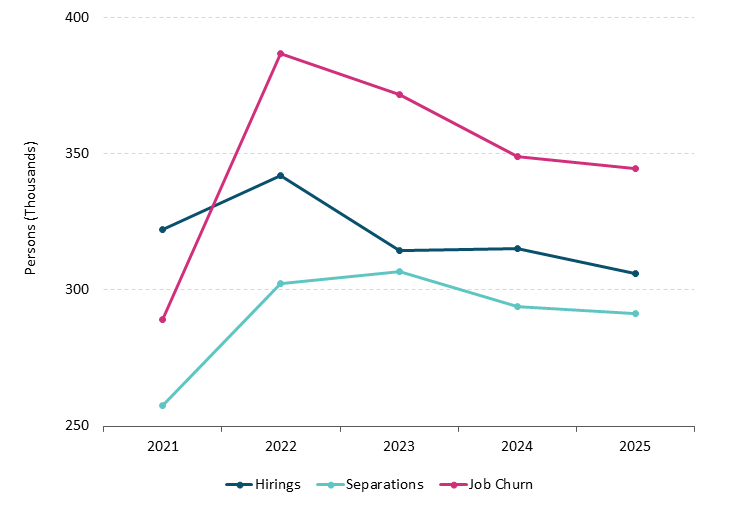
Source: CSO. Chart data in accessible format.
Labour market transition rates measure the flow of individuals between Employment (E), Unemployment (U), and Inactivity/Outside of the Labour Force (N) over time. They are an important
indicator for assessing turning points in the labour market as they can identify whether rising unemployment is the result of greater jobs loss (inflows from E) or increased labour supply (inflows from N), or some combination of the two. Previous
transition rate analysis of the Irish labour market outlined that the observed decline in unemployment in recent years was facilitated by an increase in the job-finding rate (U to E). Updating this analysis for 2025 using Eurostat LFS data, changes in labour market transition rates indicate that lower employment growth and higher unemployment levels are being driven by weaker job-finding rates (Table 1). Employment retention (E to E) remains broadly stable at 95.8 per cent and separations into unemployment (E to U) have increased only marginally. The job-finding rate (U to E) remains unchanged between 2024 and 2025, though it has declined from
its level in 2022, and there has been a 1.2 percentage point increase in unemployment persistence (U to U). These developments would be typical of a labour market slowdown as fewer unemployed individuals find it harder to secure employment in the
subsequent period, while the changes are much smaller compared to those observed following the global financial crisis. Additionally, stronger inflows into unemployment from inactivity and reduced flows in the opposite direction suggest that labour
supply is expanding while hiring slows. Overall, these developments are consistent with a phase of cyclical cooling following a period of labour market tightness, contributing to gradual upward pressure on unemployment.
A lower job-finding rate coupled with higher shares remaining in unemployment has contributed to a rise in the unemployment rate
Table 1: Labour market transition rates (2025) and change relative to 2024
|
Employment (Et) |
Unemployment (Ut) |
Inactivity (Nt) |
| Employment (Et-1) |
95.8%
(+0.1pp)
|
1.1%
(+0.1pp)
|
3.1%
(-0.2pp)
|
| Unemployment (Ut-1) |
31.8%
(0.0pp)
|
41.8%
(+1.2pp)
|
26.4%
(-1.2pp)
|
| Inactivity (Nt-1) |
7.6%
(-0.5pp)
|
4.3%
(0.4pp)
|
88.1%
(+0.1pp)
|
Source: Eurostat
The rise in the aggregate unemployment rate to 4.7 per cent in 2025 was partly driven by the youth-age cohort (aged 15–24 years), who accounted for 30 per cent of 14,100 person increase. A shift-share decomposition which holds age-specific unemployment rates constant at 2024 values shows that the increase in respective cohorts would have raised total unemployment levels by just over 2,300 persons. Changing age-specific unemployment
rates added a further 11,800 persons to total unemployment, with the youth-age cohort having the largest contribution (Figure 2). There are several factors which are likely contributing to this greater sensitivity of youth unemployment. Firstly, younger
workers are typically more exposed to cyclical fluctuations because they are concentrated in sectors characterised by higher turnover and stronger links to consumer demand, such as Retail and Accommodation, which have recently experienced relatively
greater slowdowns in hiring. Secondly, entry into employment for young people often depends on job churn creating vacancies at the lower end of the job ladder. Reduced hiring and
lower job mobility therefore disproportionately limits employment opportunities for new labour market entrants. Finally, seasonal dynamics may amplify these effects, as Ireland has historically recorded higher unemployment rates during the mid-year
months (Q2 and Q3) when students and recent graduates begin actively seeking employment.
Uptick in aggregate unemployment level primarily driven by younger cohorts
Figure 2: Shift-share decomposition of the contribution of changes in age-specific unemployment to the change in the headline unemployment rate, 2024 to 2025
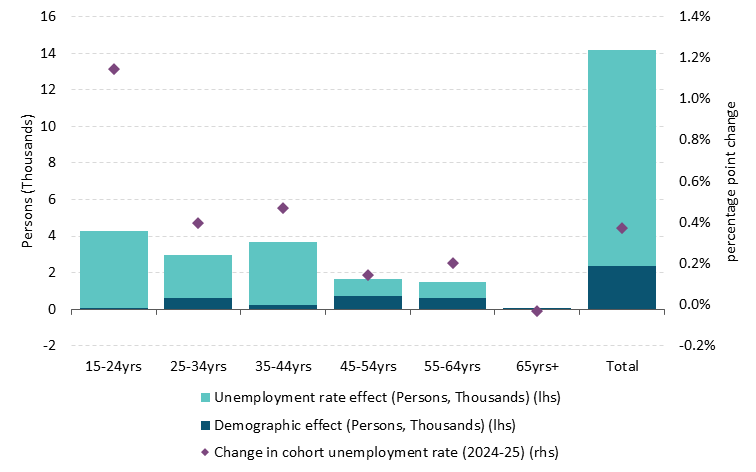
Source: CSO. Chart data in accessible format.
Structural demographic trends may reinforce these cyclical pressures as CSO population projections indicate that the number of persons aged 15–24 years has steadily increased over the previous decade and set to rise further, peaking in 2031 (Figure
3). The observed increase in this cohort in recent years has likely increased competition for entry-level jobs, particularly during the latest period of moderating labour demand. While a large share of this cohort typically chooses to remain in education,
thereby remaining outside of the labour force, the projected increase in youth population means that this additional labour supply could potentially enter the market at a time when labour demand is moderating. Against this, analysis points to a current
high level of demand – that is outstripping supply – for AI-related skills in the labour market in sectors such as ICT and engineering. If this continues, it could provide opportunities for younger workers entering the labour force over
the coming years.
Demographic projections point to a strong increase in younger age population in the coming decade
Figure 3: Projected number of persons aged 15-24 years (Thousands)
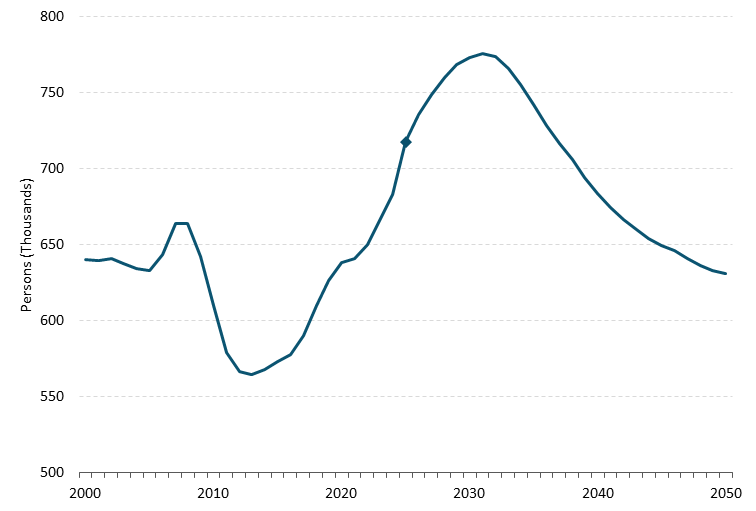
Source: CSO. Chart data in accessible format.
Note: Projected population figures are from the M1 high migration scenario to be consistent with Dept. of Finance Future Forty analysis on expected growth. Dot on line chart represents the current 15-24 year old population estimate for 2025
Job churn and labour market transition data in 2025 point to a so far muted cooling in labour market conditions, with an increase in the pool of younger workers available for work. Looking
ahead, the central forecasts point to employment growing at a slower pace relative to recent years, while the trajectory of unemployment will depend primarily on cyclical hiring conditions. Further declines in hiring or job mobility could lead to
increases in unemployment, particularly among new labour market entrants as this cohort population increases in size. Continued monitoring of job churn and labour market flows is warranted as the persistence of weaker job-finding rates or higher unemployment
persistence across all age groups, could signal more sustained labour market loosening with implications for wage growth, household income, and domestic demand.
An Timpleallacht Gheilleagrach
Leis na forbairtí sa Mheánoirthear le déanaí, tugtar dúshlán breise do gheilleagair na hÉireann agus na hEorpa, arbh éigean dóibh cheana féin dul in oiriúint do staid athraitheach gheopholaitiúil. Meastar go mbeidh fás níos ísle agus boilsciú níos airde ann ná mar a bhíothas ag súil leis roimhe seo de thoradh praghsanna ola agus gáis níos airde. Beidh méid na n-éifeachtaí seo ag brath ar dhéine agus ar fhad na coinbhleachta, agus ar scála an damáiste do bhonneagar ríthábhachtach sa Mheánoirthear. Léiríonn na teagmhais seo íogaireacht gheilleagar na hÉireann i leith forbairtí domhanda agus an gá atá le hathléimneacht an gheilleagair and an airgeadais phoiblí a chothabháil agus a chothú i leith réaltachtaí geo-eacnamaíocha is lú fabhar ná mar a bhí i gceist sna blianta roimhe seo, rud a dhéanann difear do thrádáil, do shlándáil an tslabhra soláthair agus d’infheistíocht trasteorann.
Is dócha go mbeidh éifeachtaí díreacha agus neamhdhíreacha araon ag costais fuinnimh níos airde ar bhoilsciú atá i ndán do ghnólachtaí agus do theaghlaigh araon, rud a léirítear cheana féin go pointí éagsúla i bpraghsanna cineálacha éagsúla breosla. Is furasta comparáid a dhéanamh, ar ndóigh, idir na teagmhais le déanaí, atá ag titim amach ceithre bliana tar éis ionradh na Rúise ar an Úcráin agus tar éis an ghéarardaithe stairiúil ar phraghsanna gáis, ola agus bia a bhain leis, agus an chéad tréimhse sin. Amhail ó lár mhí an Mhárta, níl scála na turrainge tosaigh do phraghsanna fuinnimh chomh géar céanna sa chás seo, sa mhéid nach bhfuil ardleibhéil 2022 á sroiceadh go leanúnach ag spotphraghsanna agus praghsanna todhchaíochtaí gáis agus ola. Tá sé ábhartha mar sin féin agus toisc gur allmhaireoir fuinnimh í Éire, léiríonn sé téarmaí díobhálacha na turrainge trádála agus tá iarmhairtí gaolmhara aige don ioncam náisiúnta.
I bhfianaise na héiginnteachta a bhaineann leis an ionchas, agus ag brath ar fhad agus ar dhéine an chogaidh sa Mheánoirthear, breathnaítear ar raon cásanna féideartha san Fhaisnéis Ráithúil seo i gcomparáid leis an toimhde bhonnlíne go mbeidh coinbhleacht ghearr ann agus go ndéanfar slabhraí soláthair a athbhunú go sciobtha.Sa chás bonnlíne, tá an fás eacnamaíoch intíre beagáinín níos ísle ná ár gcuid réamhaisnéisí roimhe seo do 2026 agus 2027, agus beidh boilsciú idir 2.5 agus 3 faoin gcéad i gceist sna blianta sin. Dá mbeadh coinbhleacht níos faide agus suaitheadh breise ann, d’fhéadfadh go mbeadh boilsciú in Éirinn thart ar 1 phointe céatadáin níos airde ar an meán ná an bhonnlíne sna trí bliana atá amach romhainn.
Tá ionchas nach bhfuil chomh dearfach céanna do chumhacht cheannaigh na dteaghlach i gceist thar thréimhse na réamhaisnéise de thoradh ráta boilscithe atá níos airde ná a mar a tuaradh roimhe seo. Mar a tharla roimhe seo, is dócha go mbeidh sé seo le brath ar bhealach éagsúil sna réimsí éagsúla dáilte ioncaim agus go mbeidh sé faoi thionchar leithdeadúlacht na dtáirgí fuinnimh agus bia i gciseán tomhaltais gach teaghlaigh. Tá sé intuigthe go ndéanfar beartas a oiriúnú nuair is gá chun tacú leis an ngeilleagar, go háirithe leis na dreamanna is leochailí. Léiríonn anailís ó fhoireann an Bhainc Ceannais gur éirigh leis na bearta costais mhaireachtála, arna dtabhairt isteach mar fhreagairt ar an turraing bhoilscitheach in 2022 agus 2023, na caighdeáin mhaireachtála a choimeád ar bun go héifeachtach (Boyd agus McIndoe-Calder, 2026). Léirítear sa taighde, áfach, gur chuir fás ioncaim leis sin freisin, go háirithe sa leath uachtarach den dáileadh ioncaim, agus tugtar le tuiscint gur féidir an tairbhe chéanna a bhaint amach don gheilleagar ar bhealach atá níos inbhuanaithe don airgeadas poiblí trí thacaíochtaí den sórt sin a spriocdhíriú ar bhealach níos éifeachtaí dóibh siúd atá ar ioncam níos ísle.
Go deimhin, bhí neart an mhargaidh saothair ag tacú le fás réasúnta ar phánna agus ar ioncam indiúscartha na dteaghlach le blianta beaga anuas. Mar sin féin, tá luas an fháis fostaíochta ag maolú le ráithí beaga anuas agus tá méadú beag tagtha ar an dífhostaíocht. Tá an maolú sin ar dhálaí an mhargaidh saothair atá thar a bheith docht ag tarlú i gcomhthráth le ráta aimsithe post atá beagán níos ísle, go háirithe i measc cohóirt níos óige (Bosca E). Ós rud é go bhfuil na hathruithe is suntasaí ag tarlú in earnálacha ina mbíonn fostaíocht ard go hiondúil don aos óg ach nach bhfuil chomh neamhchosanta céanna ar thascanna ar féidir leis an intleacht shaorga a dhéanamh (e.g. seirbhísí cóiríochta agus bia), ní dócha gurb í úsáid mhéadaithe na hintleachta saorga an chúis is suntasaí go dtí seo leis an ráta níos ísle aimsithe poist i measc daoine óga. Ar bhonn níos leithne, meastar go mbeidh athrú ar chineál an mhargaidh poist le himeacht ama, ar bhealaí nach dtuigtear go hiomlán go fóill, mar gheall ar rochtain agus ar úsáid mhéadaithe na hintleachta saorga. Is dócha go mbeidh ról ag bearta beartais chun scileanna digiteacha agus soghluaisteacht ghairme a fheabhsú do chohóirt áirithe den lucht saothair (McIndoe-Calder agus Yadav, 2026 (PDF 1.8MB)). Sa réamhaisnéis bhonnlíne atá againn, tuartar go dtiocfaidh maolú breise ar an bhfás fostaíochta, go dtí faoi bhun 2 faoin gcéad in aghaidh na bliana go dtí 2028. Tá sé sin ag teacht le hionchas atá beagán níos airde don ráta dífhostaíochta, cé go bhfuil sé fós gar do 5 faoin gcéad. Ós rud é go léiríonn an ráta sin dálaí éilimh intíre atá beagán níos buacaí, tá sé comhsheasmhach freisin le héifeachtaí indíreacha an mhéadaithe ar chostais fuinnimh a d’fhéadfadh a bheith níos ísle ná mar a bhí i gceist tar éis ionradh na Rúise ar an Úcráin.
Cé go bhféadfadh caiteachas tomhaltóirí a bheith níos srianta i bhfianaise an ionchais don bhoilsciú atá níos airde ná mar a bhíothas ag súil leis roimhe seo, meastar go dtiocfaidh fás seasta ar infheistíocht intíre. Léiríonn sé sin an seachadadh bonneagair caipitil phoiblí a bhfuil coinne leis, cur i gcrích tithíochta atá ag méadú agus fuinnimh atá beagán níos mó ná mar a tuaradh roimhe seo in infheistíocht ghnó. Mar sin féin, dá mbeadh costais níos airde fuinnimh seasmhach, d’athródh sé sin na torthaí coibhneasta agus inmharthanacht roinnt caiteachais chaipitiúil thar thréimhse na réamhaisnéise. Maidir le tithíocht, níl cuid de na táscairí tagarmhairc a úsáidtear go coitianta chun aschur a thuar, amhail tosuithe agus TLFanna, chomh simplí le léirmhíniú a dhéanamh orthu ná mar a bhí roimhe seo, agus léiríonn siad go bhféadfadh ardú nach bhfuil chomh láidir céanna teacht ar aschur tithíochta ná mar a thuartar sa réamhaisnéis reatha (Bosca A).
Seachas an t-aschur tithíochta níos airde agus an bonneagar cumasúcháin, an t-innealra agus an infheistíocht teicneolaíochta atá riachtanach chun athléimneacht i gcaighdeáin mhaireachtála a chothabháil agus a chothú san fhadtéarma, is dócha go mbeadh méadú ar ráta infheistíochta na hearnála príobháidí intíre ag freagairt do bharrachas níos ísle sa chuntas reatha ar chomhardú íocaíochtaí na hÉireann (Bosca B). Bíonn sé casta i gcónaí spreagthaí agus dinimic staid sheachtrach na hÉireann a léirmhíniú i bhfianaise mhéid agus chineál ghníomhaíochtaí FINanna atá faoin úinéireacht eachtrach. Taobh amuigh den tsaincheist sin, áfach, bhí an earnáil phríobháideach intíre ina glaniasachtóir cistí don chuid eile den domhan agus bhí an ráta infheistíochta, go háirithe ó ghnólachtaí, réasúnta íseal. Le hinfheistíocht níos airde ón earnáil phríobháideach, is féidir rannchuidiú le geilleagar níos athléimní a bhunú, go háirithe i bhfianaise cúlra domhanda níos ilroinnte. Is féidir ról a bheith ag beartas, lena n-áirítear trí scála leordhóthanach a chumasú i margaí ar féidir leo gnólachtaí a spreagadh chun infheistíocht a dhéanamh, táirgiúlacht a mhéadú, agus fás. Ar bhonn intíre, mar shampla, dá n-áiritheofaí go mbeadh talamh criosaithe agus seirbhísithe leordhóthanach ar fáil agus go ndéanfaí é a dhreasú lena úsáid i limistéir ina bhfuil éileamh ard ar thithíocht, chuideofaí le scála leordhóthanach a chruthú do ghnólachtaí chun an tithíocht sin a sholáthar ar bhealach níos éifeachtúla. Laistigh den Aontas Eorpach, trí na bacainní ar thrádáil atá fós ann a laghdú agus tríd an Margadh Aonair in earraí agus i seirbhísí araon a dhoimhniú, cuirtear deiseanna ar fáil chun scála margaidh lena gcumhdaítear 450 milliún duine a threisiú. Ar an gcaoi chéanna, trí na dálaí riachtanacha a chruthú chun leas a bhaint as tairbhí na nuálaíochta san airgeadas ar mhodh sábháilte slán, is féidir gnóthachain a scaoileadh do shaoránaigh Éireannacha agus do shaoránaigh Eorpacha eile, amhail euro Digiteach agus nuálaíochtaí eile ar nós ceadchomharthaíochta a thabhairt isteach. Lasmuigh den Aontas Eorpach, tá sé tábhachtach i gcónaí oibriú chun naisc shlána trádála agus infheistíochta le margaí eile a oscailt agus a choimeád ar bun. Sampla den bhealach inar féidir dul chun cinn a dhéanamh ar mhaithe le geilleagair na hÉireann agus na hEorpa is ea comhaontú Mercosur a rinneadh le déanaí agus a chur i bhfeidhm sealadach ag an gCoimisiún Eorpach (Bosca C).
Tá éiginnteacht bhreise ag baint leis an ionchas don bhoilsciú agus don fhás sa limistéar euro mar gheall ar an gcoinbhleacht sa Mheánoirthear, sa mhéid go bhfuil rioscaí ar an taobh thuas ann don bhoilsciú agus rioscaí ar an taobh thíos don fhás. Ar a shon sin, tá boilsciú réadaithe agus ionchais bhoilscithe araon daingnithe go maith thart ar sprioc 2 faoin gcéad le ráithí beaga anuas, agus tá athléimneacht léirithe ag an ngeilleagar. Chinn Comhairle Rialaithe BCE ag a cruinniú i mí an Mhárta go gcoinneofaí a príomhrátaí beartais ag a leibhéil reatha, i bhfianaise a measúnaithe ar an ionchas, ar shonraí ag teacht isteach, ar dhinimic an bhoilscithe bhunúsaigh, agus do neart an tarchuir beartais airgeadaíochta. Leis an bhfaisnéis atá ag teacht isteach sa tréimhse atá romhainn, cuideofaí leis an gComhairle Rialaithe measúnú a dhéanamh ar an gcaoi ina ndéanfaidh an cogadh difear don ionchas boilscithe agus do na rioscaí a bhaineann leis. I bhfianaise an chur chuige a bhíonn ag brath ar shonraí agus ar bhonn cruinniú ar chruinniú chun measúnú a dhéanamh ar an seasamh iomchuí, tá an Chomhairle Rialaithe in ann rátaí beartais a choigeartú de réir mar is gá chun boilsciú sa limistéar euro a choinneáil ag an sprioc sa mheántéarma.
Tá ról tábhachtach ag beartas fioscach inbhuanaithe freisin maidir le hathléimneacht a chothú sa gheilleagar chun aghaidh a thabhairt ar dhúshláin níos práinní agus ar dhúshláin níos fadtéarmaí araon. Chuige sin, is gá an beartas fioscach a athrú go seasamh níos cothroime trí easnamh bunúsach an rialtais ghinearálta a laghdú d’aon ghnó (i.e. an t-iarmhéid gan an cháin chorparáide bhreise mheasta san áireamh). Tá na héilimh ar an airgeadas poiblí ag dul i dtreis mar gheall ar an athrú aeráide agus mar gheall ar dhaonra níos sine sa mheántéarma agus san fhadtéarma. Sa ghearrthéarma, ba cheart go ndéanfaí aon tacaíochtaí breise a dhíriú ar na daoine is leochailí amháin, ag obair laistigh de chonair ghlanchaiteachais inbhuanaithe agus trí thús áite a thabhairt do chaiteachas caipitil éifeachtúil. Tá an choinbhleacht sa Mheánoirthear agus an tionchar diúltach eacnamaíoch a bhaineann léi ag teacht i ndiaidh dhá thurraing dhiúltacha mhóra eile a tharla le déanaí – an phaindéim agus an cogadh idir an Rúis agus an Úcráin. Ós rud é go raibh méaduithe suntasacha ar chaiteachas poiblí mar fhreagairt ar an dá ghéarchéim, tá spás beartais fhioscaigh níos srianta ann chun freagairt inbhuanaithe d’iarmhairt eacnamaíoch na coinbhleachta reatha sa Mheánoirthear. Sa mheántéarma agus san fhadtéarma, is féidir an fás inbhuanaithe riachtanach ar ghlanchaiteachas rialtais a chumasú trí aghaidh a thabhairt ar inbhuanaitheacht an bhoinn ioncaim atá sách cúng agus tríd an riosca comhchruinnithe a laghdú. D’fhéadfaí breathnú ar leathnú a dhéanamh ar an mbonn cánach, lena n-áirítear athchóiriú faoisimh chánach, cánacha réadmhaoine agus tomhaltais, agus ar ranníocaíochtaí árachais shóisialta a athchóiriú. Tríd an mbonn cánach a chur ar bhonn inbhuanaithe, chuideofaí freisin leis an spás eacnamaíoch a chruthú do na méaduithe riachtanacha ar infheistíocht phoiblí agus infheistíocht chaipitil phríobháideach, agus leis an méadú ar an gcostas a bhaineann le cothabháil seirbhísí poiblí reatha a mhaoiniú san fhadtéarma.
Endnotes