Key Insights
The use of price-based liquidity management tools (P-LMTs) can mitigate first-mover advantage dynamics in funds with liquidity mismatches, as well as better allocate transaction costs across fund investors. A novel survey carried out by the Central Bank has found that these tools are widely available in Irish-domiciled investment funds, with 84% of funds having at least one such tool. Anti-dilution levies (ADLs) are the most commonly available P-LMT, followed by redemption fees and swing pricing.
The survey also highlights that while P-LMT availability is relatively high, the use of these tools lag availability, with around one-third of funds using P-LMTs at least once over the 2022-2023 survey period. There is a lack of consistency in the application of P-LMTs, with the main determining factor behind the choice and use of specific tools appearing to be a desire for standardisation across all managed funds within a management company, as opposed to asset class-specific factors.
Few of the funds surveyed explicitly incorporate the expected price movement as a result of the fund’s trading activity (an implicit cost known as market impact) in addition to the bid/ask spread, as recommended in the FSB/IOSCO recommendations and guidance. The inclusion of a specific market impact estimate was higher among funds trading in less liquid markets, where the bid/ask spread may not fully capture all implicit transaction costs.
Introduction
Liquidity Mismatch in Investment Funds
A potential source of systemic vulnerability in investment funds stems from the liquidity transformation model prevalent in the sector, which creates liquidity mismatches. Many investment funds allow for units of the fund (i.e. units held by investors of the fund) to be traded at a different frequency than the liquidity of the underlying assets within the fund. This liquidity mismatch can be a source of financial vulnerability. It can give rise to a first-mover advantage if part of the transaction costs associated with investor redemptions (or subscriptions) are not borne by those exiting (or entering) the fund but are instead passed onto the non-transacting investors who remain in the fund. These costs can be explicit (e.g. taxes and broker commissions) or implicit (e.g. market impact and bid/ask spreads) in nature. Not appropriately attributing these costs may incentivise fund investors to increase redemptions in response to heightened market stress and/or uncertainty, increasing outflows from the fund and potentially resulting in higher asset sales over a short period of time, which can affect market functioning.
Household and retail investors typically exhibit behaviours that are less responsive to temporary market shifts. The ECB’s November 2025 Financial Stability Review found that during the US tariff related turmoil in April 2025, redemptions of fund shares by institutional and foreign investors were more pronounced than those by households. Therefore, ensuring that transaction costs are allocated to redeeming and remaining investors appropriately can be particularly helpful from the perspective of retail investors.
What Are Liquidity Management Tools?
Liquidity management tools (LMTs) are primarily designed to reduce the potential for fund redemptions to disadvantage non-transacting investors and to enable managers to better manage redemptions. Additionally, they can have the effect of reducing or eliminating any first-mover advantage at the fund level.
LMTs can be categorised into anti-dilution or price-based tools and quantity-based tools:
Anti-dilution or price-based LMTs (P-LMTs) aim to impose on subscribing and redeeming investors the estimated cost of liquidity associated with their subscription into, or redemption out of, a fund. This liquidity cost includes both the explicit costs (such as taxes and broker commissions) and implicit costs (such as bid/ask spreads and market impact). P-LMTs do not restrict an investor’s ability to redeem units, rather they adjust the price which investors receive or pay for units. By adjusting the price of units bought or sold, these tools can impact investor behaviour and mitigate the first-mover advantage dynamics mentioned previously. P-LMTs include the following:
- Swing pricing: This tool adjusts a fund’s net asset value (NAV) to reflect transaction costs, ensuring that redeeming investors bear the costs of their trading activity instead of investors remaining in the fund
- Anti-dilution levies (ADLs): This tool achieves essentially the same economic outcome as swing pricing, but rather than adjusting a fund’s NAV, the manager instead charges a fee to the redeeming investor to reflect the charges incurred as part of the required trading activity.
- Redemption Fees: This is a charge applied to investors when they withdraw from a fund, designed to compensate remaining investors for transaction costs.
- Dual Pricing: This is a pricing structure where funds quote separate bid (selling) and offer (buying) prices, with the spread covering transaction costs and protecting existing investors from dilution.
A quantity based LMT (or Q-LMT) is a tool designed to manage liquidity by restricting or delaying the volume of fund withdrawals, rather than adjusting the fund's price. Unlike P-LMTs, which typically aim to pass transaction costs on to transacting investors during both stressed and normal periods, Q-LMTs are typically used during stressed market conditions to prevent a rapid depletion of a fund's liquid assets. Examples of Q-LMTs include redemption gates and suspensions.
International Policy Background
In December 2023, the Financial Stability Board (FSB) published revised policy recommendations on liquidity risk management in open-ended funds (OEFs), with IOSCO concurrently publishing final guidance on LMTs. Recommendations in these reports include expanding P-LMT availability within fund documents and greater and more consistent use of these tools in both normal and stressed conditions. The reports also state that P-LMTs should impose on redeeming investors the explicit and implicit costs of redemptions, including any significant market impact of asset sales to meet those redemptions. These organisations have committed to reviewing progress by member jurisdictions in this area over the coming years, with a stocktake to be completed by the end of 2026, and an assessment of effectiveness in addressing risks to financial stability in 2028.
At the European level, the European Securities and Markets Authority (ESMA) published draft Regulatory Technical Standards and a final report on the Guidelines on LMTs in April 2025. These documents transpose from the AIFMDII and UCITS directives a requirement that fund managers select at least two LMTs from a defined list, with compliance required by 16 April 2026 for new funds, and 16 April 2027 for existing funds. These documents are a key step in the implementation of the revised AIFMD and UCITS Directives and will help to facilitate the harmonisation and full availability of the LMTs defined in the Directives across all Member States.
In addition, the Central Bank undertook a body of work throughout 2024 and 2025 to understand better how price-based LMTs are used in Irish-domiciled funds, as well as exploring some of the implementation challenges, to inform operational and policy discussions locally and internationally. This insight sets out the findings of that research.
Collecting Evidence on LMT Availability and Use
Survey Outline
As part of this work, in July 2024, the Central Bank conducted a survey of Irish-domiciled funds, covering a population of 5,471 funds across 88 fund management companies (FMCs). Removing all non-OEFs, money market funds and exchange traded funds, all of which are not covered by the FSB recommendations, reduces the number of funds to 3,823 with total assets under management of c. €1.86trn. The analysis contained within this insight focuses on this population of funds. Further analysis is also centred on a subset of 909 funds which used two specific P-LMTs, namely swing pricing and ADLs. The Central Bank issued an additional survey to this cohort of funds for completion in January 2025 which provided further detail around the governance and calibration of P-LMTs.
The review period for both surveys was 2022 and 2023. As part of the second survey, additional data was provided relating to the use of P-LMTs during three pre-defined ‘stress periods’ within the review period. The stress periods were 24/2/2022-16/3/2022; 23/9/2022-14/10/2022; and 8/3/2023-28/3/2023 (all inclusive) covering the invasion of Ukraine by Russia; the UK gilt market turbulence; and the market turmoil that followed the collapse of Silicon Valley Bank and the acquisition of Credit Suisse, respectively.
LMT Availability
As outlined above, according to the ESMA guidelines, fund managers must select at least two LMTs from a defined list. While availability data on dual pricing and extension of notice periods is not available, 83% of funds have at least two of the remaining LMTs available for use. The ESMA guidelines also state that fund managers should consider selecting at least one Q-LMT and at least one P-LMT. The survey data shows that 83% of funds have at least one P-LMT available for use, meaning the majority of funds in the survey are currently aligned with the proposed guideline.
Table 1: Asset Classes with P-LMT Availability
| Asset Class | Number of Funds | Swing Pricing Availability
(%) | ADL Availability
(%)
| Redemption Fee Availability
(%) | Availability of at least one p-LMT
(%) |
|---|
| Equity | 1280 | 29% | 65% | 34% | 90% |
| Bond | 724 | 44% | 57% | 30% | 91% |
| Other | 744 | 21% | 66% | 21% | 74% |
| Mixed | 720 | 18% | 72% | 26% | 89% |
| Hedge | 222 | 12% | 47% | 28% | 63% |
| Real Estate | 133 | 5% | 59% | 17% | 64% |
| Total | 3823 | 26% | 64% | 28% | 83% |
Source: Compiled from Central Bank of Ireland survey of FMCs
As shown in Table 1, availability of P-LMTs varies depending on the asset class in which a fund invests. Bond funds have high levels of availability, with 91% having at least one P-LMTs at their disposal (many funds have more than one such tool available). The highest levels of swing pricing availability is observed in bond funds, with 44% of such funds (representing 69% of AUM for this asset class) having this tool available. ADLs are less commonly available in bond and hedge funds than most other asset classes. At the more granular cohort level, high yield bond funds have the highest levels of P-LMT availability, with swing pricing available in more than 50% of these funds, whereas government and investment grade corporate bonds have lower levels of swing pricing availability.
LMT Use
The number of funds applying LMTs on at least one occasion during 2022 and 2023 was well below the availability levels outlined in the previous section. Overall, 35% of funds used at least one LMT during the review period, with the vast majority of the usage attributed to P-LMTs (34%). As seen in Table 2, 53% of bond funds used at least one P-LMT during the review period, followed by 42% of equity funds, while usage in other asset classes such as hedge funds and real estate funds was low. Q-LMT usage was very low (<1%), as expected, given that they are considered a more exceptional form of intervention.
Table 2: P-LMT Use by Asset Class
| Asset Class | Number of Funds | P-LMT Use (%) |
|---|
| Equity | 1280 | 42% |
| Bond | 724 | 53% |
| Other | 744 | 30% |
| Mixed | 720 | 18% |
| Hedge | 222 | 13% |
| Real Estate | 133 | 8% |
| Total | 3823 | 34% |
Source: Compiled from Central Bank of Ireland survey of FMCs
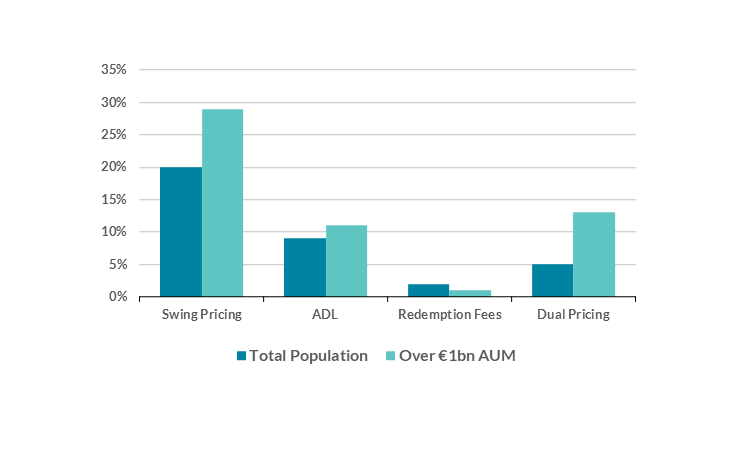
The most widely used LMT was swing pricing, used by 20% of funds, or 74% of funds which had the tool available. The next most commonly used LMT was ADLs, used by 9% of funds overall, or 14% of those which have it available. Use of other LMTs is low across all cohorts, although there is relatively high usage (37%) of dual pricing amongst Liability Driven Investment (LDI) funds, which fall under the ‘other’ asset class.
At the more granular level, the highest levels of P-LMT use are mostly observed across cohorts with greater exposure to less liquid segments of the bond market. Table 3 shows the top five cohorts by P-LMT usage, which includes Swing Pricing, ADLs, Redemption Fees and Dual Pricing. Four of the five listed are bond cohorts, with LDI funds also appearing, due to the heavy use of dual pricing in this cohort. Outside of the top five, Emerging and mixed region equity funds also have significant usage of P-LMTs at >40% of funds.
Table 3: Top 5 Cohorts – P-LMT Usage
| Cohort | Asset Class | Number of Funds in cohort | P-LMT Use amongst cohort (%) |
|---|
| IG Corporate | Bond | 193 | 57% |
| LDI | Other | 330 | 56% |
| High Yield | Bond | 157 | 49% |
| Government | Bond | 240 | 50% |
| Aggregate Bond Fund | Bond | 96 | 64% |
Source: Compiled from Central Bank of Ireland survey of FMCs. A small number of LDI funds are classified as ‘mixed’ or ‘bond’ funds and are included in this table.
Factors Affecting P-LMT Use
There are a couple of notable factors which appear to affect the level of use of P-LMTs by investment funds. First, P-LMTs are predominantly used by funds which offer daily dealing to investors whereby investors can buy or sell fund units on any business day. 72% of funds in the survey sample offer daily dealing to investors, and the large majority of P-LMT usage (c.89%) is amongst this population. Respondents were also asked for an estimate of the time it would take to redeem all units and liquidate all assets; this was then compared to their use of P-LMTs. Funds which have asset liquidation timelines similar to redemption periods used P-LMTs at an average rate. Those reporting a slight liquidity mismatch used these tools more frequently. Interestingly, funds with the largest gap between liquidation and redemption (the highest level of liquidity transformation) were the least likely to use them. This suggests that P-LMTs are viewed as most effective by funds that have a small to medium level of liquidity mismatch. Q-LMTs may be considered more appropriate for funds with higher levels of liquidity mismatch.
Second, the survey also suggests that P-LMT usage is greater at larger funds. Looking at larger funds, specifically those surveyed funds with AUM in excess of €1bn, P-LMT usage rates are higher than across the overall sample. As seen in Figure 1 below, 29% of these larger funds used swing pricing over the period, with 11% using ADLs (compared to 20% and 9% in the overall population). Dual pricing was used by 12% of these funds (compared to 5% of the overall population), due to the comparatively large size of LDI funds.
Larger funds are more likely to use a P-LMT
Figure 1: P-LMT usage in total population and funds with over €1bn in AUM
Source: Central Bank of Ireland survey of Irish Domiciled Investment Funds
Accessibility: Get the data in accessible format. (CSV 18.94KB)
Previous research by Dunne et al. (2023) has found that the size and complexity of fund families (rather than the fund size itself) is a major determinant of the availability of more tools. These larger fund families will typically also have larger funds within them, and therefore the above findings are consistent with this earlier research. Beyond this size factor, there appears to be a lack of consistency in the availability, selection and use of P-LMTs, with the main determining factor behind the use of specific tools appearing to be a desire for standardisation across all managed funds within a management company as opposed to asset class-specific factors. Management companies with funds across multiple asset classes and cohorts often use only swing pricing or ADLs at the management company level, with only a small number of management companies using both across different funds.
P-LMT Use During Stress Periods
A subset of 909 funds which indicated that they had applied swing pricing or an ADL at least twice during 2022-2023 were asked in a follow up survey to provide additional detail on their usage of these LMTs, including during stress periods.
The frequency of swing pricing use does increase markedly during stressed periods, while the increase in ADL use is less pronounced. A comparative metric of average use per fund per trading day (for all daily dealing funds in the sample) was calculated to better illustrate the differences in frequency of use. Table 4 shows that Partial Swing Pricing has significantly higher usage during times of market turmoil, being used almost two and a half times as often in stressed markets (a 149% increase) than across the overall period. ADL use across all asset classes in comparison is relatively stable with the stress periods showing average frequencies between 99% and 52% of overall.
Table 4: ADL and Swing Pricing Usage Average Daily Use – Stress and Non-Stressed Conditions
| Timeframe | ADL | Compared to Full Survey Period | Partial Swing Pricing | Compared to Full Survey Period |
|---|
| Full Survey Period (across all asset classes) | 0.199 | – | 0.047 | – |
| Bond | 0.076 | – | 0.039 | – |
| Equity | 0.296 | – | 0.041 | – |
| Mixed | 0.064 | – | 0.097 | – |
| |
| Invasion of Ukraine by Russia (across all asset classes) | 0.226 | +14% | 0.122 | +160% |
| Bond | 0.212 | +179% | 0.073 | +87% |
| Equity | 0.28 | –5% | 0.124 | +202% |
| Mixed | 0.051 | –20% | 0.307 | +216% |
| |
| UK Gilt Crisis (across all asset classes) | 0.303 | +52% | 0.121 | +157% |
| Bond | 0.229 | +201% | 0.081 | +108% |
| Equity | 0.411 | +39% | 0.105 | +156% |
| Mixed | 0.092 | +44% | 0.29 | +199% |
| |
| Banking Turmoil (across all asset classes) | 0.198 | –1% | 0.106 | +126% |
| Bond | 0.062 | –18% | 0.079 | +103% |
| Equity | 0.298 | +1% | 0.097 | +137% |
| Mixed | 0.062 | –3% | 0.263 | +171% |
| |
| All Stressed Market Events (across all asset classes) | 0.243 | +22% | 0.117 | +149% |
| Bond | 0.169 | +122% | 0.078 | +100% |
| Equity | 0.332 | +12% | 0.108 | +163% |
| Mixed | 0.069 | +8% | 0.287 | +196% |
Source: Compiled from Central Bank of Ireland survey of FMCs
Calibration of P-LMTs
When using P-LMTs, the objective is for fund managers to estimate (on a best-efforts basis) the actual cost of enacting a trade, and to attribute these costs to the investors who triggered the trades, rather than those that remain in the fund. P-LMTs should include both the implicit and explicit costs of transactions associated with adjusting the portfolio of the fund. Swing Pricing and ADLs appear to be the tools which are best suited to achieving this objective. Information on which explicit and implicit costs were included in the estimation of the ADL or swing factor and their weighting in the calculation (out of a possible 100%) was provided by funds included in the second phase of data collection. Explicit costs are direct tangible expenses associated with specific transactions, for instance broker commissions, fiscal charges or custody fees. Implicit costs are the market costs associated with a specific transaction. They include costs associated with bid/ask spreads and market impact estimates, and unlike explicit costs these can often be non-linear in nature and can change based on market conditions.
Market impact estimates the expected price movement in underlying securities stemming from that fund’s trading activity. Market impact is dependent on several factors which contribute to additional costs, including trade size, the evolution of bid/ask spreads, market depth, current market volatility, the time horizon of the trade and the trading venue.
Bid/Ask Spreads are the most common cost included in calibration of P-LMTs
Figure 2: Inclusion of Implicit and Explicit Costs within calibration of Swing Pricing and ADLs
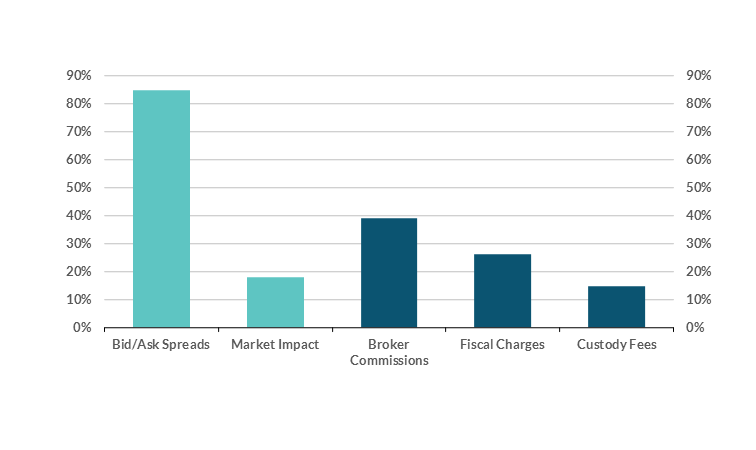
Source: Compiled from Central Bank of Ireland survey of FMCs. Implicit Costs are highlighted in green, with explicit costs in blue
Accessibility: Get the data in accessible format. (CSV 0.84KB)
From the 909 funds which submitted data in the second survey, 48% indicated that they incorporated at least one explicit cost into the calculation of the swing factor or the ADL. As seen in Figure 2, Broker commissions were the most frequent explicit cost noted with 39% of funds indicating that they included these in the calculation. 26% of funds incorporated fiscal charges and 15% including costs related to custody transfers.
Bid/Ask Spreads
Costs associated with market bid/ask spreads are generally incorporated into the swing factor or ADL. As seen in Figure 2, 85% of funds in the sample included bid/ask spreads when calibrating the LMT, including 96% of bond funds and 77% of equity funds. The weighting attributed to bid/ask spreads in the calibration was high, with an average weighting of 76% given to this aspect. At the more granular cohort level, all high yield bond funds in the sample incorporated the bid/ask spread, as did 99% of aggregate funds, 97% of government bond funds, and 89% of corporate bond funds.
Market Impact
The use of a specific market impact estimate within the calibration of swing factors or ADLs is low across the survey sample (16%). This usage is mostly concentrated among daily dealing OEFs which invest in less liquid assets, particularly bond cohorts. Amongst these cohorts, the greatest use is in the aggregate (49%) and high yield (42%) cohorts, suggesting that fund managers in these cohorts, which normally invest in less liquid assets, use market impact as it includes additional market aspects such as market depth and volatility. The weighting assigned to market impact among those funds which did include it in their P-LMT calibration is relatively high, at 31%
Conclusion
The findings from the survey suggest that while P-LMT availability is relatively high among Irish-domiciled funds, use of these tools lags availability considerably. In addition, estimates of market impact are only incorporated by a minority of funds, with bid/ask spreads much more commonly used. The inclusion of a specific market impact estimate was higher in funds which trade in less liquid markets, where the bid/ask spread may not be seen as fully capturing all implicit transaction costs.
Availability and use of P-LMTs are most prevalent among bond funds, particularly in cohorts that are exposed to more volatile assets with less underlying market liquidity, such as high yield bond funds. There appears to be a lack of consistency in the application of P-LMTs, with the main determining factor behind the choice and use of specific tools appearing to be a desire for standardisation across all managed funds within a management company as opposed to asset class-specific factors. This may be driven by systems constraints, perceived operational efficiency or a desire for governance simplicity.
The Central Bank continues to support the FSB/IOSCO work, which aims to result in increased availability, use, and consistency of use of P-LMTs in both normal and stressed conditions, and the incorporation of explicit and implicit transaction costs. Successful adoption and implementation of the revised AIFMD and UCITS Directives will be a positive step in this direction, in particular helping to facilitate the harmonisation and full availability of the LMTs defined in the Directives across all Member States. To help facilitate the incorporation of implicit costs into the calibration of P-LMTs, the Central Bank has published a ‘good practices’ document on this aspect. Going forward, the Central Bank will continue to monitor the availability and use of these tools and encourage greater and more consistent use of these tools as part of day-to-day liquidity management. Consistency in the application of these tools will also be monitored as part of our ongoing supervision of the sector, including with respect to the incorporation of implicit costs.
References
Baudino, P.A., Metzler, J., Storz, M. and Wagner, F. (2025) ‘The role of household investors in market downturns’, ECB Financial Stability Review, November 2025.
Dunne, P. G., Emter, L., Fecht, F., Giuliana, R. and Peia, O. (2023), ‘Financial fragility in open-ended mutual funds: the role of liquidity management tools’, ESRB Working Paper Series.
Endnotes