Key Insights
We find that loans to borrowers in current flood risk areas (around 7 per cent of our sample) face an interest rate premium of roughly 7 to 13 basis points (which corresponds to a 3 per cent increase over the average interest rate charged in the sample) and are between 3 and 7 percentage points more likely to provide collateral.
This Insight suggests that additional flood risk which will result from climate change is partially factored in by lenders. Some borrowers in areas where flood risk is predicted to increase face significantly larger interest rates.
While the results suggest that lenders price in this important source of climate risk to some extent, and highlight some additional difficulty in obtaining credit for these borrowers, we find that the size of the flood risk premium is relatively small.
Introduction
What is climate risk and why is it a financial stability concern?
Climate change is a key global challenge for countries, irrespective of geographic location or wealth (Intergovernmental Panel on Climate Change, 2023). The resulting climate risk (which affects households, firms and financial institutions) encompasses both physical and transition risk. The former is the direct damage resulting from a climatic event (such as flooding, wildfires and storms), while the latter is the cost associated with policy actions taken to decarbonise the economy (Central Bank of Ireland, 2023 (PDF 2.46MB)). In our newly published research (Carroll et al. (2025)) we focus on the intersection of physical risk and firm lending conditions in Ireland – specifically, the impact of flood risk on the interest rate and collateral conditions of bank loans to firms (here flood risk corresponds to the 0.1% Annual Exceedance Probability or a 1 in 1,000 odds of occurrence in a given year). This Insight summarises our main findings, with further details on our contribution to the literature, data, and methodology available in Carroll et al. (2025).
This is a key emerging financial stability question from both the perspective of the bank and the firm. Stranded assets, repair or replacement costs, loss of stock, decrease in property value, and loss of business following a flood event all impact on a firm’s ability to operate, its profit and loss account, and balance sheet position. These damages could, if severe enough, increase the probability of default and loss given default of borrowers. Considering this, banks may require tighter lending conditions from firms in flood prone areas reflecting a higher risk of insolvency. This is of the utmost importance for policymakers in the Irish context, in light of Murphy et al. (2018), Clarke and Murphy (2019), and Domonkos et al. (2020) who highlight worsening rain-related weather trends, with long-run rainfall levels on an upward trajectory, and winter and spring witnessing heavier rainfalls.
Our Contribution
The main objective of this Insight is to examine whether flood risk results in more stringent collateral requirements and/or higher interest rates, as well as quantifying the magnitude of this flood risk premium. Our key contribution is the matching of precise, granular data to capture this risk with loan-level information. By matching the exact borrower location with accurate flood maps, we can identify borrowers at risk and generate variation in the flood risk in our sample even within counties. This allows us to disentangle flood risk from other local factors which might affect firms' credit access. This contrasts with existing studies which relies instead on climate risk dimensions that are defined at broader administrative areas.
Additionally, we utilise climate change projections to study whether the expected deterioration of climate conditions (and the resulting expansion of the flood risk areas) is considered by lenders.
Matching flood risk to borrowers
Measuring Borrower Flood Risk
Flood risk is sourced from the Office of Public Works (OPW), which provides a series of maps capturing the current risk of flooding across Ireland. Flood risk refers to the predicted likelihood of a given area to be flooded during a theoretical event – this is not based on past realised flood events. In this Insight to derive a comprehensive current flood risk measure we combine coastal and fluvial flooding events (which are modelled separately by the OPW).
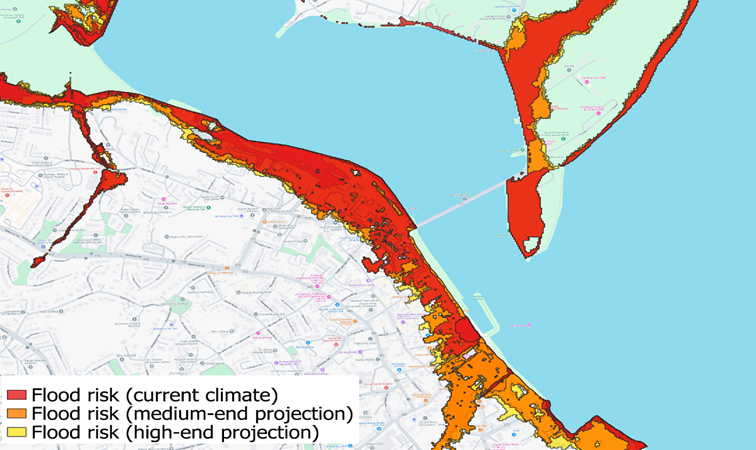
As well as providing current flood risk, the OPW flood maps are also available under two additional scenarios – the mid-range and high-end future scenarios. These are based on more extreme changes in climate patterns, resulting in larger areas at risk of flooding events. Accordingly, areas currently at risk of flooding are a subset of the territory predicted to be prone to flooding in the mid-range future scenario. This in turn is a subset of the high-range future scenario. For example, Figure 1 shows the increase in the flood risk area in the medium and high-end future scenarios over the current for Wexford town.
Areas which are currently at risk are a subset of those at risk under the climate change scenarios
Figure 1: Combined flood risk in Wexford town
Source: Office of Public Works (OPW).
Note: Locations in flood risk areas are red, orange and yellow given current, medium-end and high-end climate conditions.
Borrower loan-level information
Loan-level data is taken from the Analytical Credit Dataset (AnaCredit). This is a granular credit dataset collected by EU members' central banks since September 2018. This Insight uses Irish data from the June 2022 reference period, which includes information on all the existing loans and credit contracts from Irish resident credit institutions.
For each credit contract, the issuers indicate some basic characteristics, such as the total original amount, the current amount outstanding, the interest rate and type, repayment frequency, loan start and maturity dates, and whether the loan was collateralised. Borrower characteristics are also provided, including firm size, industry, and address. The last is particularly relevant to our purposes as it allows us to determine the exact location of the borrower.
Identifying the exact borrower location
The Eircode Address Database (ECAD) includes the exact coordinates for over 2.2 million addresses in Ireland. Each address and coordinates pair is uniquely identified by a 7-digit alphanumeric code (Eircode). This database allows us to convert the addresses from AnaCredit into coordinates, which are mapped directly to the OPW flood maps allowing us to generate a borrower level flood risk variable.
The geolocated borrower dataset
The original loan-level dataset contains information on over 200,000 separate credit contracts representing loans not yet repaid as of June 2022, and after cleaning and matching we are left with around 41,000 in our final sample. This is because we focus on loans where we can obtain a precise set of coordinates and on three credit contract types: loans, non-revolving credit and financial leases. We choose these categories since credit conditions can be easily observed and captured by interest rates and collateral requirements. Crucially, Carroll et al. (2025) shows that the matched and unmatched observations are comparable in terms of their observable characteristics and that the cross-county distribution of loans matches closely the distribution of companies operating in Ireland.
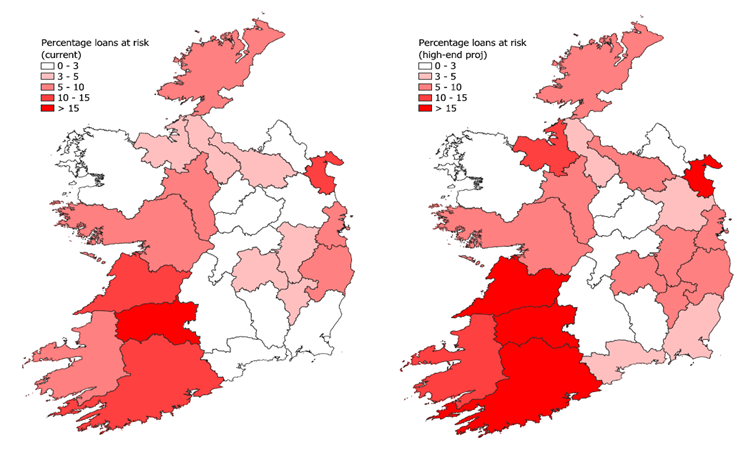
Overall, 6.8 per cent of borrowers in our final sample are in areas currently presenting some flood risk. When considering the mid-range and high-end climate change projections, the share increases to 8.9 and 9.7 per cent (respectively). As shown in Figure 2, flood risk is not homogeneous across counties – with the southwest seeing the highest exposure. In Limerick, over 20 per cent of the existing loans are in areas currently considered in at least some risk, followed by Cork, Clare and Louth where the percentage exceeds 10 per cent. In contrast, in midland counties like Offaly, Westmeath and Tipperary the figures are very small (around 1 per cent). According to the OPW projection, climate change could lead to a drastic increase in these figures, especially in counties along the West coast as well as in counties Dublin and Louth.
Flood risk is not homogeneous across counties
Figure 2: Share of loans at risk by county (current and high-end climate change projection)
Source: Office of Public Works (OPW) and AnaCredit.
Note: Map on the left refers to current climate conditions, while the map on the right refers to high-end climate change conditions.
Accessibility: Get the data in accessible format. (CSV 0.84KB)
In our final sample, most of the loans are relatively recent. The loan size distribution appears to be strongly skewed to the right, with a prevalence of relatively small loans (median ≈€40,000 and bottom quartile of ≈€20,000) and a small number of bigger contracts resulting in an average of ≈€400,000. This is in line with the vast majority (about 80 per cent) of the loans being granted to micro- or small-sized borrowers. Contracts are relatively homogeneous in terms of the duration, whose average is just less than six years and the median just below five years. Most of the contracts in the sample have an expected duration of between three and six years. While most of the contracts are characterised by monthly payments, nearly 20 per cent of the loans in the sample present less frequent repayments. There is a nearly even split between contracts with fixed (55 per cent) and non-fixed (45 per cent) interest rates. Finally, there is some variation in the credit conditions faced by Irish firms. This can be seen in the interest rate variance (where the coefficient of variation is around 0.36) and the mixed requirements in terms of collateral (with only 40 per cent of loans in the final sample providing at least one collateral item). The aim of this Insight is to examine the extent to which this can be linked with heterogeneity in flood risk of borrowers in our sample.
Is there a link between flood risk and firm credit conditions?
Model setup
We conduct a controlled empirical model to examine the relationship between flood risk and the variation in interest rates and collateral. In our suite of models, current flood risk is a binary variable taking one if the firm is in an area subject to flood risk under the current climate conditions (and zero otherwise). We isolate the impact of this flood risk measure by accounting for other factors which might affect credit conditions faced by companies. These factors include loan, firm, and local economy characteristics to control for systematic differences in borrowing costs across different credit forms, firm types, and local economic characteristics. In addition, we also control for unobserved differences across banks and industries.
Current climate conditions
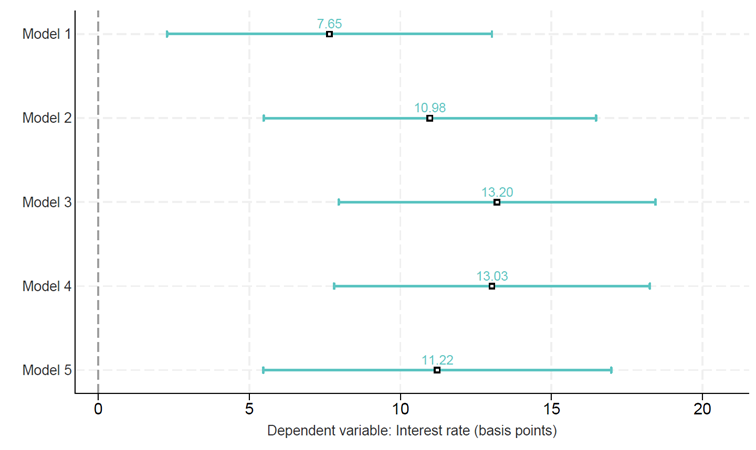
Borrowers located in areas at risk face higher interest rates, even when controlling for differences in contracts characteristics and the borrower’s size (Figure 3). Regardless of the fixed effects included, the point estimates for the current flood risk coefficient are always positive and statistically significant. Crucially, the estimates are very similar where county fixed effects are included (see specifications two to five in Figure 3), and the relationship is identified by variation in the exposure to flood risk across borrowers located in the same county.
The magnitude of the flood risk coefficient varies from 7 to 13 basis points. These findings are very similar to the estimates for other EU countries from Barbaglia et al. (2023), which argues that this premium does not fully reflect the increased credit risk following a flooding event. While the estimates are statistically significant, it is worth considering their magnitude in economic terms. The highest point estimate indicates a 13-basis point premium which is roughly a 3 per cent increase over the average interest rate charged in the sample.
Borrowers located in areas at risk face higher interest rates
Figure 3: Impact of flood risk on interest rates
Source: Authors’ computation based on OPW and AnaCredit.
Note: Square symbols are the flood risk coefficients, horizontal lines are the corresponding 95 per cent confidence intervals. Vertical axis shows different model specifications. Model 1 includes year and loan type fixed effects, Model 2 county fixed effects, Model 3 bank fixed effects, Model 4 industry fixed effects, and Model 5 year x county fixed effects. See Carroll et al. (2025) for further details.
Accessibility: Get the data in accessible format. (CSV 1.59KB)
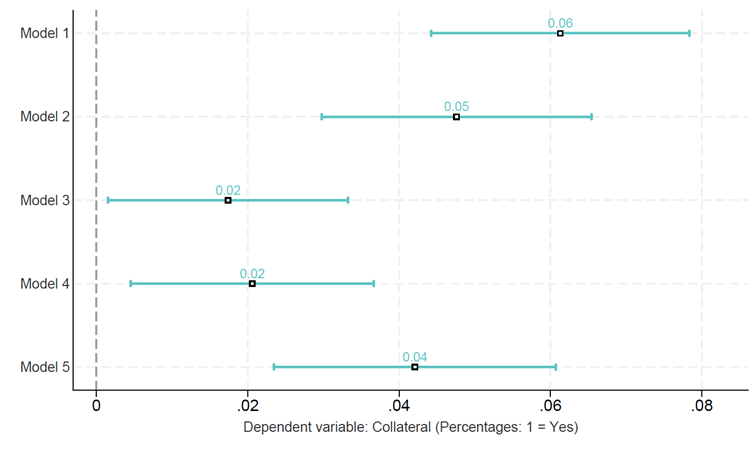
Borrowers in current flood risk areas are between 2 and 6 percentage points (or 4 to 15 per cent) more likely to be providing a collateral (Figure 4). Since most collateral is physical, this seems to indicate that lenders accept such collateral to reduce their exposure to flood risk and that borrowers unable to provide them might be denied access to credit to a larger extent where they face some risk of flooding.
Borrowers in current flood risk areas are more likely to provide collateral
Figure 4: Impact of flood risk on collateral
Source: Authors’ computation based on OPW and AnaCredit.
Note: Square symbols are the flood risk coefficients, horizontal lines are the corresponding 95 per cent confidence intervals. Vertical axis shows different model specifications. Model 1 includes year and loan type fixed effects, Model 2 county fixed effects, Model 3 bank fixed effects, Model 4 industry fixed effects, and Model 5 year x county fixed effects. See Carroll et al. (2025) for further details.
Accessibility: Get the data in accessible format. (CSV 3.48KB)
Future climate conditions
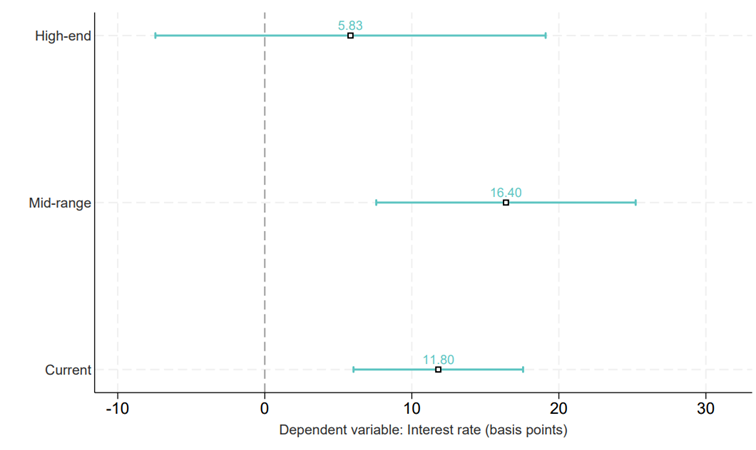
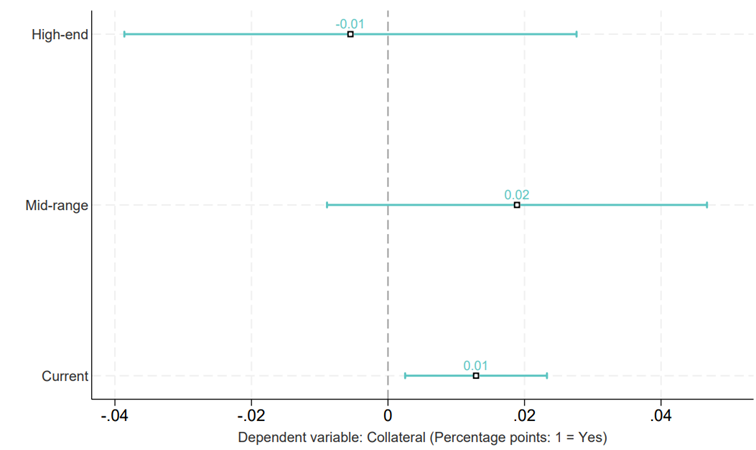
We now look at the impact of future climate scenarios on credit risk. As a comparison, we continue to use our current flood risk measure for the 2,782 (6.8 per cent) observations which are at risk under current conditions. The first scenario (medium-range) applies only to the additional 939 observations (2.3 per cent) which are at risk in the mid-range climate change projection. The second scenario (high-end) applies to the 510 observations (1.31 per cent) which are only at risk in the high-end climate change projection. Since the three categories (current, medium, high-end) are mutually exclusive, each coefficient should be interpreted as the difference compared to the baseline (no risk) group.
Thus, rather than cumulative effects, the coefficients should be interpreted as the observed average differences between borrowers that will become subject to flood risk due to climate change compared to those who will not face any risk even when climate change is accounted for. An insignificant point estimate for the high-end and/or medium-range scenarios would indicate that we are unable to identify any significant difference between borrowers that will be at risk in future and those who are never at risk (i.e. no evidence banks are pricing in projected future climate change).
We would expect the coefficients to be higher for current risk and progressively lower for the mid- and high-projection climate change scenarios, as lenders might fail to price in more extreme projections of climate change or impose lower premia to risk projections rather than current climate conditions. Overall, we find some evidence that banks account for the effects of climate change on flood risk – primarily for interest rates in the mid-range projection.
First, in Figure 5 the coefficients for the borrowers at risk in the mid-range scenario provide some evidence that banks are pricing in the impact of climate change projections on flood risk in current loans, as in the case of interest rates the point estimates are positive and statistically significant. Second, in Figure 6 while the medium-range is also positive (indicating higher likelihood of collateral requirements for borrowers that are at risk in the mid-end projection), it is not statistically significant. In fact, Carroll et al. (2025) show that for collateral, the coefficients are not precisely estimated and are not statistically different from zero in most specifications. Furthermore, the effect is only positive and statistically significant across all specifications where the current flood risk is considered. This is in line with our benchmark findings.
Some evidence that banks are pricing in the impact of climate change on flood risk in current loans
Figure 5: Impact of flood risk on interest rates – changes in future climate conditions
Source: Authors’ computation based on OPW and AnaCredit.
Note: Square symbols are the flood risk coefficients, horizontal lines are the corresponding 95 per cent confidence intervals. Specification depicted includes year x county fixed effects. See Carroll et al. (2025) for details on other specifications.
Accessibility: Get the data in accessible format. (CSV 0.55KB)
Finally, Carroll et al. (2025) show the high-end is not statistically significant in either case once bank, county and industry fixed effects are accounted for. This indicates that, currently, credit conditions for borrowers that will be at risk only in the most extreme climate change scenario are not different to borrowers facing no flood risk.
Higher likelihood of collateral requirements for borrowers that are at risk in the mid-end projection
Figure 6: Impact of flood risk on collateral – changes in future climate conditions
Source: Authors’ computation based on OPW and AnaCredit.
Note: Square symbols are the flood risk coefficients, horizontal lines are the corresponding 95 per cent confidence intervals. Specification depicted includes year x county fixed effects. See Carroll et al. (2025) for details on other specifications.
Accessibility: Get the data in accessible format. (CSV 0.53KB)
While these results cannot be interpreted as causal, they provide some suggestive evidence of an empirical link between credit conditions obtained and borrowers' current flood risk. A similar interest rate premium seems to be observed also when looking at borrowers who are considered not at risk under current climate condition but will be according to a mid-range scenario modelling the impact of climate change on the likelihood of flood risks in Ireland, indicating that lenders seem to be at least partially pricing in the expected deterioration in the environmental conditions. The corresponding coefficients for the collateral specification are also positive yet not statistically significant.
Conclusion
We combine firm loan-level data with detailed maps describing the risk of flooding under different assumptions and projections to examine whether this source of risk affects bank lending conditions. Since we can derive exact firm locations of the firms we are able to control for locally determined factors affecting credit conditions and exploit differences in flood risk within the same county.
We find that, among existing loans, around 7 per cent are undertaken by borrowers located in areas at risk of flooding, and that this figure is predicted to increase significantly due to the expected patterns of climate change. Although we are unable to make causal claims, our results suggest that firms located in current flood risk areas face steeper costs in accessing credit both in terms of interest rate premium (quantifiable in 7 to 13 basis points) and of collateral requirements (4 to 16 per cent more likely to be asked to provide a collateral). Since we only observe existing credit contracts, we can only measure the differences across borrowers who obtained a loan, and we cannot exclude that the actual impact is more significant as some might be completely unable to access credit.
We provide some evidence that the additional risks arising from climate change are to some extent already factored in by lenders. Borrowers located in areas predicted to become susceptible to flood risk due to worsening environmental conditions face, conditional on other observable characteristics, statistically significantly larger interest rates. While this indicates that Irish lenders are to some extent pricing in this source of risk, this might prove to be detrimental for borrowers located in such areas and the issue is expected to worsen in the coming years.
References
Barbaglia, L., Fatica, S. and Rho, C. (2023). Flooded credit markets: physical climate risk and small business lending. European Commission, 2023, JRC136274.
Carroll, J., Mahony, M., Morando, B., O’Sullivan, C., and Ahangarkole, S.S. (2025). Firm credit conditions and flood risk: Evidence from Ireland. The Economic and Social Review, 56(4), pp.449-483.
Central Bank of Ireland (2023). Central bank of Ireland climate observatory.
Clarke, D. and Murphy, C. (2019). Challenges of transformative climate change adaptation: Insight from flood risk management.
Domonkos, P., Coll, J., Guijarro, J., Curley, M., Rustemeier, E., Aguilar, E., Walsh, S., and Sweeney, J. (2020). Precipitation trends in the island of Ireland using a dense, homogenized, observational dataset. International Journal of Climatology, 40(15), pp.6458–6472.
Intergovernmental Panel on Climate Change (2023). Climate Change 2023: Synthesis Report. Contribution of Working Groups I, II and III to the Sixth Assessment Report of the Intergovernmental Panel on Climate Change. Intergovernmental Panel on Climate Change (IPCC), Geneva, Switzerland.
Murphy, C., Broderick, C., Burt, T. P., Curley, M., Duffy, C., Hall, J., Harrigan, S., Matthews, T. K., Macdonald, N., and McCarthy, G. (2018). A 305-year continuous monthly rainfall series for the island of Ireland (1711–2016). Climate of the Past, 14(3), pp.413–440.
Endnotes