Key Insights
Multinational enterprises respond to more stringent climate policymaking by redirecting some of their manufacturing foreign direct investment (FDI). This reallocation is more pronounced in countries hosting affiliates in the most carbon-intensive segments of manufacturing.
We study the transmission of an unexpected tightening in climate policy and find that multinationals expand affiliate assets in emerging markets, which are characterised by less stringent climate policies. These adjustments persist for up to four years.
Pharmaceutical multinationals represent a notable exception to this pattern. Potentially owing to the large fixed costs and highly specialised production processes that characterise the sector, these firms do not meaningfully reallocate FDI in response to shifts in climate policy.
In line with this finding, foreign-owned subsidiaries in Ireland do not exhibit a significant contraction in assets or employment when their parent companies abroad face higher climate policy costs.
Introduction
The relevance of climate policymaking for foreign direct investment and trade
International capital flows and trade have long been identified as a key driver of aggregate output growth. The Irish experience offers one of the clearest illustrations of how trade and foreign direct investment contributed to economic convergence with other advanced economies (Honohan and Walsh, 2002). Understanding what drives firms’ decisions to engage in international economic activity is therefore a question of considerable policy relevance, and one that has attracted a substantial body of research.
While explicit trade policies such as bilateral tariffs have featured prominently in recent debates (see Lukmanova and O’Grady, 2024; Central Bank of Ireland, 2025, for an analysis in the Irish setting), comparatively less is known about how non-trade policies shape FDI and global value chains (GVCs). The design and enforcement of environmental regulation, and climate policy in particular, represents one such area where the interaction with firms’ international investment decisions remains poorly understood. As the physical risks of climate change have intensified and the costs of delayed adaptation have risen, governments have responded with increasingly stringent climate policies, albeit unevenly across jurisdictions. Given that tighter climate policies can increase the cost of doing business considerably, particularly in sectors with high emissions, there is the potential that multinationals could reorganise their global operations to minimise the costs associated with tighter climate policy.
The economic consequences of this reorganisation might be substantial. Early evidence from the academic literature suggests that multinationals engaged in carbon intensive production might already be adjusting their operations in response to climate policy costs, directing FDI towards jurisdictions with more favourable policy regimes and importing goods from producers located in countries not subject to carbon taxation. Understanding whether and to what degree this is occurring matters not only for the effectiveness of climate policy but also for the economies, like Ireland, that host significant concentrations of multinational activity. This intersection between international economic activity and climate policymaking is also high on the agenda of EU policymakers. From January 2026, the EU Carbon Border Adjustment Mechanism (CBAM) became operational. This policy requires EU firms importing more than 50 tonnes of selected intermediate goods to surrender quantity based permits priced in line with ETS allowances. The policy’s explicit aim is to curtail carbon leakage by ensuring that European firms cannot avoid policy costs by sourcing goods from jurisdictions without equivalent carbon pricing.
In this Staff Insight, we contribute to this debate by examining the extent to which manufacturing multinationals incorporate climate policies into their decisions on where to operate production. In doing so, we provide quantitative evidence on whether carbon leakage is occurring and characterise the dynamics of firms’ FDI adjustments. The insight presents the main findings from the forthcoming linked paper (Carbone, Beck, and Hale, 2026), while also offering novel analysis of the sensitivity of inward FDI in Ireland to climate policy developments.
Data on the Geography of Multinationals and Climate Policies
Mapping FDI and climate policies
The main part of our analysis takes a global perspective, analysing FDI stocks of multinational enterprises and their manufacturing affiliates. We compile a sample of 2653 large multinational headquarters (with total assets ≥ 1 billion USD) located in 65 jurisdictions. For these multinationals, we map 133 thousand affiliates across 131 jurisdictions. We retain only affiliates where we can identify the HQ as the global ultimate owner. We study both the extensive and intensive margin of FDI by investigating multinational enterprises' (MNE) adjustments on the number of subsidiaries they operate in different countries as well as their size in terms of total assets and employment.
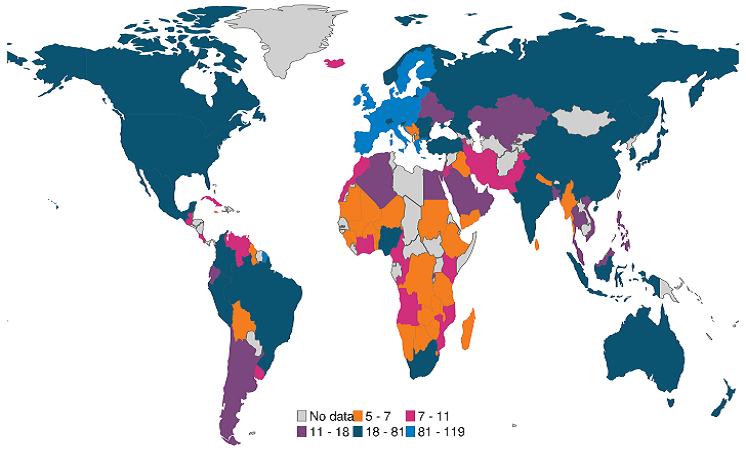
We employ two country level metrics to gauge climate policy tightness. The first draws on the International Energy Agency's (IEA) repository of climate legislation, which spans policies binding at the regional, national, and international level. We construct yearly policy counts at the country level, where higher counts indicate greater ambition in climate policymaking. The second measure is the OECD environmental policy stringency index (Kruse et al., 2022), available for 40 countries and interpretable in the same direction as the IEA counts. Figure 1 shows the cross-country distribution of IEA policy counts by yearly quintile.
From a comparative perspective, Ireland ranks among the most climate ambitious jurisdictions globally, sitting in line with the average of EU policy tightness. In addition to full participation in the EU ETS, Ireland introduced a national carbon tax in 2010 on fossil fuel consumption, which stood at €64 per tonne of CO2 equivalent in 2025 and covered approximately 34% of the country’s total emissions (World Bank, 2026).
Figure 1: Cross-country variation in relative stringency of environmental policies (IEA policy counts).
Source: IEA and authors’ calculations.
Notes: Countries are shaded by their count of IEA climate policies, with buckets computed for 2019. Orange indicates countries in the left tail of the IEA count distribution, with higher values moving the colouring to light blue. Countries in gray are those for which no data is not available.
Accessibility: Get the data in accessible format. (CSV 1.41KB)
Irish Inward FDI from Micro Data and its Carbon Intensity
FDI in Ireland is not concentrated in the most carbon intensive sectors
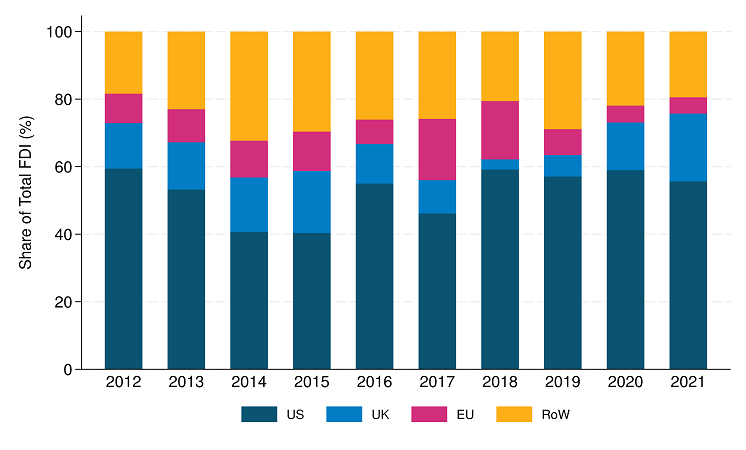
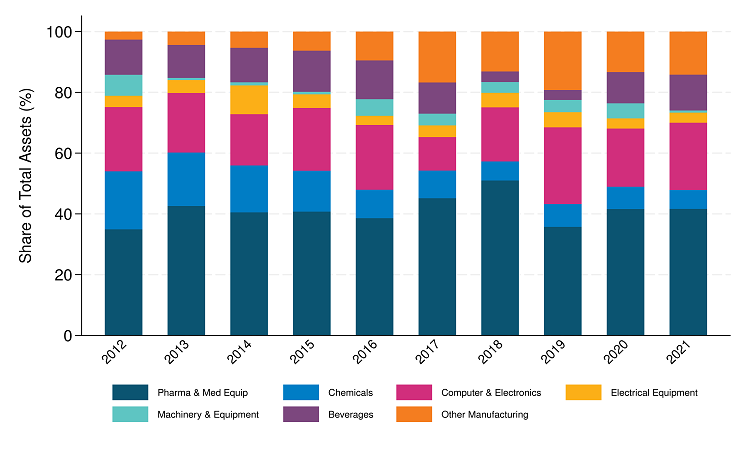
In line with Central Bank of Ireland (2025), our data on large multinationals confirms the important role of US firms in inward FDI in Ireland. Figure 2 displays the share of manufacturing subsidiaries in Ireland held by multinationals headquartered in different geographies. The differences compared to aggregate statistics come from the sample of firms we use in our analysis. When looking at the sectoral decomposition of the FDI stocks, we also observe a major role being played by multinationals active in the pharmaceutical sector and in manufacturing of computer and electronic equipment. In addition to dominating total FDI, these sectors accounted for 70% of total manufacturing employment in Ireland in 2022 and for approximately 57% of total goods’ exports in the same year.
Figure 2: Share of total assets of Irish manufacturing subsidiaries by country of ownership.
Source: Orbis and authors’ calculations.
Notes: The charts displays the share of total assets for the Irish subsidiaries in our dataset held by multinationals headquartered in a given jurisdiction. Redomiciled multinationals are excluded from the computation.
Accessibility: Get the data in accessible format. (CSV 0.77KB)
Figure 3: Share of total assets of Irish manufacturing subsidiaries by NACE 2 sub-sector.
Source: Orbis and authors’ calculations.
Notes: The charts displays the share of total assets for the Irish subsidiaries in our dataset belonging to different NACE2 sector codes. Pharmaceuticals include also manufacturing of medical equipment. Redomiciled multinationals are excluded from the computation.
Accessibility: Get the data in accessible format. (CSV 0.85KB)
Having established that the dataset captures the broad composition of FDI in Ireland, we turn to describing the carbon intensity of the industries in which the MNEs operate. The ideal setting to investigate responses of these firms to changes in climate policymaking, both within Ireland and across their global value chain, would be to precisely quantify the share of the consolidated emissions stemming from Irish affiliates. The more carbon intensive manufacturing in Ireland is in relative terms, the higher the incentive for MNEs to either decarbonize their technology or shrink production in Ireland in order to minimize policy costs.
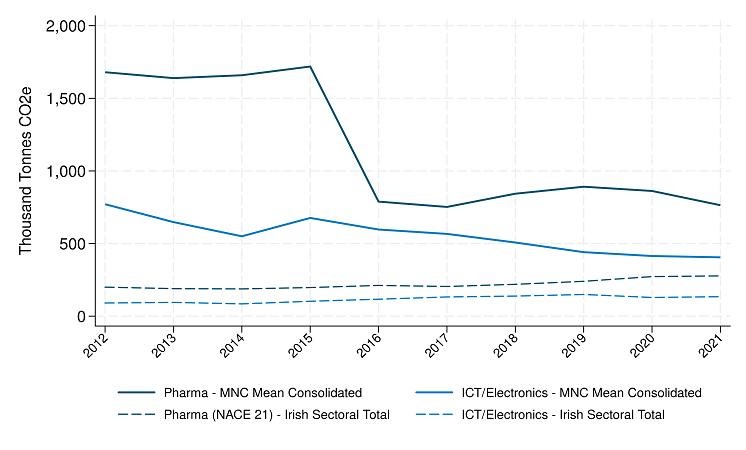
Since firm-level emissions data for individual Irish affiliates are unavailable, we draw on CSO Environmental Accounts to characterise sectoral green-house gasses (GHG) emissions in the two manufacturing sectors with the highest FDI intensity and benchmark them against the consolidated emissions reported at the headquarter level by multinationals with affiliates in those sectors. Figure 4 plots the time-series of total sectoral GHG emissions alongside the average consolidated emissions of the MNEs active in Ireland in each sector over the period 2012–2021. Consolidated figures exceed aggregate sectoral emissions by a substantial margin throughout the sample period, indicating that Irish operations account for only a small share of these firms’ global carbon footprint. Marginal changes in the Irish or EU carbon tax regime are therefore unlikely to represent a material cost increase for the multinationals driving Ireland’s inward FDI.
Figure 4: Aggregate sectoral emissions in Ireland relative to average consolidated emissions of MNEs operating in the country.
Source: CSO, Urgentem and authors’ calculations.
Notes: The figure displays total greenhouse gas emissions (thousands of tonnes of CO2 equivalent) for firms in Ireland active in manufacturing of pharmaceuticals and computer equipment, alongside the average consolidated emissions of multinationals active in those sectors. Dashed lines report the total GHG emissions of all firms operating in each NACE 2-digit sector in Ireland. Solid lines report the average consolidated Scope 1 and 2 GHG emissions across multinational enterprises active in Ireland within the corresponding NACE sector in a given year.
Accessibility: Get the data in accessible format. (CSV 0.48KB)
Globally, do tighter climate policies move manufacturing FDI?
Multinationals are internalising the lack of global coordination in climate policymaking
The results in this section are drawn from Carbone, Beck, and Hale (2026). We begin by estimating how multinationals adjust their FDI in response to climate policy changes in the countries where they operate, measuring FDI as each firm’s share of subsidiaries, total assets, and employment held in a given country relative to its global portfolio. A key additional question is whether the response differs for multinationals with a meaningful presence in carbon intensive industries. To examine this, we separately identify firms that operate in the most carbon intensive manufacturing sub-sectors and test whether their FDI responds differently to climate policy tightening.
We find a consistent negative effect for FDI in countries with more ambitious climate policies. The effects are stronger and statistically different in countries where multinationals hold affiliates from the most polluting manufacturing sectors. However, in line with the literature documenting stickiness in GVC links, our point estimates indicate modest yearly re-allocations. An average yearly change in policy tightness, corresponding to two additional climate policies being enacted, leads to a decrease of 0.06% in the share of FDI held in the target country experiencing that policy tightening.
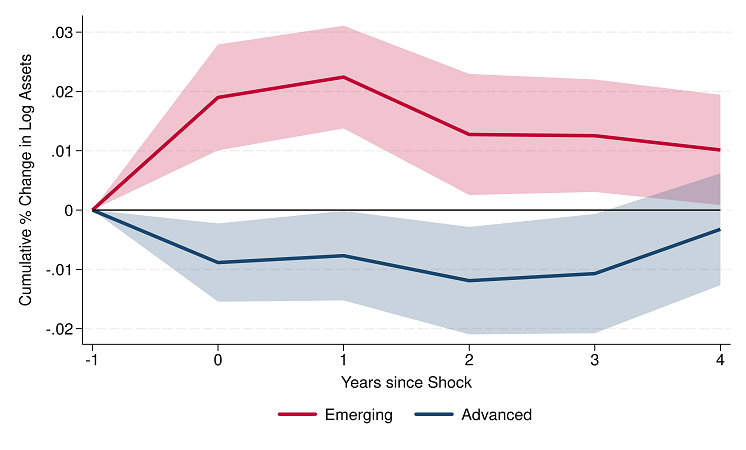
Having documented that multinationals make small but significant yearly adjustments to their FDI in response to climate policy tightening, we turn to how firms’ exposure to countries with different climate policy regimes affects their FDI over time. Figure 5 plots the cumulative response of subsidiary assets and employment to a one unit policy shock, broken down by the geographic location of the affiliate. In line with the results in the literature on carbon leakage, it appears that MNEs increase the size of the affiliates in emerging markets, countries with typically more lenient climate policies. The effects are highly persistent, being found up to 4 years after the climate policy shock. In advanced economies, we observe a more gradual decrease in both assets and employment.
Figure 5: Dynamic responses of affiliate assets and employment to environmental shocks in their holding companies’ GVC (global sample) – heterogeneity across location of affiliate.
Accessibility: Get the data in accessible format. (CSV 0.56KB)
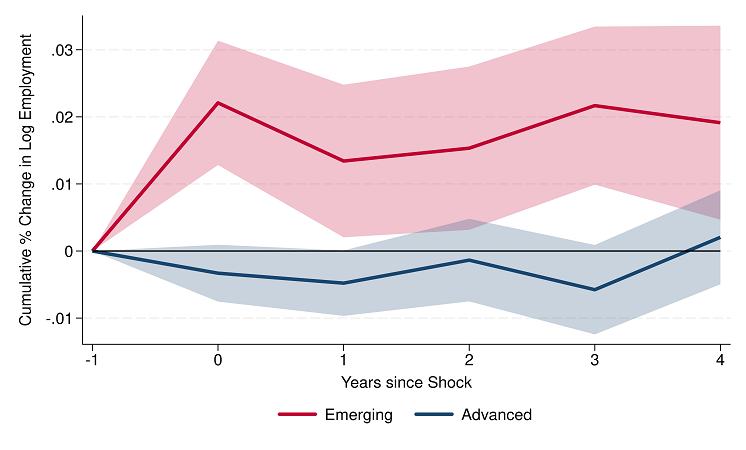
Notes: Local projections of cumulative changes in log assets and log employment of affiliates following a one unit increase in the shift-share instruments of multinationals’ exposure to climate policy shocks. Point estimates in red are for the baseline effect in emerging economies. The projections in blue are the linear combination of the baseline effect and the interaction term between the shock and the dummy indicator for advanced jurisdictions. Shaded areas are 95% confidence-intervals. Standard errors are clustered at the parent company level.
Accessibility: Get the data in accessible format. (CSV 0.57KB)
How does Ireland stand? FDI sensitivity for Phamaceuticals Multinationals and Irish affiliates
Ireland appears less exposed to the risk of losing FDI due to climate policy
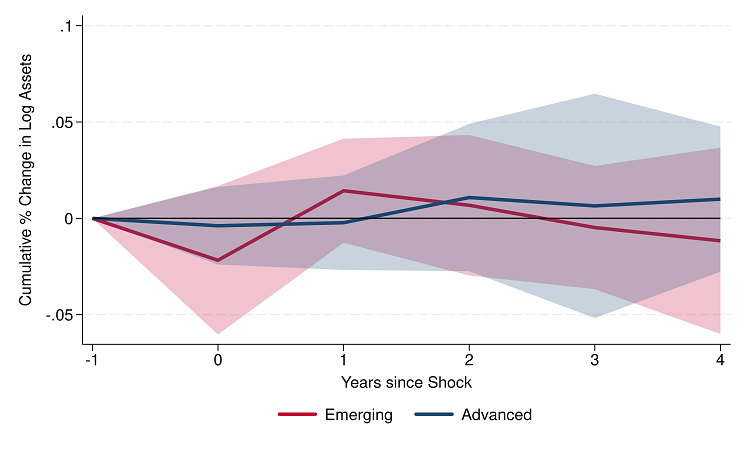
We now turn to investigate whether the effects found in the global sample of manufacturing firms and their controlling foreign parents are equally relevant in the Irish setting. Given the previous evidence on the relevance of specific sectors for Ireland’s exports, we first present results of local projections for pharmaceutical multinationals and then analyse directly whether Irish affiliates across all manufacturing sub-sectors experienced a contraction in size following climate policy shocks in the GVC of their foreign owners. Starting with pharmaceutical multinationals, which include in this analysis also those engaged in manufacturing of medical equipment, Figure 6 suggests that these firms respond to climate policy less than the total sample used previously. While the results for employment are closer to what we find for the global sample of MNEs, we do not document statistically significant differences in size of affiliates following the shocks. The relatively lower carbon intensity of this industry compared to other manufacturing activities and the large fixed costs involved in setting up plants operating highly specialised production processes (Central Bank of Ireland, 2025) are likely candidates in explaining the higher degree of inertia of GVC decisions of pharmaceutical firms.
Figure 6: Dynamic responses of affiliate assets and employment to environmental shocks in their holding companies’ GVC (global sample) – Pharmaceuticals and manufacturing of medical equipment multinationals.
Accessibility: Get the data in accessible format. (CSV 0.55KB)
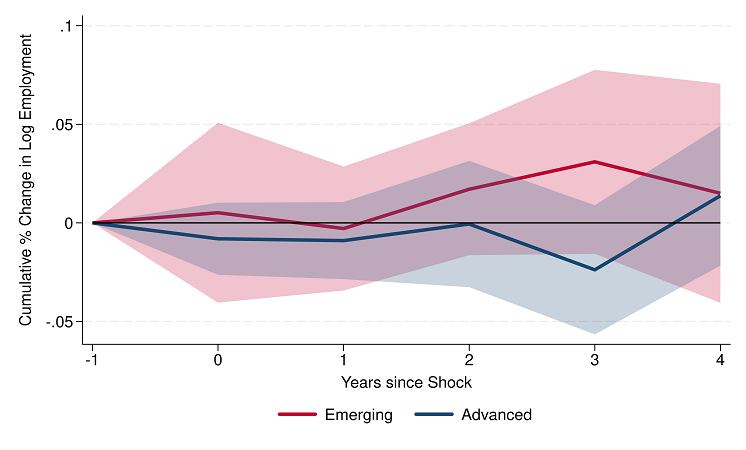
Notes: Local projections of cumulative changes in log assets and log employment of affiliates following a one unit increase in the shift-share instruments of multinationals’ exposure to climate policy shocks. Results are for the global affiliates of multinationals active in manufacturing of pharmaceuticals and medical equipment. Point estimates in red are for the baseline effect in emerging economies. The projections in blue are the linear combination of the baseline effect and the interaction term between the shock and the dummy indicator for advanced jurisdictions. Shaded areas are 95% confidence-intervals. Standard errors are clustered at the parent company level.
Accessibility: Get the data in accessible format. (CSV 0.55KB)
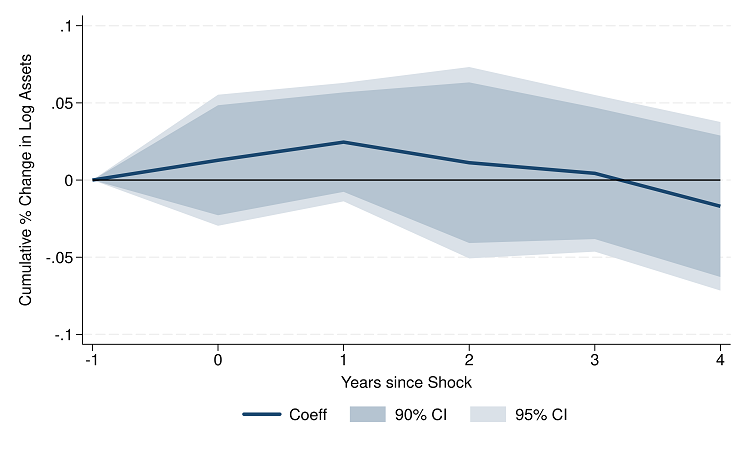
While pharmaceutical multinationals do not appear to relocate capital and employment in response to climate policy tightening, Irish inward FDI might still be seeing outflows coming from other manufacturing sectors. Figure 7 suggests this not to be the case. The chart displays the responses of assets and employment of Irish subsidiaries, across all manufacturing sub-sectors, with both having muted dynamics throughout the estimation window. Compared to the earlier results for the affiliates in advanced economies, features of the Irish economy such as the tax policy certainty, skilled workforce and access to the EU single market might be overweighting the direct costs of environmental policies. The relevance in the Irish FDI landscape of pharmaceutical multinationals, along with the relatively lower carbon intensity of the sectors of the economy most exposed to FDI, are plausible explaining factors for the documented responses.
Figure 7: Dynamic responses of Irish affiliates’ assets and employment to environmental shocks in their holding companies’ GVC.
Accessibility: Get the data in accessible format. (CSV 0.42KB)
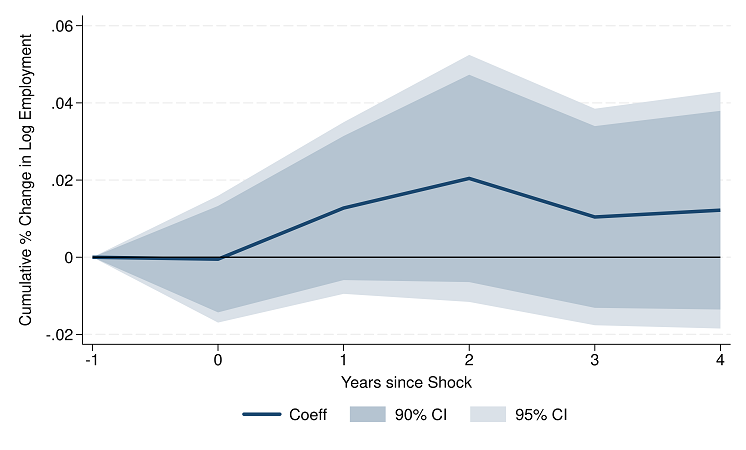
Notes: Local projections of cumulative changes in log assets and log employment of Irish affiliates following a one unit increase in the shift-share instruments of multinationals’ exposure to climate policy shocks. The darker shaded area is the 90% confidence-interval, in lighter blue the 95% confidence-interval. Standard errors are clustered at the parent company level.
Accessibility: Get the data in accessible format. (CSV 0.43KB)
Conclusion
This Staff Insight investigates whether large multinationals engaging in manufacturing FDI are internalizing climate policies and their associated costs in their decisions on where to operate productive activities. From a global perspective, we document a small but statistically significant re-allocation away from countries with tighter climate policymaking. Studying the response of MNEs following unexpected climate policy shocks, we document adjustments aligning with the carbon leakage phenomenon. Large multinationals decrease the scale of their FDI in advanced economies while persistently increasing productive activities in emerging markets, the latter being characterized by laxer policy regimes.
Applying the same methodological toolkit to Ireland and its foreign-owned manufacturing sectors, we find evidence suggesting the country is less exposed to the risk of seeing capital outflows from multinationals in response to tightening climate policies. Across their global value chains, pharmaceutical multinationals are found to be less responsive to climate policy shocks, most likely due to the presence of high fixed-costs and the highly specialised production processes in their business model. Supporting this interpretation, we document a lack of significant changes in the size of Irish foreign-owned manufacturing firms, a sector of the economy characterized by a substantial presence of pharmaceutical MNEs.
References
Borusyak, K., Hull, P., & Jaravel, X. (2022). Quasi-experimental shift-share research designs. The Review of economic studies, 89(1), 181-213.
Carbone, S., Beck, R., and Hale, G. (2026). Climate and the geography of multinationals. Forthcoming.
Central Bank of Ireland (2025). On the fault line? The Irish economy in a time of geoeconomic fragmentation. Central Bank of Ireland Quarterly Bulletin, (3), September 2025.
Honohan, P. and Walsh, B. (2002). Catching up with the leaders: The Irish hare. Brookings Papers on Economic Activity, 2002(1):1–57.
Kruse, T., Dechezleprêtre, A., Saffar, R., and Robert, L. (2022). Measuring environmental policy stringency in OECD countries: An update of the OECD composite EPS indicator. OECD Economic Department Working Papers, (1703):0_1–56.
Lukmanova, E. and O’Grady, M. (2024). The sectoral impacts of tariffs and trade fragmentation in the Irish economy. Staff Insight No. 12, Central Bank of Ireland.
World Bank (2026). Carbon Pricing Dashboard – Compliance Price.
Endnotes
- Authors’ affiliations: Sante Carbone (Central Bank of Ireland and Stockholm University), Galina Hale (University of California Santa Cruz, NBER, CEPR), Roland Beck (European Central Bank). The authors would like to thank Cian Ruane, Martin O’ Brien, Thomas Conefrey and Fergal McCann for helpful comments. The views expressed are solely those of the authors and might not necessarily reflect those of the ECB and Central Bank of Ireland