Behind the Data – Uncovering the composition of Irish households’ holdings via investment funds

Marco Moreno*
April 2026
This Behind the Data looks through investment fund holdings by Irish households to reveal their underlying composition. While investment funds form a modest share of total household wealth, it finds that household exposure to debt securities and listed equities is greater than previously quantified, and that investment funds offer greater international diversification compared to investments that households make directly, providing new insights on households' exposure to financial markets.
Introduction
In recent years the interest of policy makers in Irish households’ participation in financial markets has increased, as it remains modest by international standards, despite relatively high saving rates (Central Bank of Ireland, 2025 (PDF 1.59MB)). Investment in capital markets can help households build wealth over time and channel savings towards productive investment, yet Irish households' financial assets remain concentrated in deposits and insurance and pension instruments.
Previous research points to persistent barriers constraining retail access, including taxation, low risk tolerance, and limited financial literacy (Central Bank of Ireland, 2025 (PDF 1.59MB)). Consumer surveys highlight that investment in capital markets is limited to a smaller subset of the population - typically highly educated, male, and wealthy – and remains largely inaccessible to many lower-income households (Boyd et al., 2025). The level of risk aversion may also hinder financial investment beyond monetary constraints (Christelis et al., 2025), with more educated households exhibiting higher tolerance (Arrigoni et al., 2024 (PDF 1.44MB)).
Policy efforts to increase retail participation in capital markets are intensifying, with discussions around fiscal reforms (Department of Finance, 2024) and potential tax-incentivised investment schemes. These measures could help redirect household savings away from bank deposits and towards the financial market.
For those households that do invest in capital markets, investment funds can play a role not only for portfolio diversification but also by offering a broader range of investment opportunities that would be difficult or costly to replicate individually. By holding investment fund shares, households gain indirect exposure to a broader selection of instruments and counterparties than their direct holdings alone would suggest. Understanding how households currently use investment funds – and what assets they access through them – can therefore inform policymaking. By looking through households' investment fund holdings, this Behind the Data provides new insights into the effective exposures of Irish households to macroeconomic and financial risks through these vehicles.
The Data
Quarterly financial accounts data from the Central Bank of Ireland provide the starting point for the analysis, quantifying the total amount of investment fund shares owned by Irish households and how much of their financial assets they account for. This is combined with "look-through" data provided by the ECB for all euro area countries decomposing investment funds’ holdings into their underlying assets (i.e., what they actually invest in).
The ECB look-through data provides information on asset classes, but it does not capture the characteristics of the individual securities held by each investment fund. To bridge this gap, this Behind the Data combines security-level data reported by Irish-domiciled investment funds with data on households’ direct holdings of listed shares and debt securities from the Securities Holdings Statistics database and the Eurosystem's Centralised Securities Database. Granular data on investment funds’ holdings is only available for Irish‑domiciled investment funds. Each individual security is classified by its issuer’s sector (e.g. financial services, manufacturing, government, etc.) and country of residence to provide a new, greater breakdown of household security exposures.
There are two limitations to the data. First, households also invest through insurance and pension products, but these channels are not captured in this analysis. Second, the data only includes positions reported by Irish custodians. Assets held via foreign custodians are currently not reflected in our statistics, which may therefore understate overall holdings. A project to incorporate data on foreign custodians into these statistics is ongoing, and is intended to be the topic of a future publication.
Investment fund shares in the balance sheet of Irish households
Irish households show modest engagement with capital markets, preferring to retain savings in bank accounts or allocate them to pension products, rather than invest directly.1 As of Q3 2025, total financial assets of Irish households stood at €589bn, with the largest share of this held in insurance and pension entitlements (46 per cent), and currency and deposits (37 per cent). Outside the financial balance sheet, housing remains the primary asset, accounting for most household wealth in Ireland.
At the end of Q3 2025, financial market instruments2 accounted for 5 per cent of total household financial assets altogether, a relatively small share of the total. Within this, households’ holdings of listed shares and debt securities totalled €14.2bn (accounting for 2 per cent and less than 1 per cent of total financial assets, respectively). However, this amount does not include instruments that households hold indirectly via investment funds. By investing into a range of other financial (such as listed shares or bonds) and non-financial assets (including real estate), investment funds act as “containers” of different products.
Irish households’ holdings of investment fund shares were €11.2bn in Q3 2025. With 2 per cent, the share of investment funds in total financial assets of households in Ireland is well below the euro area average of 11.1 per cent (Figure 1).
Figure 1: Investment funds account for a much lower share of household financial assets in Ireland compared to the euro area (Q3 2025)
However, the importance of investment funds differs significantly across the wealth distribution. Distributional data shows that investment fund shares account for over 16 per cent of total financial assets for households in the wealthiest decile. These households are also more likely to invest in capital markets in the first place, and their holdings of listed shares and debt securities make up 12 per cent of their total financial assets altogether.
Analysing what assets are accessed by households indirectly through investment funds, can therefore provide additional insights on households’ balance sheet composition and their exposure to the financial market.
Looking through investment funds’ holdings
The ECB publishes experimental “look-through” data revealing the mix of assets held indirectly by households via investment funds.
The dataset is constructed by identifying the country of domicile for each investment fund held by Irish households, and looks at that country's investment fund sector’s balance sheet to break down the investment funds’ holdings into their underlying asset types.3
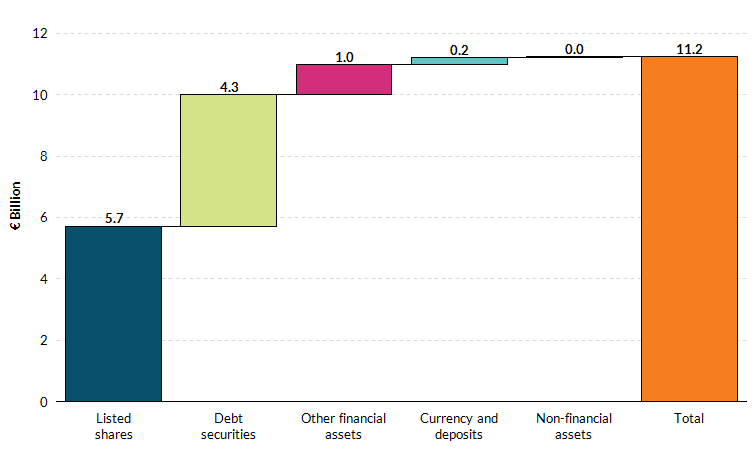
Figure 2: Investment funds owned by Irish households mainly invest into listed shares and debt securities (Q3 2025)
Source: ECB.
The look-through data reveals that Irish households hold investment funds that predominantly own a mix of listed shares and debt securities (Figure 2). As of Q3 2025, listed shares account for 51 per cent (€5.7bn) of investment funds’ holdings, whereas debt securities represent 38 per cent (€4.3bn). Other financial assets, including unlisted equities, comprise 9 per cent (€1bn) of holdings altogether. Cash, deposits, and non-financial assets such as real estate only account for a marginal share of the total.
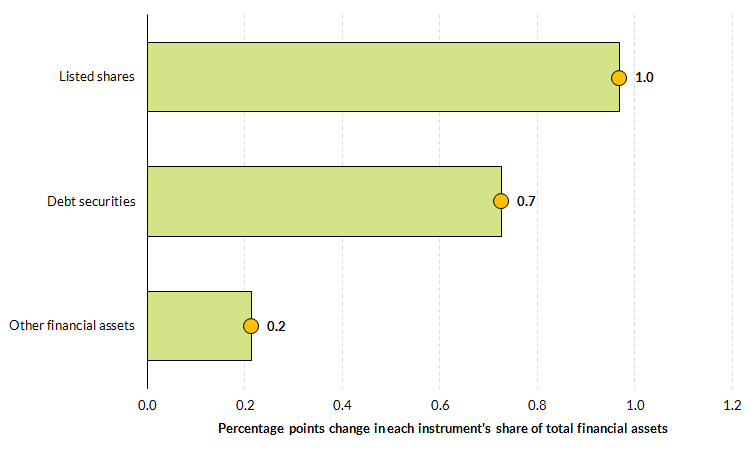
Figure 3: Household portfolios have become more exposed to listed shares and debt securities after looking through investment funds’ holdings (Q3 2025)
Source: ECB.
Looking through investment funds’ holdings reveals higher household exposure to listed shares and debt securities than previously observed in quarterly financial accounts data.
Figure 3 illustrates this by showing how combining direct and indirect holdings leads to increases in the relative weight of different financial instruments on households’ balance sheets. The share of total households’ financial assets accounted for by listed shares rises by almost one percentage point, while that of debt securities increases by 0.7 percentage points. Conversely, all other financial instruments only increase marginally (0.2 percentage points altogether), as they comprise less than a tenth of investment funds’ assets.
How do securities owned directly and through investment funds differ?
Having established that investment funds provide additional exposure to listed shares and debt securities, it is insightful to understand the characteristics of these securities accessed by households, such as geographical and sectoral distribution.
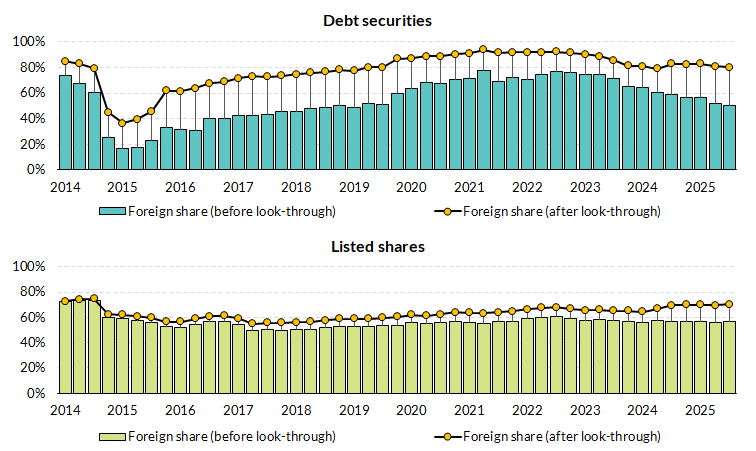
Figure 4 displays that once indirect holdings are considered, non-Irish securities rise to account for 80 per cent of total debt securities and 70 per cent of total listed shares owned by Irish households, due to the larger presence of foreign securities in the portfolios of investment funds.
Figure 4: The share of foreign debt securities and listed shares owned by Irish households increases when investment funds’ holdings are taken into account
Source: ECB.
Direct holdings of Irish securities surpass those of any other country, while investment funds can serve as vehicles to access international markets indirectly. This view is further supported by the fact that Irish households mainly invest in investment funds domiciled in the main European financial centres (Luxembourg and Ireland), which typically have more geographically diversified asset portfolios compared to those domiciled elsewhere (Lambert et al., 2024).
The ECB look-through data decomposes investment funds’ holdings into asset types, but it does not capture the characteristics of the individual securities owned indirectly through investment funds. To address this, this Behind the Data analyses granular ISIN-level data for listed shares and debt securities held by Irish-domiciled investment funds, which alone account for the largest part of Irish households’ investment fund shares (€6.1bn, or 54 per cent of the total as of Q3 2025).
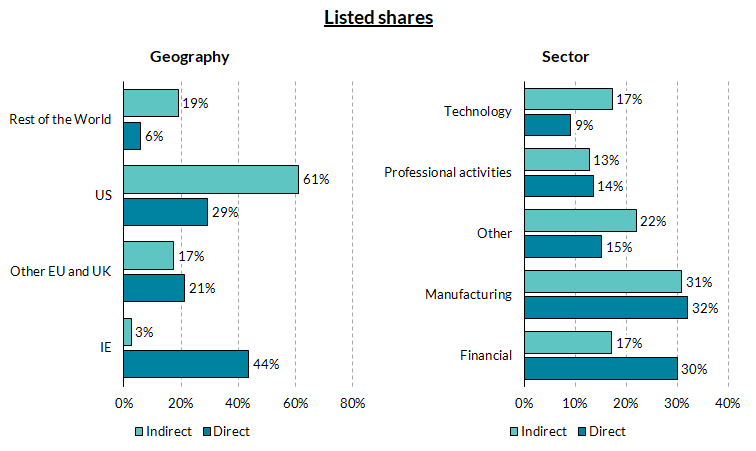
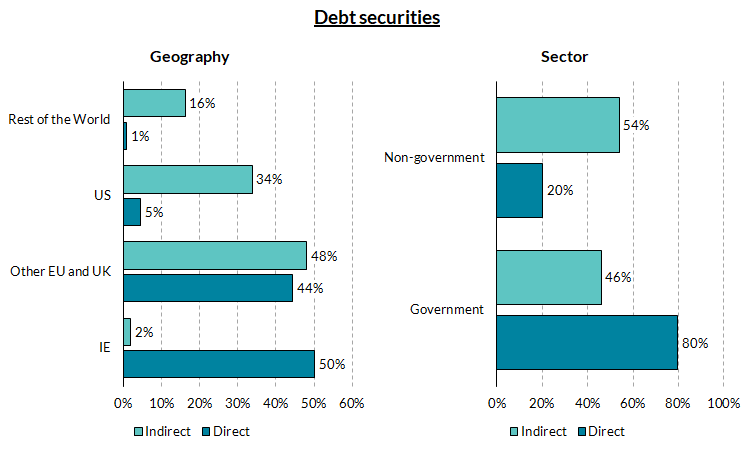
Figure 5: Listed shares and debt securities held directly and through investment funds display different geographical and sectoral compositions (Q3 2025)
Source: Investment Funds reporting data, Securities Holding Statistics, and author’s calculations.
Direct and indirect equity holdings display significantly different geographical allocations, with holdings through investment funds providing much greater exposure to the US market. Figure 5 compares the different sectoral and geographical allocation of all listed shares and debt securities held directly or indirectly through Irish investment funds. Approximately 44 per cent of listed shares owned directly by households are issued by Irish companies and 29 per cent by American companies, but the US accounts for most indirect equity holdings (61 per cent). The sectoral composition is broadly similar across direct and indirect holdings, except that direct holdings show greater allocation to financial institutions and lower exposure to the technology sector.
The large allocation to the US is driven by the large market capitalisation of a relatively small number of American companies. As of Q3 2025, shares of the so-called "Magnificent Seven"4 alone account for 17 per cent of indirect holdings and 10 per cent of direct holdings, highlighting their outsized influence on portfolio composition. Overlap between direct and indirect holdings is not limited to these few companies: investment funds’ portfolios contain thousands of individual securities, but only 38 per cent of them are also held directly by households. However, these overlapping securities account for 94 per cent of the total equity value held through funds. This indicates that both direct holdings and fund portfolios are concentrated in the same companies, even though funds provide access to a much broader universe of securities.
Investment funds diversify households' debt exposures both geographically and by issuer type. Direct debt holdings are dominated by Irish issuers (mainly the government), which together with other European issuers account for 94 per cent of total holdings. In contrast, debt securities accessed through investment funds are more geographically diversified, though still concentrated in Europe (50 per cent of the total) and the US (34 per cent). Notably, households hold almost exclusively sovereign debt (80 per cent of direct holdings), while investment funds provide greater exposure to non-government debt.
Conclusion
This Behind the Data applies a look-through approach to investment funds’ holdings to provide new insights into the composition Irish households’ financial assets. The analysis shows that, while investment fund shares represent a relatively small share of total households’ financial assets, they are largely invested in equities and bonds, effectively increasing their exposure to these instruments.
Comparing direct and indirect – via investment funds – holdings of listed shares and debt securities reveals notable differences between the two: direct security holdings are concentrated on Irish issuers, while investment funds’ holdings are more diversified across sectors and geographies (albeit with large allocation to the US). This provides new information on the sensitivity of households’ balance sheets to global repricing and foreign macro‑financial conditions.
* Email: marco.moreno@centralbank.ie if you have any comments or questions on this note.
Comments from Jean Cassidy, Barra McCarthy, Jenny Osborne-Kinch, Simone Saupe and support from the Securities and Investment Funds teams of the Statistics Division are gratefully acknowledged. The views expressed in this note are those of the author and do not necessarily reflect the views of the Central Bank of Ireland or the ESCB.
[1] Pension products and investment funds both provide households with indirect access to capital markets through professionally managed portfolios. However, pension products serve a different purpose and benefit from tax advantages which reduce the effective cost of saving and encourage long-term commitment. These features can partially explain why Irish households’ pension entitlements are much larger than their holdings of investment fund shares, despite both offering similar market exposure.
[2] Debt securities, listed shares, money market fund (MMF) shares, (non-MMF) investment fund shares.
[3] For example, if Irish households hold €100 in shares of investment funds domiciled in country A, and the assets of the investment funds sector in country A consist of bonds (40 per cent) and equities (60 per cent), then Irish households own €40 of bonds and €60 of equities on a look-through basis.
[4] Apple, Microsoft, Alphabet, Amazon, Meta, Nvidia, Tesla.