Remarks at the Climate Risk and Sustainable Finance Forum – Governor Gabriel Makhlouf
08 December 2025
Speech
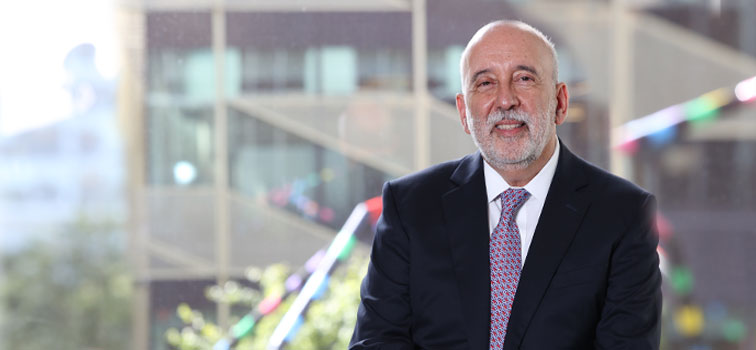
Good morning and welcome everyone. I am delighted to address the eighth meeting of this Forum.
When the Forum was established three years ago, the goal was to bring together participants from across Ireland to build a shared approach to understanding and managing the systemic risks that climate change poses, while supporting the orderly transition of households and businesses to the net zero objective that we’re all familiar with.
The Forum has come a long way in those three years. We have established cross-sectoral working groups across risk management, capability building and, most recently, data and disclosures. The groups have produced a number of reports and facilitated sharing of knowledge and best practice.
In Ireland emissions have fallen by 10 per cent since the Forum first met while emissions from energy are down 28 per cent. Change is happening – and in some areas it is happening at pace – but we are told that the country is not on track to meet its 2030 targets. The task of achieving the fundamental and deep-rooted transformation of our economy is still very much in front of us, and I haven’t mentioned the proposed EU targets for 2040 which is 15 years away, less time than the first iPhone is behind us.
The availability of financing for this transition will be a very important determinant for success.
In recent years, legal frameworks have been developed to support the transition. However, these frameworks are complex and financial flows to sustainable activities are estimated to be approximately a quarter of what they need to be by 2030.1
Financial firms have taken steps to manage climate and environmental sustainability risks. But maturity varies across firms and more is needed to embed risk management in strategic decisions, and to identify opportunities and take action.
My remarks today will focus on four areas. I will:
- Provide my perspective on climate risk and sustainable finance in Ireland and the EU, and the progress that has been made to date
- Highlight the need to ensure climate action remains a priority for the financial sector, and emphasise the Central Bank’s focus on climate risk and sustainable finance
- Explain the need for a focus on tangible outcomes that support the transition and adaptation
- Encourage this Forum to continue to promote a collaborative approach to how the financial sector supports the transition and adaptation
Progress to date
First, to progress. There has been some progress although the focus and momentum that built around sustainable finance in recent years is slowing as resources are diverted to other topics and priorities perceived to be more urgent, newer, more profitable or more likely to curry favour or less displeasure.
Through participation in the G20 this year, I have seen first-hand how changing political priorities have diverted efforts away from addressing climate change.
This would not be a problem if we had just discovered that what Nick Stern told us around 20 years ago, and other scientists before and after him, was wrong. But we haven’t, he wasn’t and they weren’t.
We should recognise that the science hasn’t been ignored completely. We have seen tangible outcomes from worldwide action. Global greenhouse gas emissions are now projected to be around 12 per cent below 2019 levels in 2035. This compares to a projected increase in emissions of between 20-48 per cent, before the adoption of the Paris Agreement.
We are no longer on a trajectory towards the very worst-case scenarios that were once feared.
Between 2021 and 2024, assets in sustainable funds2 in Europe have increased from €3.7tn to €9.1tn and have increased as a percentage from 25 per cent to 52 per cent of total fund assets. Green mortgages now make up 40 per cent3 of new lending in the Irish market, and since the launch of Irish Sovereign Green Bonds in 2018, a total of €11.5bn has been allocated to green projects4.
However, since this period of expansion we have seen some headwinds to sustainable finance, partly from political pushback but also because some sustainability products appear not to deliver on their claims. For example, research indicated that one third of sustainable funds studied had exposure to fossil fuel companies, amounting to an investment of €123bn. The incentive for greenwashing remains, which is a somewhat polite way of saying that we need to watch out for snake oil salesmen5.
Of course I recognise that the complexity of implementing sustainable finance, such as embedding complex new regulations, processes and systems, and collecting data to understand the risks, has also hampered progress.
Sustainable finance needs to move onto a new, mature phase where it is less about statements of commitment and more about action and outcomes.
So how do we get there?
First, to state the obvious, we need to build trust in sustainable finance: we need to ensure that products deliver on their promises and finance goes to where it is needed. This will broaden the transition into market segments that have yet to make significant progress.
And second, we need to maintain a focus on the management of climate risk, as well as increasing the focus on climate change mitigation and adaptation.
Maintaining momentum
In other words, we need to maintain momentum. The global macroeconomic costs of climate change are material. Under a scenario consistent with current nationally-determined contributions, the level of global GDP would be 13 per cent lower by 2050.
The macroeconomic costs of taking action to reduce greenhouse emissions are much smaller than the costs associated with inaction. Ongoing analysis within the Bank on options for recycling revenue from carbon taxes also indicates that there are policy choices that can reduce the costs, and enhance the benefits, of that transition.
We are already seeing the impacts of more frequent extreme weather events around the world and here at home. Such events are much more likely as a result of climate change.
The world is getting closer to – and in some reports, even crossing – climate tipping points where parts of the Earth’s systems could be pushed into abrupt or irreversible change6.
Ultimately, it is because climate change poses risks to these systems – which provide us with food, water, energy and raw materials – that addressing these risks remains a strategic priority for the Bank.
With this in mind we recently updated our climate and sustainable finance strategy. We’re focusing our work programme on three key aspects:
- Building financial resilience, both at microprudential and macroprudential level
- Consistent with our economic advice mandate, informing national climate policy through data, research and even greater collaboration on the macro-financial aspects of climate change and the transition to net zero; and
- Enabling the financial system to play its role in transition.
In relation to building financial resilience, we are continuing to embed climate risk management and supervision of sustainable finance into all aspects of our supervisory work.
As I hope many of you will be aware, I wrote to the chairs and CEOs of all regulated firms in November 2021 setting out the Central Bank’s supervisory expectations in relation to climate issues. Those expectations haven’t changed. Firms are expected to:
- Demonstrate clear ownership of climate risks affecting the firm, and promote a culture that places emphasis on climate and other ESG issues
- Understand the impact of climate change on their risk profile, and embed it in risk management frameworks
- Undertake scenario analysis to understand the potential impacts of climate change
- Determine the impact of climate risk (and opportunities) on their risk profile, business strategy and long-term sustainability, which should inform strategic planning
- Be transparent about what they are doing, including not engaging in greenwashing.
We have seen meaningful progress against many of these topics.
Financial institutions have enhanced board oversight, gradually incorporating climate factors into their strategies and risk frameworks, and developed scenario analyses and transition plans.
However, progress has been uneven, and we have seen that maturity varies across sectors and across firms. Many institutions remain at early stages of quantitative assessment, have limited data availability, or lack the analytical capabilities needed to quantify exposures and model forward-looking climate impacts. There continues to be gaps in data availability, scenario modelling capabilities, and the systematic incorporation of climate change risks.
I expect firms to build on the progress they have made. Regulated firms should continue to build capacity, both in terms of knowledge and data, in order to better understand and manage the risks that climate change poses to their business. In particular, firms should deepen their understanding of the potential impacts on the long term sustainability of their business model. And regulated firms should continue to deliver sustainable products in a clear and transparent way that meets the needs of investors and consumers.
Real world outcomes
So while progress has been made, there is still more work to be done, not least to have a sharper focus on achieving tangible outcomes that support the real economy’s transition away from unsustainable activities. And in such a transition, it is inevitable that business models will need to change.
Transition planning will require long-term thinking through the current cycle.
I should also add that I fully support the current efforts in the EU to remove unnecessary complexity from the sustainable finance regulatory framework. The current framework is complex and presents challenges for financial market participants who want to support the transition. We do not want to compromise the resilience of the financial sector or reduce important consumer protections but we do need to make a step change here. I hope that the review of the Sustainable Finance Disclosure Regulation will deliver something that is less complex and more user-friendly for investors.
Continuing to collaborate
Finally, the importance of collaboration.
One topic where there is a clear need for collaboration domestically is in relation to the flood insurance protection gap. The report we published last year pointed out that 1 in 20 households in Ireland had difficulty in accessing flood insurance. This number is only going to increase as flood events become more frequent and severe. Not only will it affect the ability of these households to recover after a flood event, it will also have an effect on the wider economy, not least on the availability of mortgages and the wider housing market.
There is a lot of work to be done but I am encouraged by initial discussions with the Department of Finance and the insurance industry on this topic.
Finally, I hope that we can build on the contributions that this Forum has made in the last three years. No doubt the Forum will evolve in response to the evolution of external events but in my view it will continue to have the potential to play an important role, particularly as the focus shifts to the practicalities of implementation and delivery of outcomes. By fostering dialogue, sharing knowledge and driving action, the Forum can help ensure that Ireland’s financial system is prepared to meet the challenges and opportunities of the climate transition.
Conclusion
The path to net-zero is not linear but its necessity is clear: the costs associated with taking action to tackle climate change are much smaller than the costs associated with inaction.
We must recognise that the journey to net-zero is, at its core, a real economy transition. The financial sector’s task is not just to manage the risks on its balance sheets, but to provide the incentives and the funding to ensure that households and businesses make the low-emission choices required to secure our collective future.
My call to you is that we commit to staying the course together. This Forum has the potential to be a catalyst for the transition: sharing best practice, identifying data gaps, and taking action to support the wider Irish economy to deliver the real-world outcomes we need.
[2] Assets in Article 8 or Article 9 funds
[6] The Planetary health check 2025” report, published by the Potsdam Institute for Climate Impact Research, shows that seven of the nine planetary boundaries have been exceeded.