T.K. Whitaker: Financial Policies for the State
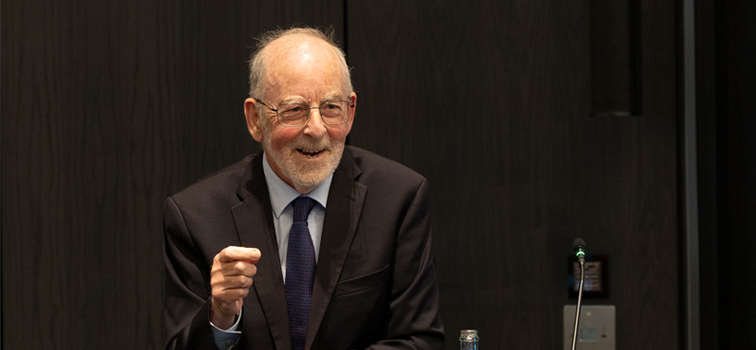
It is a great pleasure and an honour to give the 2026 Whitaker lecture. My parents were long-time friends of Ken and Nora Whitaker, and as children my siblings and I were always pleased to meet him with his gleaming infectious smile.
My mother used to comment favourably on Ken’s skills as a dance partner. In 1971, ignoring that implied criticism of himself, my father encouraged me to ask Ken to provide a reference when I was applying for my first proper job as minute-writer for the Executive Board of the International Monetary Fund. (I got the job.)
Ken Whitaker’s early months as Governor of the Central Bank in 1969 had some exciting moments. His holiday in Connemara in August of that year was interrupted by three diverse, noteworthy incidents.
- He had to travel to the Garda station in Carna to take a phone call from a worried Taoiseach, Jack Lynch. Violence in Northern Ireland was destabilising politics and Ken was being asked for his advice, including on how to “rein in” Charles J Haughey on those (non-financial) matters. (Irish Times 2017).
- Then Don Carroll, of the (commercial) Bank of Ireland, flew over to meet him (via Castlebar, after contemplating a landing at Roundstone Beach) in order to finalize details of the transfer of the commercial banks’ sterling assets to the Central Bank, a project which had been in gestation for several years.
- And, still on holiday, he learnt that his successor as Secretary of the Department of Finance was planning to undermine the independence of the Central Bank in draft legislation that would empower the Minister to direct the Central Bank to divert bank resources to finance the Government.1
Having dealt adequately with all three threats, he was doubtless encouraged that his new job looked like it might not, as he had feared, become a role of “glum isolation in an ivory tower, relieved only by the hurling of belated thunderbolts against erring governments.”2
It is almost ten years since Whitaker died. It is 50 years since his structural roles in the State’s economic institutions came to an end as he finished at the Central Bank. He was 59 years old. Twenty years earlier he had become Sec of the Department of Finance. In fact, his standing as Irishman of the Century rests more on what he achieved in his first years as – in effect – the Government’s chief economic advisor. Clearly, even acknowledging the revisionist caveats of several historians (Brownlow 2010; Barry and Daly 2011; Casey 2022), his initiative in engineering the policy pivot defined by his 1958 blueprint Economic Development was of decisive importance.
It helped ensure that Ireland avoided a lengthy further period of economic drift that might have put today’s relative prosperity beyond reach.
Much has been written about that historic turning point. But today I would like to discuss how Whitaker’s work as an architect of financial and monetary policy throws light on his motivations and the approaches he used when deploying his skills as a public servant.
T.K. Whitaker’s chief goal in this field was to strengthen and develop the financial autonomy of the—still quite new—State. The word “statist” doesn’t quite catch it, but he was certainly not aligned with the free-market advocacy of Friedman or Hayek.
In navigating the delicate balance between serving and influencing government, he exhibited a determination to ensure that long-term goals for the state received priority over myopic or short-termist preferences of politicians.
In developing the functioning of the country’s finances and the official oversight and control of this sector he was not over-awed by the banking establishment. In international financial diplomacy, far from being cowed by any post-colonial sense of inferiority, his aim was to enhance the autonomy and reputation of Ireland. Let me take these three aspects one-by-one.
Government short-termism and the welfare of the State
Conflict between central bank and government is not unusual (an extreme live case is the position of US Fed Chairman Jerome Powell, whose term of office ends next week). Ireland’s first Governor, the prickly Joseph Brennan — “no man’s man” as his biographer Leon Ó Broin dubbed him—resigned in 1953 as a result of such a conflict.
Maurice F. Doyle’s hopes for a second term as Governor in 1994 were likely dashed by Government displeasure at his public criticism of policy.3 Whitaker seems to have been able to navigate these conflicts more effectively.
Perhaps his more expansive approach to monetary matters than predecessors will have helped. I suspect that it was more down to his positive “can do” personality and charm. It is this that allowed him to couch his advice to the Minister in ways that seem to some as borderline insubordinate but are more plausibly interpreted as reflecting a relationship of collaboration and trust. The record is far from being devoid of the kind of strongly-worded cautions against waste and over-spending which are proper and necessary for a Treasury official to provide to Government. And he clearly did not fully endorse the lax budgetary strategies that were followed, especially in the 1970s.
But it was not all plain sailing. He had robust interactions with senior colleagues, and it is clear that some of the older men felt he was inclined to get a bit big for his boots.4
As Secretary of the Department he did not get on so well with Haughey, his fourth Finance Minister. Though he never said so, this is usually cited as a reason he preferred to move from that position at the early age of 53 to take up the Governorship.5
This move did not work out in the way he hoped it would. Perhaps his expectations for the position were misplaced. His view was that the “[Central] Bank’s main function as a public authority cannot be other than of trying to influence Government policy in favour of protecting, to the utmost, the value of the monetary unit.
The advisory role of the Bank is of supreme importance.” But, while from the Central Bank he vigorously and cogently engaged with his Finance successor Charlie Murray on all dimensions of fiscal and macroeconomic policy, he was not, and could not have been, as effective in that advisory role as he had been as Secretary of the Department.6
The account Whitaker has left us (in his hitherto unpublished 1979 Memoir) of his years as Governor has a downbeat quality, suggesting that his elevation from Finance to the Central Bank moved him further from the action than he might have expected.
The progressive enthusiasm of his early civil service years is no longer so clearly in evidence in the memoranda and letters he wrote to the Taoisigh, Ministers and Secretary on these matters. There was much to be concerned about in the 1970s, and little enough the Central Bank could do about budgetary policy. The fiscal situation had deteriorated dramatically as the Government struggled to meet the immediate objective of insulating the economy from the oil-shock stagflation at the expense of what would prove to be a protracted and costly fiscal adjustment in the following decade. Increased reliance was being placed on foreign borrowing. Inflation—largely imported—soared to levels never matched before or since. His advocacy of better fiscal discipline fell on deaf ears until, perhaps, the arrival as Minister for Finance of Richie Ryan, whose draconian January 1976 budget, however, caused his party to lose the next election.
Ken was still alert to banana skins in the 1970s, for example, warning Murray against producing “spurious reductions” in budgetary figures by taking at face value expenditure estimates from other Departments which had been prepared under pressure from the Department of Finance (for the 1971/72 budget). He even “risked Ministerial wrath by alerting the Taoiseach directly to the danger” of floating the idea of a wealth tax: “Don’t bring unnecessary trouble on your head” he cautioned in his hand-written note from Foster Place.
But as the years wore on, his missives (as we see from his Memoir and the official files) began to take on a somewhat jaded and negative tone.
“The position of the Central Bank was an uncomfortable and frustrating one…If our advice was constantly set aside or ignored, and our disagreement with policy became acute, the only course left, in my view, was to resign.”
In fact he did not resign,7 but he did decide not to seek a second term, reluctant to be seen as condoning “policies that I consider to be wrong”. “My term as Governor of the Central Bank which…began under seemingly good auspices, ended on a note of disappointment.”
Whitaker’s contribution to the progress of the Nation did not end in 1976, but he moved to fields other than finance.
Developing the financial infrastructure of the State
But we must not lose sight of the fact that Whitaker’s role in the development of Ireland’s central banking institutions and strategies started long before he became Central Bank Governor. Much was done in his earlier years at the Department of Finance, where indeed his very first task (back in the 1930s) cut early steps in the path towards the creation of a central bank.
An influential high flyer in the Department by the 1950s he was quite progressive in his financial policy preferences: more “abundance” than “austerity”. Chafing under the restrictions imposed, explicitly or implicitly, by the sterling link, and the dependence on conditions in the London money market, where the dominant private banks held their reserves, Whitaker aimed “at a financial policy which suits ourselves first.”
“Repatriating the external reserves” (ideally before the devaluation of 1949) was a catch-cry of radical politicians such as Minister for External Affairs Sean McBride. But Whitaker was also already working in the late 1940s and early 1950s to pressure the commercial banks to invest some of their excess sterling assets at home.8
As far as the Central Bank’s own foreign assets were concerned, he long advocated diversification of the official external reserves beyond gold and sterling to include US dollars.9 In Whitaker’s characteristically roguish words, inclusion of the US dollars would “take the bare look” off the Irish securities in the Note fund (Memo March 29, 1955).10
The year 1955 already saw Whitaker (still an Assistant Secretary in the Department) advance a sweeping overhaul of the Central Bank’s role in supporting the Government’s finances. “The Central Bank should gradually evolve towards a position in which it will perform a substantial part of the functions of banker to the Government”, he wrote. There should, he said, be a requirement on the commercial banks to place deposits with the Central Bank which in turn could be used to support the market for Government and other Irish securities; legislation should be introduced to have the main Exchequer bank account (then with the Bank of Ireland and other commercial banks) transferred to the Central Bank and for the Central Bank to be enabled “to requisition funds, to an appropriate extent, for this account from the banks.”11
Progressive politicians had already been calling for such moves, but they had not sat well with traditional orthodoxy. For example, they were in the opposite direction to the reform of US monetary arrangements set out in the Fed-Treasury Accord of 1951. Indeed, activist Central Bank financing of the Government’s borrowing requirement, as envisaged and sparingly implemented by Whitaker, would not be allowed at all under the tight restrictions of the Maastricht Treaty and the ECB Protocol, which reflect the obsession that emerged worldwide after the 1970s with avoiding inflation driven by monetary financing of government profligacy.
To be sure, he did see the risks of overdoing government reliance on monetary finance: as he later said, “a legitimate inch in financial matters may be stretched to an inordinate mile.” (Whitaker 1983, p.187).
Though far-reaching, many of his early ideas in these areas did become a reality long before he became Governor, as he exercised influence from his position in the Department. No “real progress had been made…until after [J.J.] McElligott became Governor (on 1 April 1953)” in using the new powers with which it had been endowed by the wartime Central Bank Act 1942. (It is left open as to which move was more important: the departure of its first Governor Joseph Brennan from the Bank or McElligott’s departure from the Department!).
Each early step to make use of the expanded policy toolkit was at the instance of the Department of Finance.12
- In April 1955, during the liquidity crisis of that year, the Central Bank provided funds for the struggling state-owned monopoly Tea Importers Ltd.13 (By the way, that curious tea merchant, a legacy of the World War, was an ancestor of the notorious Anglo Irish Bank – in 1955 it did repay!)
- Some months later the Central Bank agreed to rediscount Exchequer Bills, thereby indirectly financing the Government’s short-term borrowing needs.14
Although quantitatively small, these actions marked a turning point for Central Bank activism. A dozen years after being given such powers, the Central Bank was at last deploying them in the public interest, to ease financing pressures and overcome foot-dragging by the commercial banks.
As an ex officio a member of the Board of the Central Bank as soon as he became Secretary of the Department of Finance in May 1956, Whitaker was soon even better placed to encourage the Bank to use its powers in the expansive manner which he tended to favour. Indeed, beginning during what was actually a rather severe financing crisis in 1965 and continuing during his period as Governor, the Central Bank provided financial assistance to the Exchequer directly or indirectly on several occasions.15 Each occasion of monetary financing was accompanied by firm, sometimes sharp, admonitory correspondence, but in the end there do not seem to have been refusals: Whitaker’s Central Bank was one that saw its role as including that of lender of last resort to the Government. The requirement from September 1972 for commercial banks to hold a significant proportion of their assets in Irish Government securities can be seen in this light also.16
But there was much more to this programme than merely easing the financing needs of the Exchequer. Whitaker was determined to build a national financial infrastructure appropriate to an independent State, in order to be less dependent on London and on the commercial banks.
- He was very pleased with the centralisation of the bulk of the banking system’s external reserves at the Central Bank in 1968-9 by exchanging central bank deposits for most of the sterling balances held by commercial banks. He had long advocated for this against the reluctance of the banks.17
- The creation of a Dublin money market, seen by the banks as necessary to replace London, now that their sterling liquid assets had been surrendered, was largely accomplished in the 1970s. (This too entailed Central Bank indirect support of the short-term Government bond market by acting in effect as a market maker).
- Guidance and controls on the rate of bank credit expansion was increasingly enforced by the 1970s. This was not something that would always have been welcomed by the commercial bankers who then still, as of right, appointed some of the members of the Board of the Central Bank.18
- Legislation for the licensing, regulation and supervision of commercial banks was enacted in 1971—though it proved rather inadequate as Ken Bates’ notorious Irish Trust Bank slid towards its failure in February 1976.19
This, then, is the pattern: favouring the public finances, constraining the banks, escaping from the financial dominance of London.
There were also operational matters also during his term of office at the Central Bank: the construction of a printworks and mint in Sandyford and the fine headquarters building in Dame Street, though (because of the controversy over its height) the HQ was not completed until after Ken’s retirement—a fact he was fond of bemoaning in later years. But, and I think it’s an important point, he did not allow process-related aspects to crowd-out policy design: so, not surprisingly, he passes over them in his post-retirement memoir.20
That central banks might have an important developmental role is something that has gone out of fashion; yet a new State does need to build its financial infrastructure. The Central Bank of Ireland has not abandoned this type of developmental role (though it’s rightly not in the business of promoting the growth of the sector).21
In recent years, for example, it has created a proper central credit registry—superseding the closed and limited bureau which had previously been operated by a few banks for their own use. For the payments system we are also reliant on recent central banking initiatives, now operated at the level of the eurosystem.
International financial diplomacy
Promoting the interests of the State in financial matters with the rest of the world is a key aspect of policy at the Central Bank. It is an arm of the financial diplomacy of the State. Whitaker was a natural in this role, with his determination to shed the constraints of a post-colonial financial system.
As soon as Ireland joined the Bretton Woods Institutions in 1957, Ken Whitaker was keen to make use of the economic policy expertise of their staff. Perhaps the World Bank might provide an endorsement of his Economic Development, then in draft and as yet without a definite publication plan? Senior Economist Benjamin B. King wrote on Shelbourne Hotel letterhead (Saturday June 7, 1958) to the Bank’s Washington HQ: “It is over 200 pages and seems pretty good to me, halfway towards being a sensible program. It is also quite tough (in a velvet-glove sort of way) with some old-established practices.” (That “sensible program”: a Washington Consensus avant la lettre?).22
Financial diplomacy entailed awareness of both the sensitivities and the expectations of foreign financial authorities, especially those in the United Kingdom. It was a triumph when he managed to settle the final piece of the financial jigsaw created by the Anglo Irish Treaty of 1921.23 But the issue of diversifying the external reserves away from the weak sterling was an even more difficult one, requiring delicate negotiations with the authorities in London, who routinely threatened adverse consequences such as imposition of tighter exchange controls in response to attempts to diversify away from British assets.24 It also required a close familiarity with the technicalities of policy discussion; not just generalities.
We find Secretary Whitaker, for example (in a 1966 letter already highlighted by Avaro, 2024), coaching Governor Maurice Moynihan on what wording to include and what to exclude from a letter to the Bank of England seeking its non-objection to Irish reserve diversification.
And then there are the later, fraught, negotiations with London on the terms of an exchange rate guarantee of the enlarged block of sterling assets acquired from the commercial banks.25 After this guarantee expired in 1974, the share of sterling in the external reserves was drastically reduced.
Diplomacy extended beyond Britain. We find, for example, (unsuccessful) discussions in 1969 and 1970 with the Federal Reserve for access to a US dollar swap facility; and a (successful) application in November 1970 to the Bank for International Settlements for a covert reserves boosting swap transaction.26 And good use was made of membership in the International Monetary Fund.27
Meanwhile, there was the alarming prospect of being frozen out of membership of the EEC while Britain joined (because of the general view abroad that Ireland’s level of economic development was too weak). Diarmuid Ferriter has written about the key role Whitaker played in attempting to convince the EEC of Ireland’s credentials for membership in the early 1960s, touring “the capitals of the member countries to make the case for Ireland’s joining.”
With his fluent French, exemplified by his ability to converse in that language with General de Gaulle, as his biographer has informed us (Chambers 2024, p. 164), he was an ideal envoy for such work.
“It would be economic disaster [he told Taoiseach Sean Lemass] for us to be outside the Community if Britain is in it”. This was a categorical, unambiguous statement about Ireland’s policy with regard to economic engagement with the rest of Europe. He knew where Ireland should be going. It is true that, as has been noted in the literature, his views on specific measures in relation to tariffs, foreign direct investment and the taxation of corporate profits were nuanced. But this is because of the tactical trade-offs involved in such matters. The transformation of the Irish economy that ensued was not driven by ideology but by a commitment to feeling the country’s way to success in the global economy.
Awareness that trade-offs need to be carefully assessed may have been heightened by the consequences of a much earlier event, his first major demarche in the field of central banking, when he backed Minister Gerard Sweetman’s decision to persuade the Irish banks not to follow the Bank of England’s 150 basis point lending rate increase in January and February 1955.28 As Cormac Ó Gráda and myself have written, this step, subsequently compounded by the Government’s unduly austere reaction to the payments deficit that ensued, did not work out well. Whitaker, who later noted that Sweetman had “had no difficulty in accepting that the scope for manoeuvre in the matter of interest rates was limited”, never wholly abandoned the idea that some flexibility of interest rates could (thanks to “inertia and inattention”) be compatible with maintenance of the sterling link.29 But the scope was limited. By 1972, with London rates climbing, Whitaker was cabling from his fishing holiday to press the “Canute-like” Finance Minister George Colley to allow Irish rates to increase (so that the gap with Britain would not exceed 1 per cent). The lesson had been learnt.30 (The fishing was in glacier fed streams with his pal Jóhannes Nordal Governor of the Central Bank of Iceland—surely an excellent illustration of what international central banking cooperation should be all about.)
Ironically, although Whitaker’s years as Governor of the Central Bank were quite dramatic ones for the international monetary and exchange rate system, with the collapse of the Bretton Woods System in 1971 followed by the First Oil Crisis of 1973-4 and the ensuing stagflation, this all happened without any disturbance to Ireland’s fixed exchange rate peg with sterling. To be sure, the matter was studied behind closed doors, but breaking the link was more often used a bogeyman, as when he wrote to Haughey: “It would not be a source of national pride to have to admit that the Irish pound could not longer look even a depreciating pound sterling in the face.” So embedded was the peg that, responding to the inflation imported from Britain, he felt able to muse in public (albeit in Irish) in 1975-6 about the pros and cons of a break in the peg. (“An ceangal le sterling: an cheart é a bhriseadh?”) The peg was not broken until three years after he retired and then in changed circumstances.
Membership of the EEC Committee of Governors from 1973 widened the international horizon again, though it cannot at first have conveyed much additional autonomy, with Ireland still in the 1970s being seen by central bankers as little more than an annex of the UK.
Of course, this changed a lot in subsequent years. Already in the 1980s, his successors Governors Charles H. Murray, Tomás Ó Cofaigh and Maurice F. Doyle had to manage the much more complex multi-currency exchange rate mechanism of the European Monetary System. After more than 150 years of the exchange rate being fixed against sterling there was, from 1979, a new policy menu requiring decisions about currency peg adjustments and the setting of interest rates. Passivity was no longer an available option. “How can I do nothing?” asked Murray before the first ERM realignment, and as Irish interest rates soared above those in Britain in a way that seemed beyond national control. (As it happened, doing nothing on that occasion could be made to work in a sensible interpretation, though reluctance to take action has not always rewarded central bankers.)
One way or another, by the 1970s, the external reserves had indeed been brought home.
Conclusion
What was the key to T.K. Whitaker’s effectiveness as a public servant? Thanks, perhaps, to his early career advancement, he was not a prisoner of past policies. His evident alert intelligence, the ability to turn policy goals into practical proposals, his energetic communication of even complex policy choices, the loyalty he inspired in able colleagues of his own generation and younger (including those who succeeded him in his official positions), and – at least in the early years – the relatively progressive nature of his policy recommendations; all of these must have contributed to the great respect which he commanded among politicians. This respect extended well beyond the narrowly financial sphere to which I have confined myself today. Of course, the most conspicuous illustration of this was the way in which he managed to get political approval in 1958 for the publication of Economic Policy, a document which launched a direction of policy quite different from what had previously been advocated by the most prominent of the new Government’s economic ministers, Sean Lemass. Another was the way in which Northern Ireland Prime Minister Terence O’Neill was able to trust him as an intermediary with Lemass (and later with Lynch) resulting in the famous North-South Summits in the 1960s.
Whitaker was not always right in the tactical steps he recommended. But his commitment and sustained application, emphasizing the importance of the most effective policy choices, meant that he persuaded Ireland senior politicians to take measures that repositioned Ireland’s policy regime in a way that put an end to stagnation and decline. He was attentive and engaged in ensuring Ireland’s international standing in financial and economic circles. He set the interests of the state above those of short-termist governments, being most effective in this when he still had relevant executive functions. And he did all this at a time when technology and geopolitics were at turning points—the relative decline of agricultural employment and the acceleration of international trade including in the context of the European common market—which could have meant Ireland being left behind.
The intervening years since 1976 have been something of a roller-coaster for the Irish economy, albeit with a strong upward trend. The position today is not one of stagnation or decline. But it is one in which, once again, shifting technology and geopolitics threaten Ireland with a dangerous and hard-to-read set of policy puzzles and divergent paths from which to choose. Even more than in the past, technology is evolving quickly in a world of unprecedented increases in the concentrations of wealth and economic power. In order to navigate this treacherous archipelago safely, Ireland will need not only courageous and effective political leadership, but also the support of committed, farsighted and persistent advisers who are strategically oriented to ensuring that the state is able to ensure the sustained prosperity of its people.
References
Avaro, Maylis 2024. “Zombie International Currency: The Pound Sterling 1945–1971.” The Journal of Economic History 84(3): 917–952.
Barry, Frank and Mary E. Daly. 2011. “Mr. Whitaker and Industry: Setting the Record Straight.” The Economic and Social Review 42(2): 159–168.
Brownlow, Graham. 2010. “Fabricating Economic Development.” The Economic and Social Review 41(3): 301–324.
Casey, Ciarán. 2022. The Irish Department of Finance 1959-99. (Dublin: Institute of Public Administration).
Chambers. Anne. 2024. T.K. Whitaker: Irishman of the 20th Century. (Dublin: Red Stripe Press).
Ferriter, Diarmuid. 2017. “The TK Whitaker Archives: A Career of Answering Back.” Irish Times, January 14.
Honohan, Patrick and Cormac Ó Gráda. 1998. “The Irish Macroeconomic Crisis of 1955-56: How Much Was Due to Monetary Policy?” Irish Economic and Social History. 25: 52-80.
Irish Times. 2017. “T.K. Whitaker Obituary.” Irish Times, January 10, 2017.
Kennedy, Frank. 2018. “Escape from ‘Tranquillity’? How TK Whitaker Centralised and Diversified Ireland’s Currency Reserves after the 1967 Devaluation of Sterling.” In his Institutional Effects: Studies from the Sterling Area in the 1950s-60s, London School of Economics PhD Dissertation.
Meenan, James. 1970. The Irish Economy since 1922. (Liverpool University Press).
Ó Broin, Leon. 1977. “Joseph Brennan, Civil Servant Extraordinary.” Studies: An Irish Quarterly Review, 66(261): 25-37.
O’Riordan, Turlough. 2016. “Maurice Francis Doyle.” Dictionary of Irish Biography. (Dublin: Royal Irish Academy). https://www.dib.ie/biography/doyle-maurice-francis-a9816
Savage, J.W. 1987. Tea Importers Limited and Tea Importers (1958) Limited: A Memoir. (Dublin: Irish Bank of Commerce).
Whitaker, T.K. 1979. Central Bank and Government, 1969-76. Unpublished memoir.
Whitaker, T.K. 1983. Interests (Dublin, Institute
[1] Though in January 1970 he was still making sure that this threat would not materialise.
[2] Except where otherwise indicated, quotations are from Whitaker’s own writings in the Archives of the Central Bank of Ireland (CBI) or the collection of his private papers held in the Archives of University College Dublin (UCD) and, notably, from many documents which are reproduced in his 1979 Memoir The Central Bank and the Government 1969-76.
[3] Especially in relation to social welfare fraud, cf. O’Riordan (2016).
[4] In a telling April 1961 correspondence, which Governor Maurice Moynihan shared with his predecessor J.J. McElligott, the former took exception to Ken’s dismissive reference in a speech to “Gladstonian ideals of ‘saving candle ends’ and thwarting all proposals for expenditure”, among other anti-traditionalist barbs. Evidently displeased with such a supercilious remark by the Secretary of the Department of Finance, Moynihan retorted: “Is it not always important to try to prevent the wasteful use of money?” (CBI File F0610849). Another example is a rather patronising “Dear Governor” letter from Whitaker to Moynihan in March 1965 noting that the statutory requirement for the central bank to have regard to the welfare of the people as a whole was “a condition to be observed by the Central Bank in exercising any control of credit within the limits of its power, rather than as a delegation to the central bank of discretion to decide what constitute the welfare of the people as a whole.” In his “Dear Secretary” response, Moynihan rather feebly cites paragraphs in Economic Development which he alleges are now being forgotten by Whitaker. (CBI File F0742785).
[5] Kennedy (2018) wonders (albeit without direct evidence) whether there was a falling out between the two over the negotiations with London for an exchange rate guarantee on the sterling assets.
[6] Near the end of his term, Whitaker set down “for the record” that there had been no consultation whatever between the Minister for Finance and himself about the terms on the January 1976 budget. He felt he should have had an opportunity to comment, not only on the proposed borrowing requirement (about which he had been informed) but also on the intended breakdown between direct and indirect tax increases. (CBI File F0742785). Clearly the Department did not feel that the Central Bank Governor was entitled to such access. Furthermore, “my last piece of advice, like so much that went before, was to go unheeded.” This was to create a position of Deputy Governor and appoint the Central Bank’s General Manager, Bernard Breen, to the role. The formal creation of such a position ultimately had to wait 34 years.
[7] Though, interestingly, he did seek legal advice as early as May 1970 (during the Arms Crisis) as to whether, under the draft legislation which had been introduced, a governor would be entitled to an immediate pension if he were to resign before the end of a seven year term and before the age of 60. (CBI File F0610850)
[8] UCD Files P175/42-43. McBride brought a memo to Government on 23 June 1949 calling for spending of the sterling reserves on public infrastructure before what he rightly saw as an inevitable devaluation.
[9]Not only in the so-called “General” reserve fund (1954) but in the Note reserve fund (LTNF) backing the currency issue (1956).
[10] UCD Files P175/45. He meant that, for one thing, adding US dollars to the fund backing the currency notes could help draw attention away from the addition shortly afterwards of Irish Government securities as partial backing for the currency, hitherto backed fully by non-domestic assets.
[11] Though he did caution against too quick a recourse to enabling legislation in this direction, arguing “that reform in this field should be made judiciously and in an calm atmosphere and not be pushed forward too precipitately under pressure of extremist views, for the expression of which a Bill debate might provide excessive scope.”
[12] The Memoir includes a dozen of what he called “stages in the evolution of central banking in Ireland” where minutes and memos “written in the Department of Finance” are presented as decisive.
[13] This was the first use of a rediscount of a trade bill, and it “originated in a suggestion from the Department of Finance” to McElligott.
[14] This too, Whitaker says “arose out of pressure by the Department of Finance on the commercial banks for temporary finance at a time of depleted bank reserves”.
[15] The £72 billion of support agreed for 1975 comes to about 1.7% of GNP that year.
[16] That required share, at first 31 per cent, may be compared with an actual share of less than 8 per cent twenty years before. It came on top of a 13 per cent primary liquidity ratio.
[17] It was when the opportunity suddenly arose to expand the scope of the exchange rate guarantee being offered by the Bank of England on official sterling balances that the final steps were taken to accomplish this exchange. It is perhaps not all that surprising that the banks were reluctant to exchange British Government securities for a deposit at the Central Bank.
[18] And did so until 1989. When it came up for discussion ahead of what became the 1971 Act, Governor Moynihan argued in favour of retaining this old-fashioned system. (CBI Files F0610849)
[19] Cf. UCD Files P175/88
[20] He was, though, insistent that the Central Bank should not come under the aegis of the Devlin Review Body on remuneration in public sector bodies. (CBI File F0742785)
[21] The word “development” has acquired weasel-like characteristics when it comes to central bank policy. From 2003 to 2010, the Central Bank was, by law, given the function “to promote the development within the State of the financial services industry (but in such a way as not to affect the objective of the Bank in contributing to the stability of the State's financial system)”. As we know, the caveat was ineffective. Inclusion of this “function” will have been welcomed by lobbyists from the industry; it likely chilled prudential regulation pre-crisis. To be sure, overly complex or heavy-handed prudential regulation can damage the users of financial services. It goes without saying that there should be a balance, or, in the words of the 2010 Act: that regulation should ensure “that the best interests of consumers of financial services are protected”. “Developing the financial services industry” is rightly no longer stated as an objective of the Central Bank. Well-run financial service firms will thrive under a well-designed regulated regime. “Competitiveness” is another word being mis-used these days to sanitize financial deregulation.
[22] The World Bank was reluctant, though, to provide a wholehearted public endorsement. By the time the White Paper had been published, King felt it was “a retrograde step from the Whitaker Report. There is still jam for everybody.” While keen to provide funding for well-reasoned projects, the World Bank thought some of the proposed public investment schemes “were of doubtful economic value, e.g. the proposal for a nitrogenous fertilizer plant and for the extension of the Steel Works at Haulbowline.” I sourced this material in World Bank files several years ago.
[23] Specifically, on his last day as Secretary of Finance in 1969 he obtained “agreement of the British Government to waive the Damage to Property Annuity which Ireland had been paying since 1926” – amounting to £4mn.
[24] CBI Files F0609318; cf. Avaro (2024).
[25] Well discussed in Kennedy (2018, pp. 284-98), who notes that Whitaker pointed out to London that Dublin had, out of consideration of the pressures on sterling, been slow ‘to the point of being blameworthy’, in having failed to protect the external reserves from the devaluation of 1967. Losses from the 1949 devaluation included those on a large block of Marshall Aid recently received in US dollars and unfortunately converted to sterling.
[26] (CBI Files F0742765 and F0702109). The main US contact was Charles Coombs of the New York Fed, but Whitaker also corresponded with Fed Vice Chair James Robertson, and met Alfred Hayes and Dewey Daane on the topic in Basel. He also sounded out Bank of England Governor Leslie O’Brien on whether such a swap arrangement would be uncomfortable for the UK, given Ireland’s place in the Sterling Area. O’Brien said he wouldn’t lose sleep over it, but his colleague Jeremy Morse seemed less complacent. The BIS seems to have been purely transactional.
[27] Both in using Ireland’s reserve position as a means of diversifying exchange risk and meeting temporary payments pressure, and as a source of information from colleagues, notably the Canadian partners in the IMF Constituency. Building relations with private international finance was also a challenge, never more so than in 1965/66 as the State, facing a budgetary squeeze, failed to float a dollar bond and managed to fund its expenses only with difficulty, tapped the (unconditional) IMF reserve tranche among other expedients.
[28] As Professor James Meenan, himself a member of the Central Bank board at the time, subsequently noted: “It was officially stated in Dublin that ‘the banks had accepted that the different circumstances obtaining in the Republic made it unnecessary to follow the British changes’. There is no reason to believe that the banks held this opinion with conviction, or indeed that they held it at all.” (Meenan 1970).
[29] As he puts it in his 1979 memoir, “Central Bank first began early in 1955 to intervene to modify the previous automaticity of changes in interest rate in Ireland in line with changes in Britain. … In subsequent years an interest rate policy of modified parallelism was established….It was found…that inertia and inattention…did create to some degree a separate market for funds in Ireland and the practice became…to keep the prime rate here one percentage point below the corresponding British rate.” (P. 81)
As far as the official rate of the central bank was concerned—not strictly a market-facing rate—we find him, in 1960 still somewhat wedded to the notion that, insofar as they had a symbolic relevance, Irish interest rates should not have to move with those in Britain. But, when the Bank of England again increased its rate that year, he had to acknowledge that, while there was “no specific cause for alarm here”, and therefore no symbolic reason to increase rates in Ireland, the international context, and specifically the free movement of funds between Ireland and Britain, meant that a “symbolic interest rate” (i.e. one that signified no alarm) that was too low to be used in effective practice should not be maintained. (This is from a memorandum sent to the Central Bank board and entitled “The rediscount rate of the Central Bank: symbol or interest rate?”) (UCD Files P175/45).
[30] Though there were continuing differences in interest rates across the Irish Sea (Honohan and Ó Gráda 1998, Kennedy 2018)