Overview
According to the National Claims Information Database (NCID) 2025 report, the average private motor insurance premium in Ireland is around €655.
Your actual premium might be very different, depending on who you are, what type of car you drive, and the cover you choose.
This guide explains the factors affecting your premium, and shows you the value of shopping around.
What influences the cost of your insurance premium?
Your motor insurance premium is made up of three parts: claim costs, an allowance for expenses, and a profit margin.
Every insurer calculates these differently, which is why two quotes for the same driver can vary.
Claim costs are typically the largest component of your premium (as outlined in our Behind the Data publication), accounting for approximately 60 per cent of the total premium in 2025. This element is generally based on your individual risk profile — how likely you are to make a claim (frequency), and how expensive that claim might be (severity).
The quote may also vary depending on where you buy your policy (for example, buying online versus using a broker). As a result, two insurers can assess the same driver and arrive at materially different prices.
Your individual risk profile, and therefore the claim costs element of your premium, is influenced by a range of factors specific to you, your vehicle, and the cover you require:
Your personal circumstances
Your personal circumstances and driving history are among the most significant factors in determining your premium. Insurers typically consider:
| Criteria | Impact |
|---|
| Age and driving experience | Younger and less experienced drivers generally face higher premiums due to statistically higher claims frequency. Older drivers may also face different premium considerations depending on the insurer. |
| Licence type and duration | Whether you hold a full, provisional, or foreign licence, and how long you have held it. |
| Claims history | The number, nature and cost of any previous claims. |
| No Claims Discount (NCD) | The number of consecutive claim-free years you have accumulated. A longer claim-free record typically results in a lower premium. |
| Penalty points and driving convictions | Points or convictions on your licence may increase your premium. |
| Occupation | Certain occupations are associated with different risk profiles. |
| Location | Where you live can affect your premium, as claims frequency and severity vary by area. |
| Named drivers | The age, experience, and claims history of any additional drivers on the policy. |
Your vehicle and how you use it
The characteristics of the vehicle you drive and how you use it also affect the premium quoted:
| Vehicle / Usage | Impact |
|---|
| Make, model, age, and value | Higher-value or higher-performance vehicles typically cost more to insure. Older vehicles may also be more difficult or more expensive to insure due to parts availability, repair costs and safety features. |
| Engine size and fuel type | Including petrol, diesel, hybrid, and electric vehicles. |
| Purpose of use | Whether the vehicle is used for social and domestic purposes, commuting, or business use. |
| Annual mileage | Higher annual mileage may increase exposure to risk. |
| Overnight parking | Whether the vehicle is kept in a garage, on a driveway, or parked on the street. |
| Vehicle security | The presence of alarm systems, immobilisers, or tracking devices. |
Your policy
The level and type of cover you choose also plays a role in the premium you are quoted:
| Policy Feature | Impact on Premium |
|---|
| Level of cover | Comprehensive cover is typically more expensive than third party or third party, fire and theft. |
| Excess | A higher voluntary excess generally reduces the premium, but increases your out-of-pocket cost in the event of a claim. |
| No Claims Discount (NCD) protection | Full NCD protection preserves your discount entirely after a claim, while step-back NCD reduces it rather than removing it. Full protection is typically priced higher. |
| Optional extras | Additional benefits such as breakdown assistance, windscreen cover, or legal expenses cover. |
| Payment method | Paying annually in a lump sum is typically less expensive than paying monthly by direct debit, as instalments often include an interest charge. |
How do factors affecting insurance premiums make a difference in practice?
The combination of factors affecting insurance premiums can make a substantial difference to how much a consumer is quoted for motor insurance. To illustrate this, consider two profiles from the Central Bank's analysis of motor insurance quotations in June 2026.
Profile 1
A 35-year-old married accountant living in County Meath, with 10 years on a full Irish licence and 8 years of claims-free driving. The insured vehicle is a 2023 Opel Astra (1.2L Petrol) valued at €28,000, used for social and domestic purposes, with annual mileage of 20,000km. The typical (median) premium quoted was €442.
Profile 16
A 20-year-old single student living in Mayo, holding a provisional Irish licence with no prior driving experience and 0 claims-free years. The insured vehicle is a 2012 Seat Ibiza (1.2L Diesel) valued at €5,000, used for social and domestic purposes with annual mileage of 9,000km. The typical (median) premium quoted was €1,733.
As these examples show, your premium depends on factors specific to you, your vehicle and the cover you choose.
A higher premium doesn’t always mean worse value. It may reflect your risk profile, or differences in what the policy covers.
Do all insurers charge the same premium?
No. Insurers assess risk differently and have different cost structures. This means that two insurers may quote you different prices for the same cover.
Price differences may also reflect variations in what is covered, such as excess levels, coverage limits, No Claims Discount (NCD) protection, and additional benefits.
A lower price doesn't necessarily mean better value, so when comparing prices, ensure you are getting the right cover for you.
The Central Bank obtained a sample of online new business quotes from eight primary insurers – collectively underwriting more than 90 per cent of the Irish private motor insurance market – for 16 standardised consumer profiles in June 2026.
The 16 profiles have been grouped into two categories based on the typical (median) premium quoted.
The charts below show the range of premiums (minimum to maximum) quoted for each profile, with the dot indicating the typical (median) value.
Group 1: Premiums below €1,000 (13 profiles)
This group consisted of 13 distinct profiles representing more mature, experienced drivers with established driving records.
Characteristics:
- Mature, experienced drivers with clean driving records
- Median premiums ranging from €442 to €674
- Wide premium ranges for each profile indicating different price points when shopping around
- Strong online quote availability (most profiles received quotes from all eight insurers).
Group 2: Premiums above €1,000 (3 profiles)
This group consisted of three distinct profiles with elevated risk levels.
Characteristics:
- Elevated risk factors (young age, limited experience, penalty points)
- Median premiums ranging from €1,377 to €1,733
- Substantial premium ranges (e.g. Profile 14 ranges from €834 to €4,909)
- More limited online quote availability compared to Group 1.
Quotes varied significantly between insurers for the same profile, with potential savings of around €300 available by comparing quotes. The savings are greatest for higher-risk profiles, so shopping around is especially important if you fall into this category.
A lower premium doesn’t always mean better value – it may come with a higher excess or less cover. Always compare the full policy terms, not just the price, to get the right cover for you.
Online quotes weren’t available for all profiles, especially those with higher-risk factors. If this applies to you, try contacting brokers or insurers directly.
What does consumer research show?
Our analysis shows the value of shopping around – with potential savings of around €300, and even greater potential value for higher-risk consumers. But are people actually doing it?
Data from the Central Bank’s Consumer Insights Model (sampling 127 car insurance holders from June – August 2026) gives us a picture of how consumers approach their motor insurance renewal.
Shopping around and switching
At renewal:
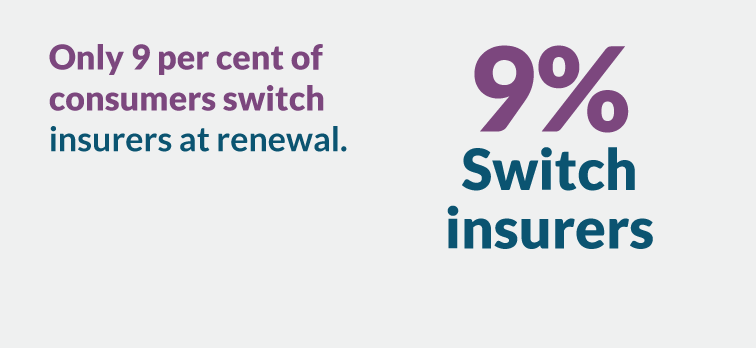
- Only 9 per cent switched to a new insurer
- 1 in 5 renewed without engaging with their insurer at all
Most consumers renewed with their existing provider. However, our analysis shows that consumers who don’t compare quotes could lose out on a better price or more suitable cover – especially higher-risk consumers, where the savings can be much larger.

How consumers arrange their cover
Consumer preference for obtaining cover (they may use more than one channel):
- 53 per cent call their insurer over the phone
- 20 per cent use a broker or intermediary
- 18 per cent go directly through an insurer's website
- 4 per cent use a price comparison website.
If you prefer to deal by phone, you can still shop around. Call multiple insurers, or use a broker to find a better deal. This is especially important for higher-risk consumers who can't always get quotes online.
Satisfaction and engagement
How consumers feel about their insurer:
- 78 per cent are satisfied with their current insurer
- 76 per cent are happy with how their cover was arranged
- 70 per cent only engage with their insurer at renewal.
Being happy with your insurer doesn't mean you're getting the best price. Renewal is when you should act – it's your chance to review your cover and compare other options on the market.
Beyond shopping around, what else can I do to lower my premium?
Shopping around is one of the most effective ways you can find a better price, but there are also practical steps you can take to help reduce the premium you are quoted.
Reduce your risk
Some factors that affect your car insurance premium, like your age, can’t be changed. Others, like where you live, aren’t practical to change just to lower your premium. However, there are some ways that you could reduce insurers’ perception of your risk (and therefore your premium):
- Drive safely: drivers with penalty points, or who have made claims in the past, are likely to pay a higher premium. By driving safely, you minimise these factors.
- Your choice of car affects your premium. Luxury cars cost more to repair, sports cars and modified engines suggest higher risk, and older cars often have fewer safety features. All of these can increase your premium.

Get your discounts
Most insurers offer discounts. The most common is a new business discount, which is offered to customers taking out a policy with an insurer for the first time. You may also get discounts for buying online, or by negotiating directly with the insurer. Shopping around each year helps you find the best price.
Pay annually
Insurers usually let you pay monthly or as a one-off payment. Monthly payments cost more overall because of an added monthly fee.
Increase your excess
Your excess is the amount you agree to pay towards a claim. The higher your excess, the lower your premium.
Adjust your level of cover
You must have third party liability cover by law. All other types of cover are optional – decide which ones best suit your needs.