Key Insights
In this Insight, we examine how banks and Loan Servicing Firms (LSFs) approach resolving mortgage arrears using a sample of distressed mortgage cases from 2024. LSF portfolios contain deeper legacy arrears cases than retail banks. In our sample:
Banks made greater use of short-term arrangements; LSFs made use of trial Alternative Repayment Arrangements (ARAs) while both offered long-term restructuring similarly.
Borrowers at LSFs are approximately five years older than at banks (median age 56 vs 51) and: have higher mortgage balances; have accumulated higher arrears and; are currently repaying only 58% of their contractual amounts versus 80% for bank borrowers.
45% of LSF borrowers have no capacity to repay any of their principal balance, while another 22% would not be able to clear more than half their balance by retirement at current repayment rates. The equivalents are 18% and 16% for banks.
Introduction
Mortgage Arrears and Central Bank of Ireland
Borrowers who have fallen behind on their mortgage repayments or unlikely to repay their mortgage are protected by the Central Bank’s Consumer Protection Code (The Code (2025)). The Code aims to ensure that firms operate in the best interests of their customers, including borrowers. When borrowers are in or facing arrears, their lender must work with them to try find appropriate and sustainable solutions to help them meet their obligations. This Insight examines the range of solutions offered by banks and Loan Servicing Firms (LSFs) in the Irish mortgage market when they engage with borrowers in or facing mortgage arrears. Previous work (Kelly et al, 2021 (PDF 1.19MB)) examined the solutions offered by banks only. This Insight expands on that study by also examining solutions offered by LSFs.
The existing consumer protection framework provides a significant number of protections and supports for borrowers in or facing mortgage arrears and the Central Bank has reviewed and strengthened these rules when necessary.
The Decline in Mortgage Arrears
Mortgage arrears in Ireland rose rapidly in the aftermath of the Global Financial Crisis (GFC) but have been on a steady decline since. The number of principal dwelling house (PDH) mortgage accounts in arrears over 90 days has fallen from a peak of 12.9% of all PDH accounts in September 2013 to 3.1% at end December 2025. (Donnery et al, 2018 (PDF 426.9KB)) provide an overview of the policy interventions that were put in place to aid the reduction in overall arrears, alongside significant supervisory interventions undertaken by the Central Bank.
At end-2025, 75% of arrears cases (over 90 days) were at LSFs, with banks holding the remaining 25%, in contrast to ten years earlier, when it stood at 20% and 80%, respectively. This reflects the deleveraging strategies adopted by the Irish retail banks to repair their balance sheets following the GFC, which included selling large portfolios of distressed mortgage loans which are now serviced by LSFs and also reflects the changes in the composition of retail banks operating in the Irish market.
The emergence of a secondary market for non-performing loans has played an important role in the post-crisis recovery of both the Irish and European banking sectors. Loan sales enable banks to remove distressed assets from their balance sheets, freeing up capital that can be redirected toward new lending to support households and businesses. Importantly, in Ireland when loans are sold, the same consumer protection obligations continue to apply regardless of who owns the loan over its term—these protections are simply transferred from the selling entity to the purchasing entity. Banks and LSFs, supervised by the CBI, must comply with consumer protections and offer appropriate and sustainable solutions to borrowers in or facing mortgage arrears, where feasible. This applies to borrowers engaged with the Mortgage Arrears Resolution Process (see next section).
Using detailed financial information that distressed borrowers provide to their lenders through Standard Financial Statements (SFS), this Insight provides new evidence on how banks and LSFs approach resolving mortgage arrears.
Legal and Data Framework
Consumer Protection Code and Regulations and SFS Data
The Central Bank introduced the Code of Conduct on Mortgage Arrears (PDF 1.36MB) (CCMA) in 2009 and enhanced it in 2013. The CCMA was consolidated into the modernised Consumer Protection Code and Regulations (The Code). The Code includes a specific section applicable to Consumer Banking, Credit and Arrears, specifically Part 3, Chapter 9 contains the former CCMA requirements - for ease of reference, we will refer to it here as Conduct Requirements – Mortgage Arrears (CRMA). The CRMA regulates the specific engagement between the lender and the borrower to achieve an agreed solution, where appropriate. Under the CRMA, both banks and LSFs are required to implement a Mortgage Arrears Resolution Process (MARP) when addressing the needs of customers in arrears or pre-arrears. The MARP framework outlines the process that regulated entities must adhere to, compelling firms to assess each borrower’s individual circumstances to determine whether it can offer an ARA. Any ARA offered should aim to be appropriate and sustainable for the borrower, in accordance with Central Bank Guidance. The guidance requires that an appropriate and sustainable ARA must be tailored to an individual’s financial circumstances and it must allow for reasonable living expenses and long-term debt servicing without placing a disproportionately high burden on a borrower’s net disposable income.
As part of the MARP, borrowers must complete an SFS, which aids in assessing their financial circumstances. The CRMA does not prescribe the specific solutions that should be offered to consumers. Suitability for an ARA needs to be determined on a case-by-case basis. Both banks and LSFs submit these SFS reports to the Central Bank on an anonymised basis. The level of granularity in the SFS data enables the Central Bank to compare borrower demographics, financial circumstances, the types of solutions offered, and the likelihood that borrowers will be able to resolve their arrears over time.
The data analysed in this Insight comprise SFS returns from both banks and LSFs for the year 2024. In total, there were 5,838 SFS submissions over the period of analysis, with LSFs representing 47% of all cases submitted. Our analysis focuses on a subset of these submissions (5,374 in total, Table 1), including those cases where an ARA was offered and those cases where no ARA could be agreed. The SFS submissions contain information regarding the financial conditions of borrowers with distressed debt in the Irish mortgage market. This includes information on repayment amounts due, amounts paid, household expenditure, and family composition, among other details for each borrower. It is important to note that the SFS data consists of both self-reported and bank-collected information. Consequently, there may be omissions during the submission process. Data on borrowers at LSFs is more limited in both time series length and detail compared to bank data. Therefore, this Insight concentrates on the most current data available for both banks and LSFs, providing a snapshot of the situation in 2024.
Forbearance Type – Banks and LSFs
In 2024, given the profile of loans that completed an SFS, LSFs record a "No Resolution" outcome in 27.3% of cases, compared to 15.4% for banks (Table 1). Such variances in "No Resolution" cases can occur for various reasons: the borrower may not be fully engaging with the process, or key details on the SFS to make a decision might be missing, or the lender may determine that no sustainable arrangement is possible given the borrower's circumstances.
This higher rate of unresolved cases at LSFs may also reflect the fact that many of these borrowers were already in arrears when the loans were acquired. This difference in loan book composition is significant. According to the Central Bank’s mortgage arrears and repossession statistics (PDF 1.06MB), at end-2025, LSFs held 75% of all accounts in arrears over 90 days.
Table 1: Outcomes of Mortgage Arrears Reviews by Banks and LSFs (2024)
| | Banks | LSF |
|---|
| Lender Decision | Count | % | Count | % |
|---|
| Forbearance Offered | 2,403 | 84.61% | 1,843 | 72.73% |
| No Resolution | 437 | 15.39% | 691 | 27.27% |
Source: SFS returns for the year 2024.
Types of Repayment Arrangements
For repayments arrangements agreed between lenders and borrowers, the types of arrangements can differ somewhat between banks and LSFs (Table 2). These arrangements fall into three main categories:
- Short-term arrangements typically last one year or less and provide temporary relief when financial difficulties are expected to be short-lived. Examples include payment breaks, interest-only periods or temporarily reduced payments.
- Long-term arrangements extend over multiple years and involve more substantial modifications to the mortgage terms, such as extending the mortgage term, permanently reducing the interest rate, or writing off part of the debt.
- Trial arrangements are temporary arrangements lasting three to six months that test whether a proposed long-term solution will work before finalizing it. The lender assesses whether the borrower can meet the proposed repayments during this trial period.
Table 2: Forbearance Offered Type – Banks and LSFs (2024)
| | Banks | LSFs |
|---|
| Forbearance Offered Type | Count | % | Count | % |
|---|
| Short Term ARA | 1,490 | 52.5% | 605 | 23.9% |
| Long Term ARA | 913 | 32.2% | 861 | 33.9% |
| No Resolution | 437 | 15.4% | 691 | 27.3% |
| Trial ARA | | | 377 | 14.9% |
Source: SFS returns for year 2024.
Findings from this analysis indicates that banks made much greater use of short-term arrangements (53% of cases) compared to LSFs (24%). Another key difference is that LSFs made use of Trial ARAs, 15% of cases, while banks did not report any trial arrangements in 2024. Trial ARAs are a test run of a longer-term restructuring solution. Both banks and LSFs offer long-term arrangements at similar rates—around one-third of cases for each. This suggests that when borrowers require fundamental restructuring of their mortgage terms, both types of lenders are willing to offer these more substantial solutions.
Interest Rates
Recent Interest Rate Trends
Recent Central Bank of Ireland Frontier Statistics show that across the overall mortgage market, the median interest rate at LSFs is lower than at banks (Figure 1). This aggregate view reflects all mortgage holders at each lender type, including both performing and non-performing loans. However, LSFs continue to have a wider distribution of interest rates compared to banks or non-bank lenders.
Figure 1 - Interest Rate Distribution by Lender Type as of December 2025.
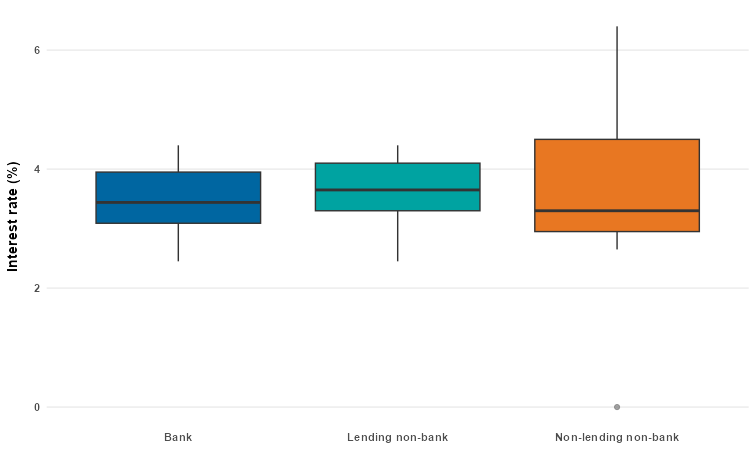
Source: Central Bank of Ireland Frontier Statistics on Interest Rates, December 2025.
Accessibility: Get the data in accessible format. (CSV 0.89KB)
The picture changes when examining borrowers in arrears specifically in our sample of data. Among the engaged borrowers in our (2024 SFS) sample, those at LSFs pay median interest rates approximately 1.5 percentage points higher than those at banks (Table 3). In our 2024 sample, a time when official interest rates were elevated, the median borrower interest rate was 5.65% at LSFs, compared to 4.25% for bank borrowers.
This higher rate among LSF borrowers reflects the characteristics of these loans at origination. Many were issued during the pre-GFC period when rates were higher and subsequently entered distress. The rate type also differs. In our sample, over a quarter of bank borrowers were on fixed rates, while LSF borrowers were predominantly on variable rates (58%), with slightly fewer on tracker rates (34% vs 38% at banks).
Table 3: Interest Rate Characteristics of Distressed Borrowers at Banks and LSFs (2024)
| Interest Rate Characteristics | Banks
N = 2,840* | LSFs
N = 2,534* |
|---|
| Interest Rate (%) | 4.25 (3.75, 4.65) | 5.65 (5.15, 6.60) |
| Rate Type |
| Tracker | 924 (38%) | 681 (34%) |
| Fixed | 679 (28%) | 145 (7.3%) |
| Part-fixed, part-variable | 0 (0%) | 8 (0.4%) |
| Variable | 850 (35%) | 1,151 (58%) |
*Median (1Q, Q3): n (%)
Source: SFS returns for the year 2024.
Note: Percentages show the proportion of borrowers on each rate type. The 25th to 75th percentile range shows where the middle 50% of borrowers fall.
Characteristics of Borrowers
Understanding borrowers in or facing arrears is essential for assessing their capacity to resolve their mortgage difficulties. This section compares the demographic profile, financial circumstances, and mortgage characteristics of borrowers at banks and LSFs. As we will show, LSF borrowers tend to be older, have larger mortgage balances, and face deeper arrears than bank borrowers.
Borrower Demographics
Age and Time to Retirement
Borrower age is a critical factor in determining appropriate and sustainable solutions to mortgage distress. Younger borrowers have more years of working life ahead of them to repay outstanding debt, while prospects for income growth are typically higher at a younger age.
Engaging borrowers in arrears whose loans are held by LSFs are older than engaging borrowers in arrears whose loans are with banks. As shown in Table 4, the median age of the primary borrower at LSFs is 56 years, compared to 51 years at banks. Where there is a second borrower (e.g. spouse), the pattern is similar: a median age of 56 years at LSFs versus 50 years at banks.
Figure 2 illustrates the age distribution of distressed borrowers, with the distribution for LSF borrowers clearly shifted toward older age groups compared to bank borrowers.
Table 4: 2024 Bank & LSFs – Borrower Demographics
| Characteristics of Borrowers | Banks
N = 2,840* | LSFs
N = 2,534* |
|---|
| Age of Borrower 1 | 51 (46, 57) | 56 (50, 64) |
| Age of Borrower 2 | 50 (45, 56) | 56 (51, 64) |
| Number Employed | 1,915 (67%) | 1,536 (63%) |
| Net Monthly Income | 3,192 (1,905, 4,710) | 3,195 (2,149, 4,522) |
| Monthly Spending | 2,387 (1,588, 3,400) | 2,093 (1,450, 2,878) |
*Median (Q1, Q3); n (%)
Source: SFS Returns for year 2024.
Note: For age and income/spending figures, the table shows the median (middle value) with the 25th and 75th percentiles in brackets. For employment, the table shows the number and percentage of households where at least one borrower is employed.
Figure 2: Age Distribution of Distressed Borrowers at Banks and LSFs
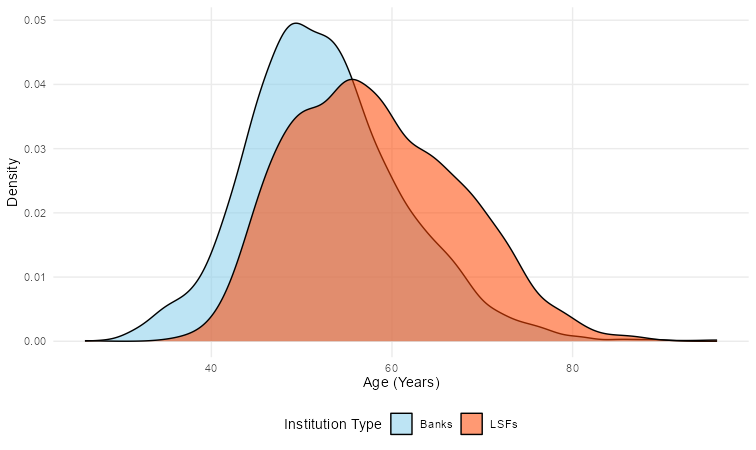
Source: SFS Returns for year 2024 from selected bank and LSF entities.
Note: The chart shows the share of borrowers at each age. Approximately 25% of borrowers at LSFs are aged 65 years or older while the equivalent figure for banks is 10%.
Accessibility: Get the data in accessible format. (CSV 0.11KB)
Income, Employment and Expenditure
Despite the age difference, household incomes are similar between the two groups. The median monthly household income is approximately €3,200 for both bank and LSF borrowers. Employment rates are also broadly similar, though slightly lower at LSFs, with roughly one-third of distressed borrowers in both groups having no employment income, against a backdrop of close to full employment in the wider economy. The median bank borrower reports spending €2,387 per month, while the median LSF borrower reports spending €2,093 per month—a difference of €294.
Mortgage Characteristics
The mortgages held by LSFs differ substantially from those held by banks in terms of loan size, arrears levels, and overall financial position (Table 5). These differences partly reflect the nature of the loan portfolios that LSFs acquired.
Outstanding Balances and Time to Maturity
LSF borrowers have larger outstanding mortgage balances than their bank counterparts. The median LSF borrower owes ~€169,000, compared to ~€156,000 for bank borrowers (Table 5). LSF borrowers also have less time remaining on their mortgages (typically 12 years vs 16 years for bank borrowers).
Contractual Payments vs. Actual Payments
Despite having larger outstanding balances, LSF borrowers actually have lower contractual monthly payments than bank borrowers. The median LSF borrower is contracted to pay €1,029 per month, compared to €1,162 for bank borrowers. This apparent contradiction—larger loans but smaller payments—reflects the fact that many LSF loans have been restructured with extended terms, split mortgages or reduced payments or may have been on interest-only arrangements. However, the critical difference lies in actual payment behaviour. Bank borrowers are making payments closer to the monthly contractual agreement, whereas LSF borrowers are meeting less of their contractual payment obligations:
- Bank borrowers: The median borrower pays €936 per month against a contractual payment of €1,162—about 80% of what is due.
- LSF borrowers: The median borrower pays €600 per month against a contractual payment of €1,029—about 58% of what is due.
Arrears Levels
The difference in payment behaviour naturally translates into much higher arrears at LSFs. The median engaged borrower at LSFs has accumulated €6,238 in arrears, compared to €3,072 for bank borrowers—roughly twice as much. In addition, one quarter of the borrowers at LSFs have arrears exceeding €33,611, indicating very long-term payment difficulties (the equivalent for banks is €8,628). These high arrears levels reflect the fact that many borrowers at LSFs have been in financial distress for extended periods.
Leverage: Loan-to-Value and Loan-to-Income Ratios
Leverage—the size of the mortgage relative to the property value and the borrower's income—is higher for LSF borrowers, indicating less equity held in the property:
- Loan-to-Value (LTV) ratio measures the outstanding mortgage balance as a percentage of the property's current value. Reflecting the recovery in the housing market since the GFC, there is substantial home equity in most distressed mortgages. The median LTV is 63% for LSF borrowers compared to 42% for bank borrowers. Higher LTV ratios indicate less equity in the home and greater financial vulnerability. One quarter of LSF borrowers have LTV ratios of 90% or higher.
- Loan-to-Income (LTI) ratio measures the outstanding mortgage balance relative to annual household income. The median LTI is 4.3 for LSF borrowers compared to 3.9 for bank borrowers.
Table 5: 2024 Bank & LSFs – Mortgage Characteristics
| Mortgage Characteristics | Banks
N = 2,840* | LSFs
N = 2,534* |
|---|
| Years to Maturity | 16 (10, 20) | 12 (5, 18) |
| Mortgage Payment Due | 1,162 (825, 1,567) | 1,029 (598, 1,566) |
| Mortgage Payment Being Paid | 936 (502, 1,367) | 600 (0, 1,126) |
| Current Mortgage Arrears | 3,072 (0, 8,628) | 6,238 (779, 33,611) |
| Current Outstanding Balance | 156,231 (101,702, 222,222) | 169,231 (103,391, 254,799) |
| LTV | 0.42 (0.27, 0.57) | 0.63 (0.38, 0.90) |
| LTI | 3.9 (2.5, 6.2) | 4.3 (2.7, 6.9) |
*Median (Q1, Q3); n (%)
Source: SFS returns for the year 2024.
Ability to Repay Mortgage Obligations
A critical question for borrowers in arrears, particularly those approaching retirement age, is whether they will be able to repay their mortgages before retirement when their income may decline. This section examines borrowers' capacity to clear their mortgage based on their current payment patterns and the time they have remaining before retirement.
A substantial proportion of the sample of distressed borrowers at both banks and LSFs have significant challenge in repaying their mortgages before retirement age. For borrowers with no capacity to repay, traditional restructuring arrangements that extend the loan term or reduce payments temporarily will not work—more fundamental solutions are needed.
This data shows that there is a need to consider further if there is more that can be done by LSFs and banks to support engaged and non-engaged borrowers.
How We Assessed Repayment Capacity
To assess whether the sample of borrowers can repay their mortgages, we projected their repayment paths forward based on their current payment behaviour. Specifically, we assumed that borrowers would continue making payments at their current rate until they reach retirement age or until their mortgage matures, whichever comes first. This approach follows the methodology applied in an earlier study of Long-Term Mortgage Arrears (LTMA) cases (Kelly et al., 2021 (PDF 1.19MB)). We use retirement age as the key milestone because income typically falls substantially at retirement. In Ireland, the state pension age is currently 66.
Table 6 presents the results of this simulation, showing the percentage of the total mortgage balance expected to be repaid under these assumptions for both banks and LSFs. The results indicate that LSFs hold a larger share of loans with the significant challenge of being repaid before retirement age: only 32% of households submitting SFS reports to LSFs are projected to repay more than 50% of their outstanding mortgage balance by this time. Furthermore, 45% of borrowers are unable to clear any of the mortgage balance at all. In contrast, over 65% of distressed bank borrowers are estimated to be able to repay more than half of their mortgage debt before retirement or maturity.
Table 6: Projected Repayment Capacity Before Retirement
| Repayment Capacity | Banks | LSFs |
|---|
| | Count | % | Count | % |
|---|
| Can clear more than 50% of balance | 1,851 | 65.2% | 814 | 32.1% |
| Can clear some, but less than 50% | 464 | 16.3% | 573 | 22.6% |
| Cannot clear any of the balance | 525 | 18.5% | 1,147 | 45.3% |
Source: SFS Returns for year 2024 from banks and LSFs. The sample represents engaged borrowers only.
These simulation findings highlight that the mortgage balances for a large proportion of SFS cases at banks and LSFs in 2024 can either not be cleared before retirement or the borrowers can only repay less than 50% of the balance before retirement. The proportion of such cases is higher at LSFs than banks. Specifically, our findings show that 18.5% of our sample or 525 cases cannot clear any of their balance before retirement under current repayment behaviour while the equivalent for LSFs equates to 45.3% or 1,147 mortgages.
The Need for Solutions Beyond the Financial System
While banks and LSFs can and should continue do more in offering appropriate and sustainable ARAs to borrowers in arrears, the findings in this Insight highlight that for a cohort of borrowers in or facing arrears, solutions within the financial system alone will not be sufficient. Traditional mortgage restructuring tools such as term extensions, payment reductions, or interest rate modifications can help borrowers who have some capacity to repay. But for the 45% of borrowers at LSFs in our sample (and 19% of bank borrowers in our sample) who cannot clear any of their mortgage balance before retirement, other interventions are likely needed. Following sustained house price growth in recent years (FSR 2026:I, Chart 21 (PDF 0.98MB)), the significant positive equity for many may allow for a wider set of options to be considered than would be the case were house prices falling. For those mortgage arrears cases that cannot be resolved with solutions within the financial system alone, there are other options, for example, involving programmes and bodies with statutory standing, such as the Mortgage to Rent scheme and the system of Personal Insolvency Arrangements.
Conclusion
This Insight has examined the approaches taken by banks and LSFs when working with borrowers who have fallen into arrears in Ireland. Borrowers at LSFs are closer to retirement age with the average age of borrowers in this group at 56 years. There is a larger concentration of borrowers in longer-term arrears at LSFs. The analysis displays some differences in resolution practices of LSFs when compared to banks. Banks made greater use of short-term arrangements than LSFs. LSFs made similar use of trial arrangements in their suite of resolution options. Banks and LSFs made similar use of longer term ARAs. LSFs have a higher proportion of borrowers who are not meeting their repayment requirements. The ability to repay mortgage obligations by borrowers in long-term arrears who are now approaching or at retirement age remains a concern. Finding sustainable restructures within the financial system for engaged borrowers in long-term mortgage arrears may not be possible. The Central Bank expectation is that firms continue to work with borrowers in arrears or those facing arrears and to offer appropriate and sustainable ARAs that meet the criteria outlined in its July 2025 (updated August 2026) guidance (PDF 441.72KB).
References
- Terry O’Malley. 2021. “The Impact of Repossession Risk on Mortgage Default". The Journal of Finance, Volume 76, Issue 2.
- Fergal McCann. 2017. “Resolving a Non-Performing Loan crisis: The ongoing case of the Irish mortgage market” (PDF 0.97MB). Research Technical Papers 10/RT/17, Central Bank of Ireland.
- Christian Danne, Anne McGuinness. 2016. “Mortgage modifications and loan performance” (PDF 877.17KB). Research Technical Papers 05/RT/16, Central Bank of Ireland.
- Robert Kelly, Fergal McCann. 2016. “Some defaults are deeper than others: Understanding long-term mortgage arrears”. Journal of Banking & Finance, Volume 72, Pages 15-27.
- Robert Kelly, Terry O’Malley. 2014. “A Transitions-Based Model of Default for Irish Mortgages” (PDF 870.65KB). Research Technical Papers 17/RT/14, Central Bank of Ireland.
- IMF FSAP, 2022, Technical Note on Insolvency and Creditor Rights.
- Central Bank of Ireland. (2025) "Appropriate and sustainable ARAs." (PDF 441.72KB) Central Bank of Ireland.
Appendix A
Table 1A
| Lender Decision | Banks | LSFs |
|---|
| | Count | % | Count | % |
|---|
| Forbearance Offered | 2,414 | 83.18% | 1,855 | 63.18% |
| No Resolution | 437 | 15.06% | 691 | 23.54% |
| Full Capital and Interest | 50 | 1.72% | 22 | 0.75% |
| Review No Change | 1 | 0.03% | 277 | 9.43% |
| Review Increased Payments | | | 91 | 3.10% |
Table 2A
| Short Term ARA Options | Banks | LSFs |
|---|
| | Count | % | Count | % |
|---|
| Payment Moratorium | 709 | 47.5% | 132 | 21.8% |
| Interest Only Up to One Year | 302 | 20.4% | 55 | 9.1% |
| Reduced Payment Greater than Interest Only | 244 | 16.4% | 258 | 42.6% |
| Reduced Payment Less than Interest Only | 215 | 14.4% | 66 | 10.9% |
| Deferred Interest Scheme | 11 | 0.7% | | |
| Interest Only over One Year | 9 | 0.5% | | |
| Temporary Interest Rate Reduction Not Currently Part of Another Arrangement | 1 | 0.1% | 94 | 15.5% |
Table 3A: Long Term Arrears Resolution (ARA) Options by Banks and LSFs
| Long Term ARA Options | Banks | LSFs |
|---|
| | Count | % | Count | % |
|---|
| Arrears Capitalisation not Currently Part of Another Restructure Arrangement | 509 | 55.8% | 254 | 29.5% |
| Term Extension not Currently Part of Another Restructure Arrangement | 163 | 17.9% | 17 | 1.9% |
| Trade Down Mortgages in Positive Equity | 134 | 14.7% | | |
| Term Extension and Arrears Capitalisation | 88 | 9.6% | 272 | 31.6% |
| Trade Down Mortgages in Negative Equity | 7 | 0.8% | | |
| Mortgage to Rent | 5 | 0.6% | | |
| Split Mortgage | 4 | 0.4% | | |
| Full and Final Settlement | 1 | 0.1% | | |
| Mortgage to Lease Scheme | 1 | 0.1% | | |
| Permanent Interest Rate Reduction Not Currently Part of Another Arrangement | 1 | 0.1% | 67 | 7.8% |
| Arrears Capitalisation and Write Down | | | 1 | 0.1% |
| Permanent Rate Reduction and Arrears Capitalisation | | | 25 | 2.9% |
| Positive Equity Sustainable Solution | | | 4 | 0.5% |
| Reduced Payment Greater than Interest Only and Permanent Interest Rate Reduction | | | 12 | 1.4% |
| Reduced Payment Greater than Interest Only and Temporary Interest Rate Reduction | | | 23 | 2.7% |
| Reduced Payment Greater than Interest Only and Term Extension | | | 35 | 4.1% |
| Reduced Payment Greater than Interest Only and Term Extension and Permanent Interest Rate Reduction | | | 80 | 9.3% |
| Reduced Payment Greater than Interest Only and Term Extension and Temporary Interest Rate Reduction | | | 3 | 0.4% |
| Term Extension and Arrears Capitalisation and Write Down | | | 1 | 0.1% |
| Term Extension and Permanent Rate Reduction | | | 6 | 0.7% |
| Term Extension and Permanent Rate Reduction and Arrears Capitalisation | | | 44 | 5.1% |
| Term Extension and Permanent Rate Reduction and Arrears Capitalisation and Lump Sum Payment | | | 4 | 0.5% |
| Term Extension and Reduced Payment Greater than Interest Only | | | 1 | 0.1% |
| Term Extension and Temporary Interest Rate Reduction | | | 12 | 1.4% |
Endnotes