Bridge to the Future: Mobilising Europe's Savings in a Fragmenting World - Speech by Governor Gabriel Makhlouf at Eurofi
27 March 2026
Speech
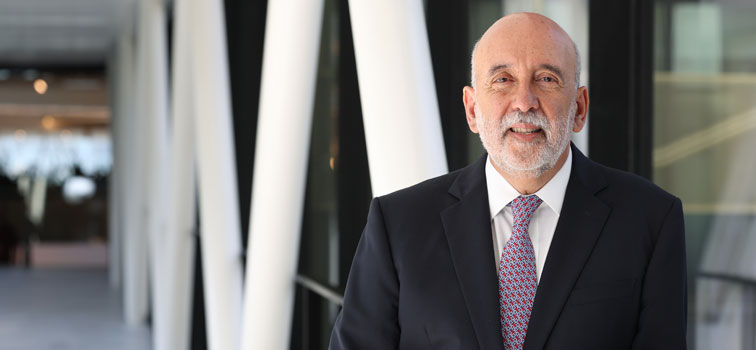 Good morning and thank you for the invitation to join you.
Let me begin by acknowledging the difficult backdrop to my remarks today. The sad fact that this event has been forced online underscores the realities of the changed world we are in. Προς τους φίλους μου στην Κύπρο, λυπάμαι που δεν είμαι μαζί σας και ελπίζω να μπορέσω να έρθω σύντομα κοντά σας.
We are living through a period where the global environment is shifting economically, politically and institutionally. These shifts reinforce the need for the values, systems and structures that we have relied upon, indeed built our economic model upon: multilateral, shared rules, collaboratively designed and based on mutual respect and trust. While we may not have sought out the shifts, we need to recognise that they represent a new reality and, as European policymakers, we should double-down on our commitment to openness, to the rule of law, to stable institutions and to our values.
My main message today is that mobilising Europe’s savings requires us to ensure that our economy is productive and innovative and operates as a genuine Single Market, creating the prosperity that generates capital that supports the longer-term wellbeing of Europe’s citizens. To put it another way, don’t ask only what the Savings and Investments Union can do for you; ask what a genuinely barrier-free Single Market can do for Europe’s savings and investments.
In thinking about how we respond to this moment of economic and political shifts, I find it useful to consider the image of a bridge. A bridge connects by bringing places and peoples closer together, arguably the raison d’être of the European Union. In responding to our new, more fragmented, world, we need to think about the bridges that will help us to connect better. And the bridge I want to talk about today is bringing European economies closer together so that they and their financial systems are better connected to European citizens.
Europe today finds itself in a curious position: households and institutions collectively hold substantial savings. In the euro area alone, savings rates spiked during the pandemic and remain materially high at around 15 per cent, still in excess of pre-covid levels. This has meant that Europe’s total stock of household deposits is now nearing €10 trillion1.
Yet investment, particularly through European capital markets has not kept pace with this increase. While only one-fifth of euro area household wealth is held in financial assets, we know that households in other countries allocate a significantly larger share of their wealth to market-based instruments.
Echoing the paradox of thrift: while saving is prudent for individuals, when considered at the macro level they can dampen demand and constrain growth if not channelled into investment.
Channelling a proportion of that stock and flow of savings into investment would go some way to helping the EU meet its investment needs, estimated at an additional €750-800 billion annually by 2030.
The savings and investment habits of Europeans reflect a range of considerations, some of them are structural, some are cultural, some align with economic incentives or risk appetites and others are about knowledge and understanding.
You will be relieved to hear that I won’t address all of these today. But in considering how to mobilise savings to invest in European capital markets – or how to strengthen the bridge that brings savings and investments closer together – I want to start by focusing on a key fundamental, namely the economic growth that generates the savings that are needed by European capital markets.
Sustainable growth and deep and liquid markets enable capital to flow efficiently to investment. And with capital allocated productively, the economy can grow in a sustainable way.
The policy agenda to strengthen the bridge that we now call the Savings and Investments Union is welcome, needed and more important than ever.
A more fragmented world
That is because we are operating in a global system that is becoming more fragmented.
Trade, technology and capital flows are increasingly shaped by geopolitical considerations. Supply chains are being reconfigured. Autonomy is becoming a policy objective across jurisdictions. Sometimes it can be strategic. And sometimes it can even be open. Either way, the rules-based system that has underpinned decades of economic integration is broken.
The resulting geoeconomic fragmentation, coupled with the pandemic and Russia’s war on Ukraine and its people comprise a trifecta of serious shocks to the European economy. The war on Iran has turned that into a quadruple. And perhaps we are seeing an emerging environment resembling Joseph Nye’s “Kindleberger Trap”, a world in which global leadership and coordination weaken, and with them the stability of the economic system.
Whether or not you accept that scenario, the direction of travel is clear: we are moving toward a world where European economic strength matters more than ever.
For us in Europe, it presents both a challenge and an opportunity.
The challenge is that our growth performance is not as high as we would expect from an advanced economy of 450 million people accounting for over 14 per cent of global GDP. We are not achieving the potential of our underlying fundamentals.
The opportunity is that we have a set of institutional strengths that are highly valued – and increasingly highly valued – in a fragmented world: predictability, stability and a deep commitment to the rule of law. The question, therefore, is not whether Europe has the resources to succeed. It is whether we are deploying them effectively. Mario Draghi and Enrico Letta have addressed that question.
Mobilising European savings: getting the foundations right
Which brings me to the core issue I want to focus on today, how to build the bridge that helps to ensure European capital works for Europeans. We know that Europe has abundant savings. And yet a significant proportion of those savings continues to be invested outside the European Union. Why is that?
Growth prospects
At its core, the answer is straightforward: capital will always seek out the greatest potential returns. If European savings are flowing abroad, it reflects the fact that investors, whether households or institutions, expect higher risk-adjusted returns elsewhere.
So, the question we should be asking is not simply how to redirect those flows, but why those returns are perceived to be higher outside Europe, and what we can do about it.
Fundamentally, it comes back to the performance of the real economy. If European growth remains relatively weak, it limits the effectiveness of any financial or regulatory reforms aimed at deepening and integrating our capital markets.
This is the central message that runs through the Draghi and Letta reports: productivity and growth are the fundamental drivers of economic success.
Of course, growth does not exist in isolation. It depends on a stable macroeconomic framework: sound monetary policy delivering price stability, prudent fiscal policy, and sustainable debt dynamics. These are not optional. They are the foundations upon which everything else is built.
But beyond these fundamentals, we should focus on the structural conditions that support growth. And here, I think we need to be clear: the Single Market remains our most powerful, and underutilised asset.
Thirty years after its creation, significant barriers remain, particularly in services. Removing those barriers would not only boost productivity directly; it would also enable a step change in the development of Europe’s capital markets.
Market depth and liquidity
The fact is that European capital markets remain less deep and less liquid than their counterparts elsewhere. This is both a cause and a consequence of capital outflows.
Liquidity attracts liquidity. Large investors are reluctant to commit to markets where exit is uncertain. This keeps volumes low, which in turn keeps liquidity thin. Breaking this equilibrium requires scale.
It requires a critical mass of issuance, including the development of a European safe asset. European policy makers need to give serious consideration to whether now is the right time to pursue a European safe asset, one which could anchor institutional capital. In my view the answer is an unambiguous ‘yes’. It would be a significant step forward, and an important counter to European savings and capital being drawn towards alternatives.
Our capital markets also require stronger retail participation, including – I suggest – through pension reform. And it requires continued efforts to reduce fragmentation within markets. I mention this not for the sake of the financial services industry but because of the benefits that participation in capital markets can bring to the real economy and to individual households.
The Savings and Investments Union has the potential to improve market functioning, simplify the regulatory framework, and support innovation. But we should also be clear about its limits.
Financial market reforms cannot substitute for real economy performance. Nor should debates about supervisory structures distract us from higher-priority objectives. Improving convergence in supervision matters but it is not the defining feature of a successful capital market.
What matters more are deep and liquid markets, supported by strong economic growth and a large supply of high-quality assets. These elements would improve the bridge between savings and productive investment both for the individual European citizen and the European community as a whole.
The role of central banks and regulators
So where do central banks and regulators fit into this picture?
Our role is not to deliver productivity growth or remove barriers in the Single Market. But we are responsible for anchoring the conditions that make growth and investment possible.
First and foremost, that means delivering on our mandate of price stability despite the geoeconomic environment becoming increasingly more volatile.
Stable and predictable prices are essential for long-term investment decisions. Without them, uncertainty increases, risk premia rise, and capital allocation becomes less efficient.
Second, we have a responsibility for financial stability.
A stable financial system is a precondition for effective capital allocation. It protects consumers, supports confidence, reduces risk, and enables investment.
At the Central Bank of Ireland, our priorities reflect these realities. Our recently published Regulatory and Supervisory Outlook report emphasises the importance of resilience across institutions, markets and the system as a whole. It highlights the need to protect consumers and investors. And it recognises the growing importance of innovation and technological change.
We are also focused on ensuring that our regulatory framework is effective and efficient and have published a roadmap on how we intend to ensure we regulate and supervise well, supporting better outcomes and effective resilience.
Conclusion
Let me conclude. Europe does not lack savings, and it certainly does not lack potential. But we need to work collectively to enable the conditions – namely growth, market depth and scale – required to retain and deploy those savings within European capital markets.
In a more fragmented world, this matters more than ever. Because capital will increasingly flow to those economies that offer not only stability, but also opportunity.
The task before us is therefore clear:
- Strengthen our growth prospects
- Complete and deepen our Single Market
- Build more effective and integrated capital markets
- And maintain the macroeconomic and institutional stability that is Europe’s hallmark
Oscar Wilde once put it well, “the truth is rarely pure and never simple”. And the way forward is neither easy nor simple.
But, if we do these things, European savings will not need to be persuaded to stay. They will remain because the opportunities are here, because we have built the bridge – one of Robert Schuman’s réalisations concrètes – to connect savings with productive investments.
And although building bridges isn’t a straightforward task, we Europeans have a history of doing it well, from the Arkadiko Bridge in Greece and the Ponte Vecchio in Florence to the Viaduc de Millau in France and the Øresundbron between Denmark and Sweden and many others.
By harnessing our Single Market alongside our international openness, outlook and leadership and by building a Savings to Investments Bridge, we can ensure that Europe’s economic future is not only secure but strong.
Thank you to Seán O’Sullivan, Cian O’Laoide, Caroline Mehigan and Vasileios Madouros for their input into these remarks.
[1] https://data.ecb.europa.eu/key-figures/money-credit-and-banking/bank-balance-sheets/deposits?tab=Households&indicator=Deposits%2C+total+-+stocks