“Capital, Competition, and Complexity – regulatory perspectives on the regulatory debate” – Remarks by Deputy Governor Mary-Elizabeth McMunn
07 May 2026
Speech

Introduction
Good morning – I am delighted to be here, and many thanks to Brian and the BPFI for hosting us.1
I very much look forward to the discussion, and to hearing from you all today, but before I do I would like to set out some reflections on a number of topics which are currently high on the regulatory agenda.
While the discussion is multifaceted, and tied up with a regulatory cycle which has turned, an economic one which has become more challenging, not to mention a renewed focus by policymakers on longer term challenges to productivity, innovation, and growth – I will focus my remarks on what I would broadly categorize as the ‘3 Cs’, namely:
- Capital
- Competition and
- Complexity
Given their importance, and indeed their prevalence in the regulatory debate, I would like to set out my perspective on these 3 Cs as Deputy Governor for Financial Regulation at the Central Bank of Ireland – informed by our mandate, our experience, and the data and analysis we undertake.
But before I do, let me very briefly touch on the current risk environment – the crucial context in which we are having this debate.
Current risk environment
We are living through a time of extraordinary change – with significant geo-economic shifts and fragmentation, coinciding with rapid and potentially transformative technological innovation.
Such change is reshaping our economies, our financial system, and the risk landscape of the sectors we supervise and of the consumers and investors we work to protect.
We set our views and thinking on this challenging risk environment and our priorities in our Regulatory and Supervisory Outlook (RSO) – and so I won’t go into detail on them now.2 I would just note that some of these risks are intensifying, and reiterate that while the sector has demonstrated its resilience in the face of such uncertainty, instability and complexity, you must continue to respond, ensuring that response is characterised by
- Resilience – financially and operationally, to withstand and respond to both traditional and novel shocks;
- Adaptability – so that the sector is able to continue to deliver on its important function, now and into the future, in the face of uncertainty and rapid change; and
- Trustworthiness – providing confidence to consumers and in the financial system through times of challenge and change, by maintaining trust, the crucial underpinning of the modern economy.
Capital
Let me turn now to my first C – Capital – and the capital requirements in place for the banking sector.
Since the first Basel capital accord in 1988, there has been a near continuous global debate on bank capital – a debate which is often procyclical, and follows the regulatory cycle, inevitably learning lessons, often hard learned, from that cycle.
Alongside liquidity, the very oxygen of the financial system, capital is a crucial part of the resilience of the financial sector and banks’ own ability to withstand shocks. We have all seen what happens when the banking sector does not have enough capital – when it cannot absorb shocks, but rather amplifies them. And so robust capital positions play a fundamental role in the safety and soundness of banks and the wider system.
Keeping the sector strong and resilient, is not about resilience for resilience’s sake – but rather so banks can continue to perform their important functions through good times and bad. This is why I firmly believe that a resilient, stable and well-capitalised banking sector is not just good for consumers: but good for banks, good for their investors, and good for the economy.
In terms of setting capital, we think carefully about capital requirements, and follow what for me are some key tenets of modern capital setting, which include being:
- Risk based – to state the obvious, capital requirements should reflect the risks of a banks’ exposures, as well as the risks facing the system as a whole.
- Forward looking – capital requirements should be set to anticipate risks, and to prepare for future shocks, informed through regular stress testing;
- Coherent – while different aspects of the framework have different purposes, and are looked at through different lenses, the parts of capital setting must be cognisant of the whole – avoiding either underlaps or overlaps – something as an integrated central bank and regulator we are focused on3; and
- Countercyclical – a key principle is that capital is built up in the good times, rather than trying to build it in the bad times – given the vicious circles we have seen from pro-cyclicality in the past.
So what does that mean in practice?
Well it means that capital requirements go up and down depending on the risk profile of an institution as well as the magnitude of the risks facing the system as a whole – and so banks will see reductions or increases in capital requirements informed by the risks they face. There is an onus on regulators to clearly explain movements in either direction, and be open to constructive challenge and debate.
Capital requirements will be based on a robust and realistic assessment of the future, including plausible worst case stress scenarios.
And capital should be used – and indeed requirements lowered – in the bad times, to ensure banks continue to lend through the cycle. This is why we have releasable capital buffers, on which strong institutions can and should draw in times of economic stress.
But the capital framework we have is not a theoretical exercise – but a very real part of regulation in practice. And so in this regard, it is important to look at the numbers – the requirements themselves – not in isolation but in action.
The 2020s so far has been an extraordinary one in terms of economic shocks and shifts.
While many of these shocks have seen unprecedented policy responses4, Ireland and the EU’s banking sector has shown real resilience in the face of the global shocks and financial volatility that has so far characterised this decade.
We should take confidence from this. But of course confidence should not be confused with complacency – and policymakers may not always have the policy space to intervene.
I would argue that a huge part of the strength demonstrated through the difficult times, has been the strength built up in the better times – of which ex ante resilience in the form of robust capital and liquidity positions are key.
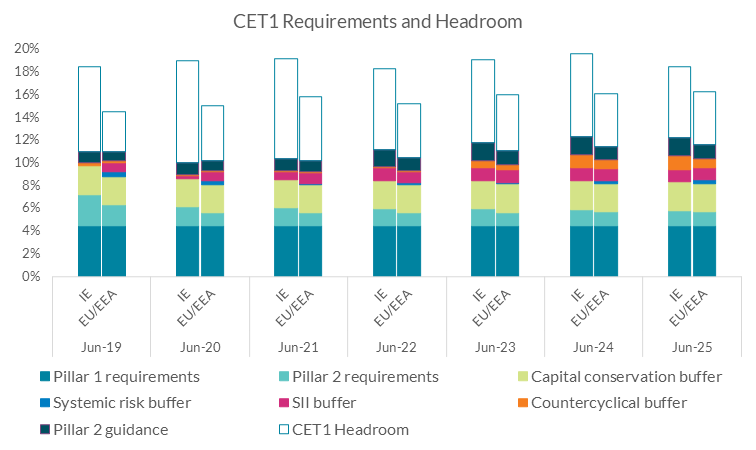
Furthermore, looking at the capital requirements during this period bears out a framework working broadly as intended and in line with good capital setting – with the requirements themselves built in advance, and broadly stable at the aggregate level throughout, aside from the reduction of the countercyclical buffer as part of the regulatory response to Covid, demonstrating that regulators will release buffers and reduce requirements when necessary.
Figure 1: Capital Requirements by component parts, Irish and EU banks5
Such strength built in good times, and relied on at times of stress, has been a huge asset for the sector, our financial system and the economy. However, despite this, in the face of an increasingly challenging global outlook, there are now emerging – and increasingly explicit – calls for a lowering of capital requirements.
I fully believe that regulators and policymakers should be humble, accountable and open to challenge and debate. But I also believe that independent regulators should actively engage in that debate – given the different interests at play, and their responsibility to serve the public interest.
In that regard while it is healthy that regulations and requirements are regularly reviewed, to ensure different aspects of the framework are working right – which for me is the essence of simplification – an explicit focus on reducing levels of capital in itself to be honest sounds much more like de-regulation.
This is why central bankers and regulators across the Eurosystem endorsed the firm principle last December that any proposals to change the EU prudential banking framework must sustain current levels of resilience.6
This recognises that financial stability, and the stability of the banking sector, are a pre-requisite for sustainable growth.
I of course acknowledge that mine is a regulatory perspective, and that there are others who believe the opposite, and that capital requirements are simply too high.
In my experience proponents of lowering capital, usually focus on three things: boosting credit to the real economy, boosting profitability of the sector itself, and international competitiveness.
But looking at the data and considering these three aspects suggests to me that lowering capital requirements is a solution in search of a problem.
Firstly, credit growth has recovered significantly in the last few years, following the inevitable tightening that came alongside an unprecedentedly rapid monetary policy tightening cycle. Bank Credit growth in the euro area now stands at c.3%; and in an Irish context this figure is above 6%.7
This is in the context of a banking sector with significant headroom above regulatory requirements – over 600bps in Ireland and nearly 500bps in the EU, meaning capital requirements are far from binding, with banks having ample additional capital to support additional new lending.8
Combined this data does not suggest capital requirements are unduly constraining credit to the real economy – which is very much consistent with a large body of economic literature showing that at a steady state the level of capital requirements has little effect on bank lending, and that well-capitalised banks typically lend more to the real economy.9 10
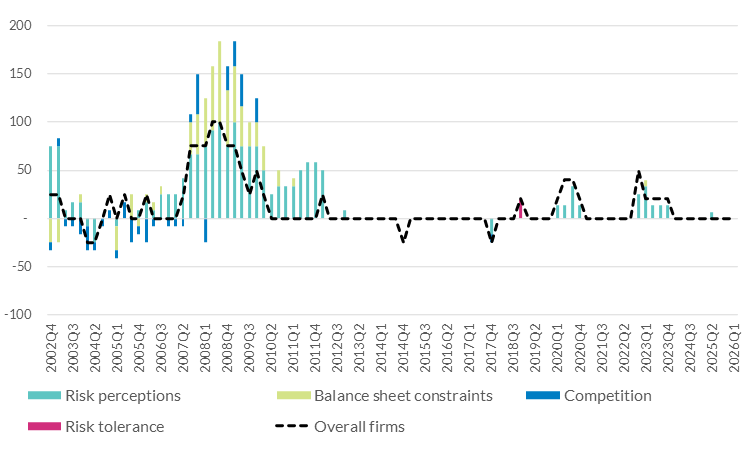
It is also consistent with information we have on bank lending conditions in the euro area over the last two decade, which indicates that while banks’ capital position (and related costs) was a constraint on lending during the Financial Crisis and early sovereign debt crisis, since then it has had limited effect on banks’ credit standards (with a slight exception during the pandemic).11
Figure 2: Bank Lending Survey, credit standards loans to firms12
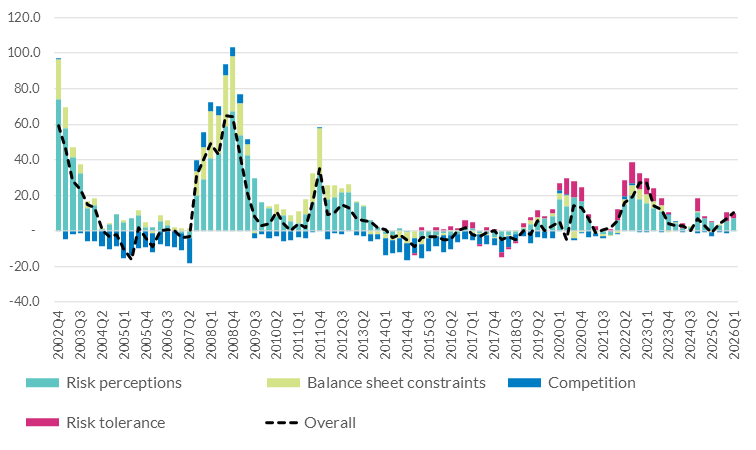
Figure 3: Bank Lending Survey, credit standards loans to firms, Ireland
In terms of profitability, return on equity of euro area banks is at its highest since the introduction of the post crisis reforms, aided by aforementioned monetary policy normalisation. Now standing above 10% in both Ireland and the EU, this does not suggest to me that capital is unduly dampening profitability. This is also consistent with many studies that find that there is no evidence that higher capital requirements lead to lower profitability.13
Figure 4: Return on Equity compared to CET1 requirements and headroom – Irish and EU banks14
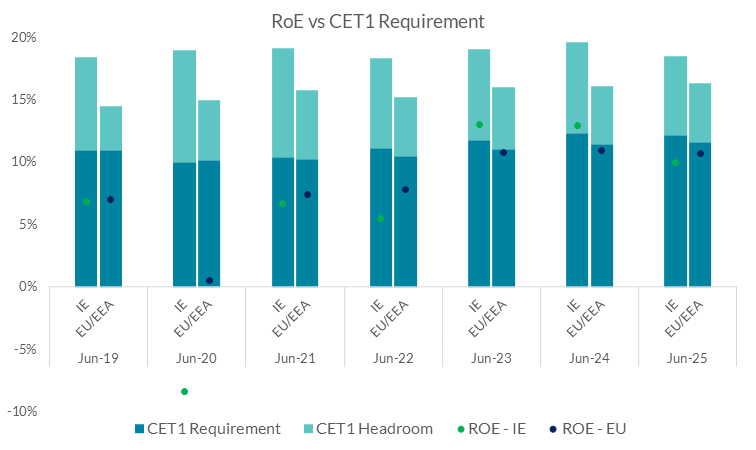
Or to put it another way this does not suggest to me that the balance between the resilience of the sector – crucial to the economic wellbeing of the country and our citizens – and the profitability of its banks – an important part of a long term safe and sound sector – is in conflict.
Lastly, people cite international competitiveness – with the US and UK the jurisdictions often compared to by advocates for capital lowering.
The first thing to say is it is very hard to compare like for like – there are different markets, different business models, and indeed different types of balance sheets. But as ECB research published last week shows, US large banks in fact face higher capital requirements than their European counterparts.15
This is the starting point for comparisons. I would also note that when Europe finalised its implementation of Basel III, it resulted in a lowering of capital requirements for some banks – including a 6% reduction in capital requirements for Irish banks, important context for the future debate.16
But when we think of the competitiveness of the US vs Europe, it is the competitiveness of our economies - indeed their productivity – that we should be focused on. And as we seek to close any competitiveness gap, it is not the overall levels of their bank capital that comes to mind for me – but rather it is their deep and liquid capital markets, providing risk capital and funding for innovation, alongside the dynamism and investability of their companies, that stands out.
This is what we should be focused on as we seek to boost the productivity of our economy, and why Savings and Investment Union remains a priority for Europe.
Competition
This brings me to my second ‘C’, namely Competition – another topic with many facets, and of course competition and competitiveness is subject to huge focus in the international debate.
For my part I will focus on our sector here in Ireland – namely in terms of a) the domestic banking sector, b) Ireland’s broader banking and financial sector, and c) the role I feel central banks and regulators can and should play in this issue.
Firstly, for the last number of years there has been understandable focus and concern about competition in the retail banking sector in Ireland.
While no one has been advocating for the return to the unsustainable competition of the 00s, the exit of two full service retail banks in recent years naturally intensified concerns about competitive conditions in the sector and led to the Government’s Retail Banking Review.
We fully recognise the importance of a competitive retail banking landscape for our economy. We engaged fully with and supported the Retail Banking Review and have been conducting our own research and analysis into this issue – in particular considering the profound structural transformation that has taken place in the financial system over recent decades, meaning it is not as simple as comparing like for like.
Given the evolving financial system, we have always felt that focusing on the number and balance sheet of domestic retail banks gives an increasingly incomplete assessment of market structure in retail credit provision in Ireland, and does not capture an increasingly diverse lending market made up of foreign banks, non-bank lenders, and credit unions.
In light of this colleagues in the Central Bank have undertaken an analysis of the state of the Irish loan market using granular loan-level data from the Central Credit Register.17
Analysing market concentration based on new lending, firm borrowing patterns across lender types, and loan pricing using loan-level data, the research yields a number of findings that offer a more nuanced perspective on the question of competition in the Irish loan market.
The full paper is being published today but I will briefly highlight a few aspects.
In business lending and consumer credit – key channels for the real economy – the paper shows the presence of these different lenders alongside domestic retail banks significantly reduces estimates of market concentration.
When taking the full market into account, new business lending is more than 50% less concentrated and concentration metrics for consumer credit fall by almost 80%.
Importantly, this is not non-bank lenders merely serving borrowers excluded from the banking sector – rather a third of Irish firms, and 40 per cent of SMEs, borrow from multiple lender types – typically combining a core domestic banking relationship with non-bank credit. This points to an increasingly competitive, and much more dynamic, market than is often understood.
As I noted, we will be publishing the full analysis today, but taken together the findings paint a much more diverse landscape than analysis relying exclusively on data related to domestic retail banks – and rather evidences a loan market characterised by a diverse ecosystem in which alternative lender types both contribute to market depth and provide alternative funding options for both SMEs and households.
Such increasing diversity in terms of credit provision, is echoed in other segments of retail banking services, with an increasing number of digital banks, payments firms and e-money institutions adding competition in the areas of payments and deposits. Our focus here is on ensuring such new entrants are well-run and well-regulated, and subject to a robust authorisation and supervision, given their important responsibility being trusted with the public’s money.
More broadly, as we have said before the last decade has seen extraordinary growth in Ireland’s financial sector – both in terms of scale and complexity – with some of the highest rates of growth occurring in the most complex parts of the system.
For example, over the last decade the number of trading venues has increased from 2 to 5 and the number of complex trading firms has tripled to 10, with the size of that sector in terms of assets having grown more than 600%. Total assets under management by Irish authorised investment funds has grown from €1.7 trillion to €5.3 trillion.
While there has been some consolidation in the number of banks, there has been significant growth in terms of scale of the banking sector– with total assets of Irish authorised credit institutions now above €770bn, growing by 70% since 2016.
This comes alongside the pace at which the Payments and E-Money sectors have developed – with the number of PIEMI firms growing from 14 in 2016 to 58 in 2025, which includes 15 fold increase in safeguarded funds, now standing at near €12bn.
2025 also saw the first new authorisation of a retail bank in some time; and judging by the authorisation pipeline we are currently dealing with our financial sector is growing and set to continue to grow.
These metrics in terms of size and scale of the entities we supervise, are echoed by other metrics.
When the Government launched its IFS strategy in 2015, international financial services was providing work to 35,000 people across the country.18 10 years later when it consulted on its upcoming strategy in 2025, employment had near doubled to over 60,000.19 This growth is seen elsewhere, and indeed the BPFI’s own membership has also nearly doubled over that period from 70 members to over 125.
All of this is exceptional growth by any measure.
It is a success story for the sector and the Government – but it also says to me that Ireland’s international financial centre is strong, diverse and it is growing – and that Ireland does not appear to be unable to compete for financial services due to its regulations or its regulator.
In fact I would argue in the long run a stable, robust regulatory environment is a key part of developing, and maintaining, an international financial centre – and so strong regulations and a strong regulator is in fact an advantage.
This brings me to my final point on Competition – namely the role of central banks and regulators.
This has become something of a debate once more - and both in Europe and domestically there have been some calls to give regulators a mandate to promote the competitiveness of the sector.
While the regulatory cycle has clearly turned, I have to admit I am still surprised that so soon after the financial crisis – for which we are in many ways still paying the price – proposals for such a mandate have returned.
A mandate, which as set out so well in the Honohan report20, contributed so significantly to the failings of that period, and therefore the enormous economic and societal costs borne by the country and our citizens.
While ultimately a matter for legislators, to address the suggestion directly let me say that I think our mandate is already broad, and I firmly believe well balanced.
As such – to be frank – I think adding a competitiveness mandate, even secondary, is simply a bad idea – and it is not clear to me what this has to with simplification as opposed to deregulation.
A competitiveness objective risks blurring our mandate at best, and at worst risks having a corrosive effect on decision-making leading to financial stability issues – precisely what happened the last time, not so long ago, we had a secondary mandate to promote the sector.
Lastly the evidence doesn’t suggest to me a financial centre struggling for growth – indeed Ireland’s financial sector has seen exceptional growth over the last 10 years.
None of this is to say we don’t think a productive and competitive economy and financial sector is important. We do – and indeed competition and innovation, subject to appropriate guardrails, is clearly in the best interests of consumers and the wider economy.
But a regulator focusing on the “competitiveness” of the sector is unlikely to end well, with this job better left to others. Indeed the last time the Regulator had such a mandate it did not end well. It was clearly not in the interests of the public, the economy or indeed the country – and in the long run was certainly not in the interests of the sector itself.
So how do I think we can and should contribute to competitiveness of our economy? Put simply, by doing our job.
By maintaining monetary and financial stability – two key pillars of stable growth.
By working to ensure the financial system operates in the best interest of consumers and the wider economy.
By delivering robust, clear and predictable regulation, including through considering the costs and benefits of regulatory interventions, as well effective and efficient supervision and a clear, transparent and timely authorisation processes.
And by ensuring we discharge all of these in a way that is consistent with the orderly and proper functioning of financial markets.
This is a mandate that I firmly believe is broad, balanced and in the best interests of us all.
Complexity
Let me turn now to my third C, namely Complexity – a defining feature of the modern world.
Complexity in itself is complex, but let me just cover two aspects now, and we can get into more detail in the discussion. The first is the increasing complexity of the sector and its risk landscape; and secondly what we are doing to reduce regulatory complexity.
In terms of the complexity of the sector, we are all grappling with increasingly complex organisations in an increasingly complex world.
Geo-economic shifts and rapid digital developments have only served to intensify these challenges.
In the face of such complexity it is imperative that banks are resilient and prepared – and are focused on the interconnections and dependencies of your businesses within and without the financial system.
In particular I would highlight the importance of operational and cyber resilience.
We called this out again in the RSO in February as a key risk and priority and even since then the risk has intensified – with geopolitical tensions as well as the potential deployment of the new generation of AI models making this priority all the more urgent.
In the face of this constantly evolving technological and cyber-threat landscape, including related to frontier AI models, firms need a future-proofed strategic response with senior sponsorship and appropriate levels of investment.
I would underline three objectives, in this regard:
- Maintain a clear view of your ICT risks - firms should continuously assess their ICT risk landscape, ensuring that cyber and operational vulnerabilities are identified and addressed in a timely and effective way. Existing known gaps need particularly urgent remediation.
- Ensure ICT controls evolve with emerging threats – ICT risk management and control frameworks should continuously adapt to an evolving threat landscape, including increasingly sophisticated cyber risks and emerging technologies such as frontier AI.
- Be prepared to respond and recover – firms need a capability to manage disruption effectively, with robust response and recovery capabilities supported by regular testing.
All of these are in line with DORA, and existing expectations – though the potentially accelerating risk landscape makes them all the more important.
Finally let me say a few brief words about the complexity of the regulatory framework.
I would not like you to take my strong beliefs on Capital and Competitiveness mandates for hubris – in particular, as I have spoken of before, I believe in the importance of humility.21
Rather they reflect the importance of these topics, the data, our lived experience and the current risk landscape.
But as regulators I firmly believe we should be open to challenge, accountability, and to review – and that we should listen and we should engage.
This is why we have focused on continuous improvement over the last number of years, in terms of our engagement and our processes – including how we regulate, authorise and supervise our financial sector. This is also why we are serious about simplification and have been proactively engaging on it both domestically and internationally.
I have spoken about this on a number of occasions, about the real opportunities – as well as the risks – from the agenda. And following engagement with many stakeholders, including the industry, at the end of last year we set out our ongoing commitment to Regulating and Supervising well. This includes a roadmap for domestic simplification which is a comprehensive multi-year programme of initiatives to deliver further efficiencies and effectiveness across regulation, supervision, gatekeeping and reporting.
We do this as we see there is an opportunity to streamline rules and processes without weakening the important protections we have built over the past decade.
But as I have said before we cannot simplify so much that we do not capture complex risks. Nor can simplification mean no new rules – or regulation risks falling behind.22
In a world of complexity and rapid change, regulation must adapt too – ensuring it remains fit for purpose in a changing world.
But while adapting we should ensure new regulations, and the overall framework itself, is as simple as possible – but no simpler!23
Conclusion
Let me conclude.
A competitive, productive economy is crucial for growth and better living standards for our citizens. So too is a well-functioning financial sector.
Central banks and regulators play a key role in delivering these aims.
Not through promoting growth or competitiveness but by underpinning them through monetary and financial stability – pre-conditions for sustainable growth.
Nor through lowering standards, but by ensuring that the financial system is well-regulated, resilient and operating in the best interests of consumers and the wider economy.
In this way we serve the public interest by delivering on our mission and mandate, including by Regulating and Supervising well – which means for me robustly, effectively and efficiently.
And so as we look to the future and to delivering on our productivity and competitiveness aims – in an age of challenge, change and complexity – there is an onus on all of us to remember the lessons of the past.
Collectively we have worked hard to build up resilience in the system, which is now serving the sector well. We should now focus on maintaining and reinforcing such strength – recognising that resilience and stability are not the enemy of growth; but rather its foundation.
Thank you!
[1] Many thanks to Cian O’Laoide, Paul Dolan, and Sorcha Foster for their help preparing these remarks and to Vasileios Madouros, Simon Sloan, and Fergal McCann for their helpful comments.
[4] For example fiscal and monetary policy interventions, payment moratoria etc, all of which cushioned the macro-financial shock, and which may not be repeatable.
[5] IE sample includes Significant Institutions based in Ireland each year, included in EBA sample.
[7] Y-o-Y growth as of Q1 2026. Irish credit growth is the sum of loans by Irish banks to households and firms (in Ireland) calculated in year on year terms (based on nominal stock); Euro area credit growth is the sum of loans to households and firms (in the euro area) calculated in year on year terms (based on nominal stock).
[8] As of June 2025; 620bps and 480bps respectively. See EBA
[9] See for example: Malovaná, S., Hodula, M., Bajzík, J., & Gric, Z. (2024). Bank capital, lending, and regulation: A meta-analysis. Journal of Economic Surveys, 38, 823–851. Accounting for publication bias they find that a 1 percentage point (pp) increase in capital (regulatory) ratio results in around 0.3 pp increase in annual credit growth
[10] See for example Gambacorta, L., & Shin, H. S. (2016). Why bank capital matters for monetary policy. BIS Working Papers No 558 In a cross country bank-level study, they find that a 1 percentage point increase in the equity-to total assets ratio is associated with a 4 basis point reduction in the cost of debt financing and with a 0.6 percentage point increase in annual loan growth.
[11] While Bank Lending surveys point to a recent tightening of credit standards, perceived risks to the economic outlook and lower risk tolerance of banks were the main contributing factors influencing credit supply.
[12] Net percentages are defined as the difference between the sum of the percentages of banks responding “tightened considerably” and “tightened somewhat” and the sum of the percentages of banks responding “eased somewhat” and “eased considerably”. This is weighted by each country’s share of total loans outstanding. Positive net percentages refer to a tightening of credit standards, whilst a positive factor implies that the factor contributed to a tightening of credit standards.
[14] Sample as per figure 1
[16] Central Bank of Ireland staff analysis of Irish Significant Institutions