Key Insights
Our analysis indicates that the macroprudential measures introduced by the Central Bank have been effective at maintaining the resilience of Irish domiciled sterling denominated LDI funds to a range of interest rate shocks.
The LDI fund cohort appears resilient to shocks along both liquidity and solvency dimensions.
While the size of the cohort has decreased since 2022, it continues to play a significant role in the UK gilt market, especially in the index-linked gilt segment.
Introduction
This Staff Insight sets out evidence on the size and resilience of the sterling denominated liability driven investment (GBP LDI) fund cohort following the Central Bank’s codification in 2024 of its ‘yield buffer’ measure, requiring funds to maintain resilience to a 300 basis point increase in gilt yields. Our Insight presents preliminary findings in the Central Bank’s assessment of the effectiveness of these measures, including by means of a liquidity stress test framework.
LDI strategies are used by defined benefit (DB) pension schemes to better match the interest rate and inflation sensitivity of their assets to that of their liabilities, in the form of schemes’ long-dated and inflation-linked obligations to pensioners. For GBP LDI funds, liability-matching typically involves building a portfolio of long-dated, index-linked gilts. LDI strategies are also characterised by their use of leverage. GBP LDI funds borrow via gilt repo transactions to purchase additional gilts, allowing their DB scheme investors to match liabilities with smaller capital allocations whilst maintaining exposure to growth assets. Alternatively, or in combination with gilt repo, GBP LDI funds can choose to build a leveraged exposure through their use of derivatives (primarily interest rate and inflation swaps).
The 2022 gilt market crisis exposed significant vulnerabilities in the business model of GBP LDI funds. The material and rapid increase in UK gilt yields following the UK government’s ‘mini budget’ created a sharp decline in the value of LDI assets which, in the presence of substantial leverage, resulted in liquidity demands in the form of collateral and margin calls and a significant decline in funds’ net asset value (NAV). In the face of this joint liquidity-solvency pressure, GBP LDI funds fire-sold gilts, further disrupting the gilt market. Dunne et al. (2023) found that Irish GBP LDI funds accounted for 30 per cent of net sales by all LDI entities over the crisis period and that this selling was concentrated among less-resilient funds who entered the crisis with a yield buffer below 300 basis points.
In response, the Central Bank published an industry letter in November 2022, in coordination with Luxembourg's Commission de Surveillance du Secteur Financier (CSSF), European and UK authorities, setting supervisory expectations that GBP LDI funds maintain a 300 to 400 basis point yield buffer. Following consultation in late 2023, these expectations were codified into formal macroprudential measures implemented in July 2024, establishing a minimum 300 basis point yield buffer requirement with limited flexibility provisions to prevent procyclical deleveraging.
The rest of this Insight is structured as follows: Section 1 provides an overview of the cohort, focusing on its size and resilience since the implementation of the measures, while Section 2 presents the results of liquidity and solvency stress testing of the cohort.
Section 1: What we Have Seen Since the Implementation of the Measures
Cohort Resilience
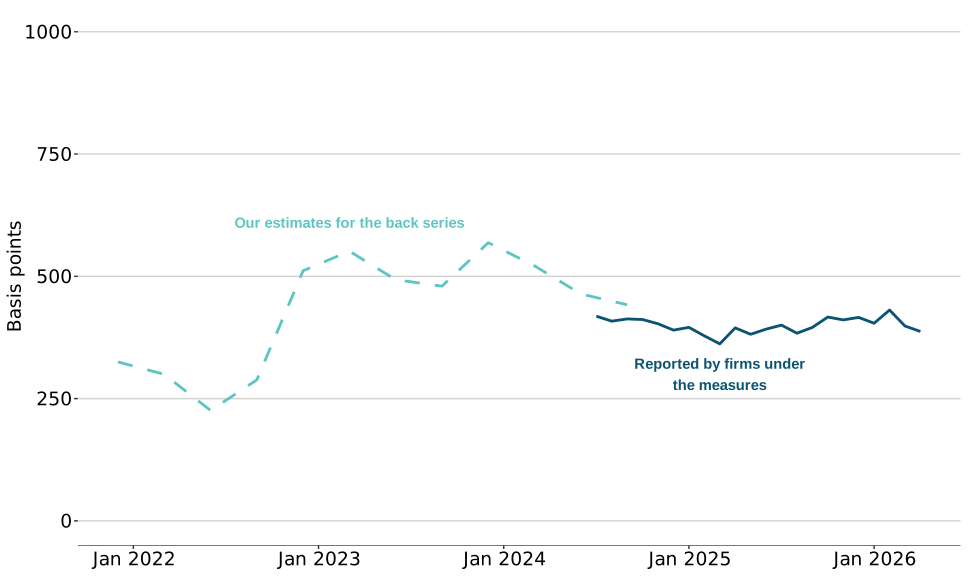
The ‘yield buffer’ is a helpful way to understand the resilience of a GBP LDI fund to a sudden change in UK gilt yields as it measures the size of interest rate shock a fund can withstand before its NAV becomes zero. In doing so, the yield buffer summarises two key dimensions of the strategy’s underlying vulnerability - the scale of leverage being used and the underlying interest rate sensitivity, or duration, of their portfolios. To give a sense of how the resilience of the cohort has evolved over time, we have estimated historical fund-level yield buffers for the Irish GBP LDI cohort. As of 31 December 2021, the first observation in our analysis, we find that the median yield buffer for the cohort was around 325 basis points (Figure 1). As gilt yields rose in early 2022, following Russia’s invasion of Ukraine, our estimated median yield buffer fell to a trough of around 225 basis points in June 2022. This sharp decline reflects fund managers’ decision to allow funds’ yield buffers to adjust in response to rising rates and falling asset valuations, rather than wind down their repo positions or call for recapitalisation from their pension scheme investors.
GBP LDI Funds’ Yield Buffers Remain Well Above the Levels Seen Immediately Before the 2022 Gilt Market Crisis.
Figure 1: Median Yield Buffer of the Irish GBP LDI Cohort Over Time
Source: Monthly dataset reported by LDI managers as part of the Central Bank’s measures, the Central Bank’s quarterly Investment Funds Return, the Securities Financing Transaction Regulation (SFTR) dataset, the European Market Infrastructure Regulation (EMIR), and authors’ calculations.
Note: The data cut-off is April 2026.
Accessibility: Get the data in an accessible format. (CSV 18.94KB)
Following the gilt market crisis, our estimated median yield buffer increased materially as funds deleveraged, and the Central Bank introduced a supervisory expectation that Irish funds maintain their yield buffer in the 300-400 basis point range. Since July 2024, LDI managers have reported monthly yield buffer data which show a median yield buffer that varies within a range of 350 to 450 basis points. The cohort’s median yield buffer has ticked downwards in recent months driven by higher gilt yields, though it remains materially above the level reached in H1 2022.
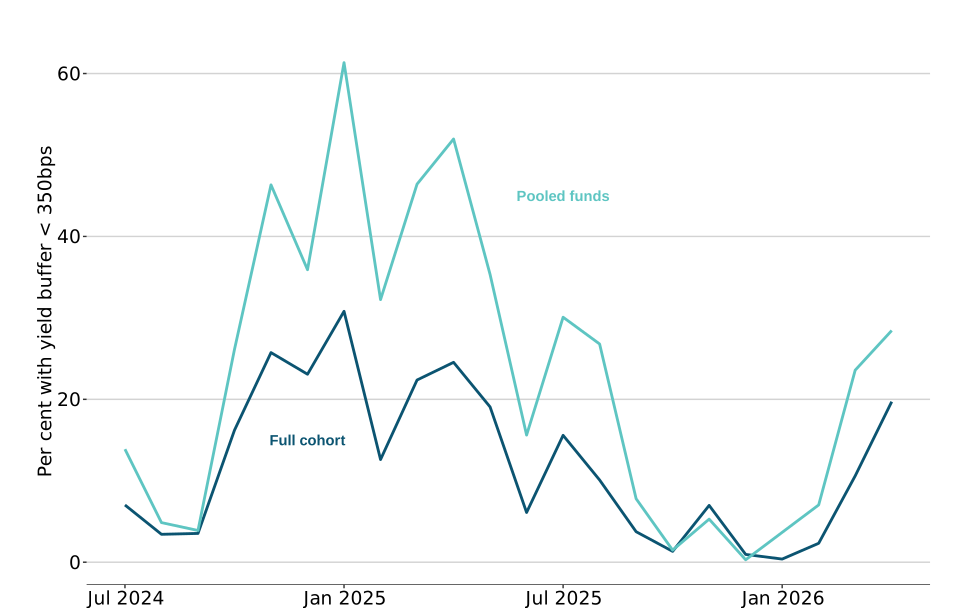
While the high average level of resilience documented above is welcome, the Central Bank’s LDI measures seek to address the less-resilient tail of the cohort which is most relevant from a financial stability perspective. As already noted, Dunne et al. (2023) found that it was the tail of less-resilient funds, facing the threat of insolvency in the face of the shock, that sold most gilts. Similarly, this analysis identified that gilt sales were concentrated amongst funds with more than one investor. These ‘pooled’ funds sold almost double the value of gilts during the crisis period as their single investor counterparts. The share of the cohort with a monthly-average yield buffer between 300 and 350 basis points peaked at just over 30 per cent in January 2025 before declining steadily to near zero in February this year (Figure 2). Since then, the share has increased sharply, to 20 per cent in April, as gilt yields have increased sharply in response to the conflict in the Middle East. Pooled funds, which account for around a third of the cohort’s gilts, have seen a higher share of funds with a yield buffer in the ‘less than 350 basis points’ category since the introduction of the measures, peaking at around 60 per cent in January 2025. As of April 2026, no fund, either single investor or pooled, has yet used the flexibility in the Central Bank’s measures to report a monthly average yield buffer below 300 basis points on a rolling 1-in-4 month basis.
Less Than a Third of the Overall Cohort’s Gilts Belongs to Funds With a Yield Buffer Less than 350 Basis Points, Though This Share has Been Higher for the Sub-cohort of Pooled Funds.
Figure 2: Share of the Cohort’s Gilt Holdings Belonging to Funds With a Yield Buffer Less Than 350 Basis Points Over Time, Total vs Pooled
Source: Monthly dataset reported by LDI managers as part of the Central Bank’s measures.
Note: This chart shows the share of the cohort’s gilt holdings belonging to funds with a monthly-average yield buffer below 350 basis points. It does this for the total cohort as well as for the subset of pooled funds (i.e. funds with more than one pension scheme investor). The data cut-off is April 2026.
Accessibility: Get the data in accessible format. (CSV 0.84KB)
Overall, evidence from estimated and reported yield buffer data indicates that the cohort has maintained a high level of resilience, on average and in the tail, thereby reducing the likelihood that Irish GBP LDI funds might contribute to future gilt market disruption through forced gilt sales.
Size of the Cohort
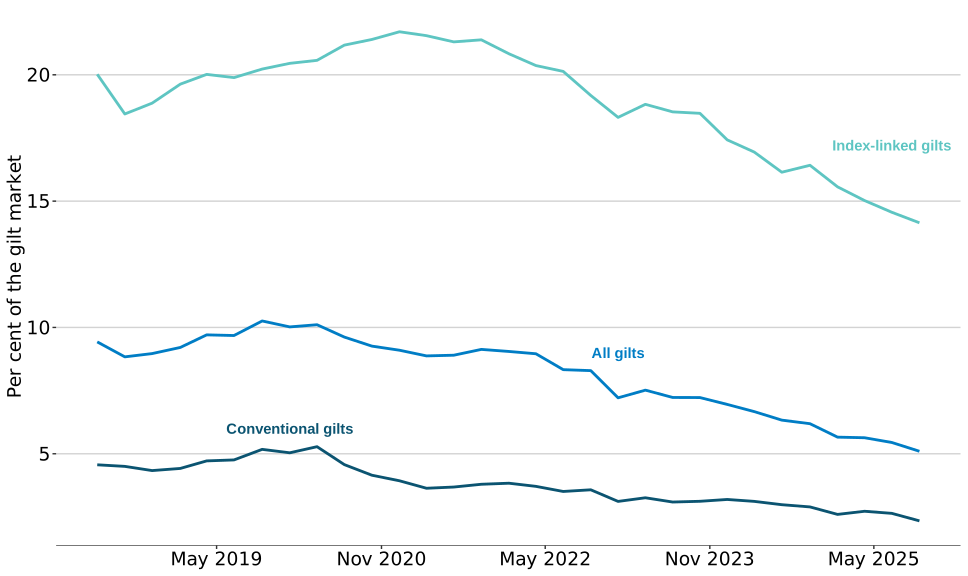
The Irish GBP LDI cohort’s share of outstanding gilts has declined from its peak in the years before the gilt market crisis, though it remains material, especially for the index-linked market. The cohort’s share of the overall market peaked in recent times in September 2019 when it accounted for just over 10 per cent of the total gilt market (or around £238 billion of gilt holdings) (Figure 3). The difference between conventional gilts and index-linked gilts, the value of which are adjusted in line with the UK retail price index, is particularly noteworthy. At their peak in December 2020, the Irish GBP LDI cohort held almost 22 per cent of the index-linked market (or around £173 billion of index-linked gilts). This compares to only around 4 per cent of the conventional market in the same period. Across all of these measures, the cohort’s share has been in decline since before the 2022 gilt market crisis. As of September 2025, the cohort accounts for just over 5 per cent of the total gilt market and just over 14 per cent of the index-linked market. A similar pattern is evident when examining the cohort’s share of gilt market turnover, which is material, especially for long-dated and index-linked gilts.
The Cohort’s Share of Outstanding Gilts has Declined Since its Peak in 2020, Though it Continues to Play a Significant Role, Especially for the Index-linked Segment.
Figure 3: Irish GBP LDI Cohort’s Share of Outstanding Gilts, 2018-2025
Source: Central Bank of Ireland and the UK Debt Management Office.
Accessibility: Get the data in accessible format. (CSV 1.59KB)
The Irish cohort’s falling share of the gilt market comes in the context of a decline in the size of the wider GBP LDI sector. Industry estimates indicate that the total notional value of liabilities hedged through GBP LDI strategies reached its peak in 2021 before declining each year since. The Irish cohort has declined in line with the wider GBP LDI sector, maintaining its share of between a quarter and a third of the wider sector. This is in part due to the large and sustained increase in interest rates observed since 2021, which has led to material improvements in the funding levels of UK DB pension schemes. Improved funding reduced schemes’ need for leveraged LDI strategies, including those offered by fund managers in Ireland. Furthermore, improved funding levels have also made pension schemes more attractive to ‘bulk annuity’ life insurance companies that ‘buy out’ DB pension schemes. This sector has seen very high levels of activity in the period since the gilt market crisis, also reducing demand for Irish LDI strategies. Meanwhile, DB pension schemes continue to mature with only a small share remaining open to new members and future accrual. This increasing maturity also pushes down on demand for LDI strategies.
Section 2: A Closer Look at the Cohort’s Liquidity and Solvency Resilience to a Range of Rate Shocks
This section presents an assessment of the effectiveness of the macroprudential measures in enhancing the resilience of the Irish GBP LDI cohort, in terms of both liquidity and solvency resilience. Using fund-level balance sheet data, data for repo borrowing, and data for interest rate and inflation swaps, we estimate the impact on funds’ solvency and liquidity given a series of interest rate shocks.
Solvency Resilience
The yield buffer evidence presented in Section 1 showed that the cohort’s solvency is resilient to material gilt yield shocks, both on average but also for the less-resilient tail of the cohort. In this section, we examine the ‘recapitalisation need’ of the cohort over time - that is, the amount of additional capital required for the cohort to return to a yield buffer of at least 300 basis points following a given interest rate shock. While these estimates of a hypothetical ‘recapitalisation need’ are useful as an alternative measure of the cohort’s solvency resilience, the Central Bank’s LDI measures were designed to ensure that the yield buffer is “usable” and that managers are not required to immediately replenish their yield buffer following a shock, something which could replicate the forced sale dynamics observed in the gilt market crisis.
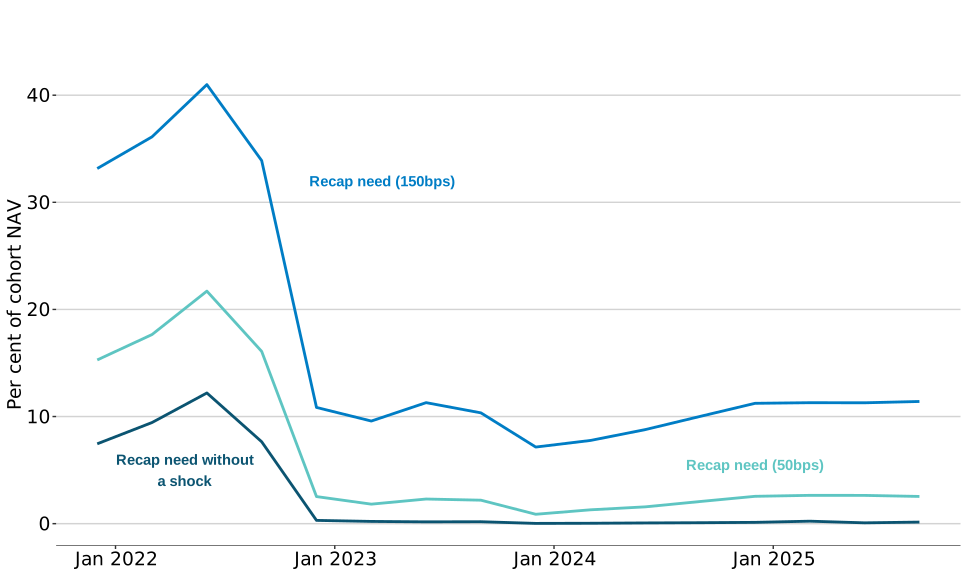
Before turning to the impact of interest rate shocks, we first note the non-zero recapitalisation need in the baseline scenario in which no shock is applied (Figure 4). This baseline recapitalisation need is near-zero in the period since the gilt market crisis, consistent with the Central Bank’s macroprudential measures, but we estimate it was as high as 12 per cent of the cohort’s NAV (or £14 billion) in June 2022. Applying a plausible range of instantaneous shocks to gilt yields of between 50 and 150 basis points creates a material recapitalisation need. For September 2025, we estimate that the need was as large as 11 per cent of cohort NAV (or £9 billion) for a 150 basis point shock. Significantly, this is materially smaller than the pre-crisis peak recapitalisation need of around 40 per cent of cohort NAV (or £48 billion) in June 2022.
The Cohort’s Post-shock Recapitalisation Need Declined Materially Following the Gilt Market Crisis and the Implementation of Macroprudential Measures.
Figure 4: Post Shock Recapitalisation Need of the Cohort Over Time
Source: Monthly LDI dataset reported by LDI managers, the Central Bank’s quarterly Investment Funds Return, SFTR, EMIR and Bank staff calculations.
Note: We estimate the amount of additional capital required post-shock to return each fund to a yield buffer of at least 300 basis points.
Accessibility: Get the data in accessible format. (CSV 3.48KB)
Liquidity Resilience
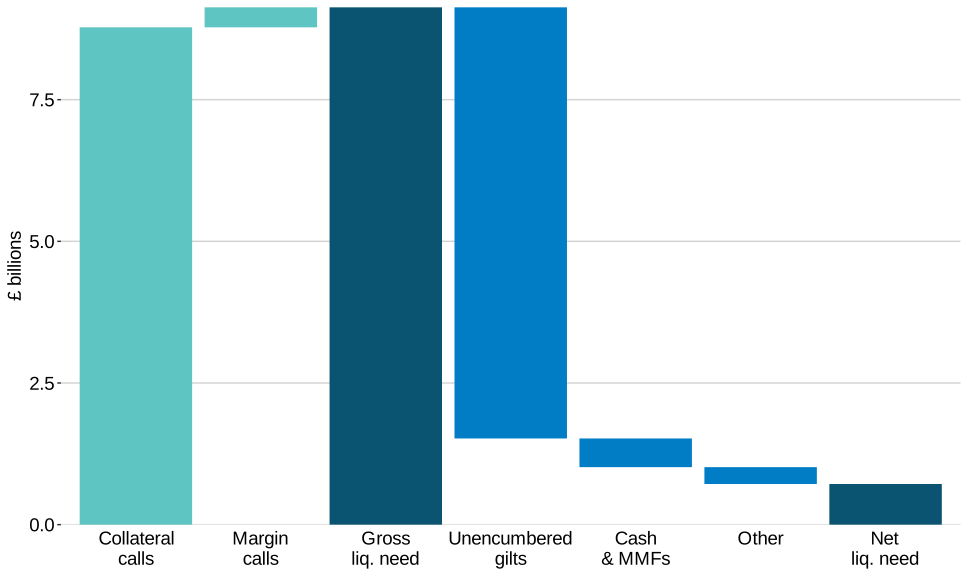
As well as the threat to solvency, a sharp rise in gilt yields places liquidity demands on the LDI cohort. While the Central Bank’s yield buffer requirement primarily targets the solvency risk, it should also indirectly enhance the cohort’s resilience to liquidity demands in the form of collateral calls on their gilt repo positions and margin calls on their swap positions. For the Irish GBP LDI cohort, the former materially outweigh the latter. As of September 2025, we estimate that a 150bps shock to gilt yields creates a gross liquidity need of around £9 billion (or 13 per cent of the cohort’s NAV) (Figure 5). The liquid assets available to funds to meet gross liquidity needs are mainly unencumbered gilts, which we assume may be used to meet collateral calls without the need for gilt sales. Pledging unencumbered gilts meets almost all of the collateral calls generated by the shock. Remaining collateral calls and margin calls must be met by cash, MMF shares and selling other liquid assets (e.g. equities or shares in other investment funds). As of September 2025, the cohort’s net liquidity need after having used its available liquid assets, and before selling any gilts, is less than £1 billion (or around 1 per cent of the cohort’s NAV).
A Large Interest Rate Shock Creates Material Liquidity Needs Which are met, Almost in their Entirety, by Funds’ Holdings of Unencumbered Gilts and Cash and MMF Shares.
Figure 5: Gross Liquidity Needs and net Liquidity Shortfall Created by a 150bps Rate Shock as of September 2025
Source: Monthly LDI dataset reported by LDI managers, the Central Bank’s quarterly Investment Funds Return, SFTR, EMIR and Bank staff calculations.
Note: The two leftmost columns here show the source of the cohort’s gross liquidity needs in a shock. The remaining columns show first the cohort’s ability to meet these liquidity needs using available liquid assets and finally the cohort’s remaining liquidity needs net of their liquid assets.
Accessibility: Get the data in accessible format. (CSV 0.55KB)
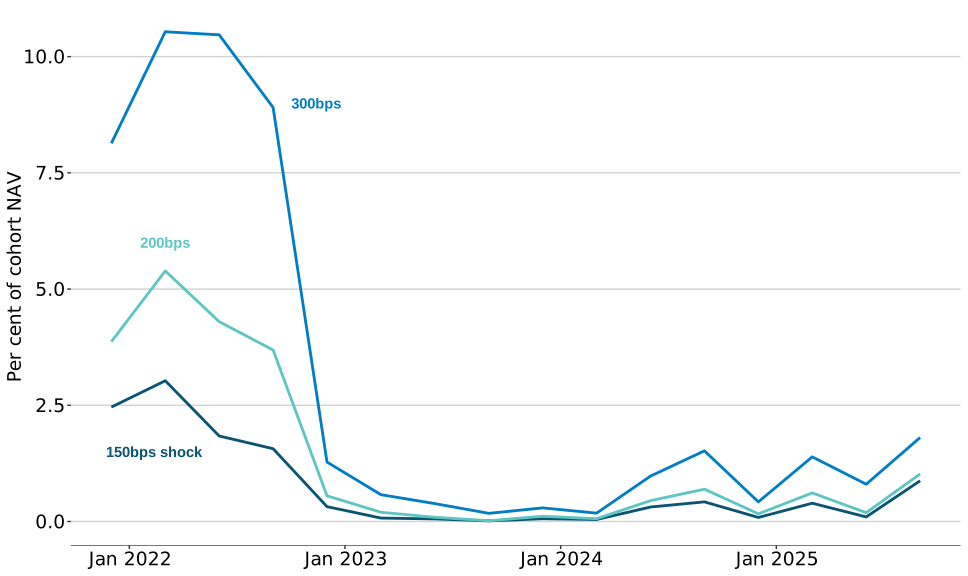
To put these estimates for September 2025 in context, we extend this analysis back for each quarter to December 2021, presented as a share of cohort’s NAV (Figure 6). For a 150 basis point shock, we estimate that net liquidity need remaining once available liquid assets have been used was around 3 per cent of the cohort’s NAV in March 2022. This is more than 3 times larger than our estimate for September 2025, reflecting the cohort’s increased resilience. The difference in resilience is starker for larger shocks – for a 300 basis point shock, we estimate a net liquidity need for September 2025 of 1.8 per cent of the cohort’s NAV, almost 6 times smaller than our estimates for March and June 2022.
Net Liquidity Needs Generated by an Interest Rate Shock Declined Materially in the Aftermath of the Gilt Market Crisis.
Figure 6: Net Liquidity Needs Over Time for a Range of Gilt Yield Shocks
Source: Monthly LDI dataset reported by LDI managers, the Central Bank’s quarterly Investment Funds Return, SFTR, EMIR and Bank staff calculations.
Note: This chart takes the rightmost column from Figure 5, the cohort’s net liquidity needs, and extends it backwards over time for a variety of interest rate shocks.
Accessibility: Get the data in accessible format. (CSV 0.53KB)
Conclusion
The purpose of this Insight is to present evidence on the size and resilience of the Irish GBP LDI cohort following the implementation of the Central Bank’s macroprudential measures for this fund cohort, which require that funds maintain a minimum yield buffer of 300 basis points. Evidence presented shows that this requirement has helped the cohort maintain the high level of resilience achieved following the 2022 gilt market crisis, both in terms of the cohort’s average, but also with respect to the less-resilient tail of the cohort.
There has been a substantial reduction in the size of the cohort, consistent with a number of structural trends affecting the demand for LDI strategies. Nevertheless, the Irish cohort remains an important player in the gilt market.
More detailed analysis indicates that the cohort is resilient to a range of gilt yield shocks, in terms of liquidity as well as solvency. The cohort appears to have sufficient liquid assets to meet the collateral calls and margin calls generated from a material shock to gilt yields, while the amount of capital required to restore the resilience of the cohort following a shock remains near post-crisis lows.
Looking ahead, the Central Bank will continue to monitor the cohort’s compliance with the yield buffer measure.
Endnotes