Key Insights
Retrofitting homes to a Building Energy Rating (BER) of B2 or higher generates net lifetime savings for most households, particularly for those with a starting BER of C3 or lower.
Financial benefits would improve significantly if 'Net Zero' climate targets are achieved as, in such a scenario, expectations would be for higher fossil fuel prices and lower electricity prices.
Retrofitting through loan financing can create short-term cash flow pressures which may pose a significant barrier for many households. Longer loan terms and mortgage top-ups are the most effective means of smoothing costs over time, though they may result in higher lifetime credit costs.
For Ireland to achieve its national climate targets and reduce household exposure to transition risk our findings underscore the importance of tailored financing options and supportive policies to encourage retrofitting at scale.
Introduction
Policy Context
Ireland faces significant challenges in meeting its climate targets while ensuring household financial resilience. Ireland's Climate Action Plan commits Ireland to achieving a 51% reduction in emissions by 2030 and net-zero emissions by 2050, aligned with the European Green Deal. The residential sector accounts for almost one quarter of Ireland's energy-related emissions (SEAI), making building efficiency a critical decarbonisation lever. Central components of this strategy include retrofitting 500,000 homes to a Building Energy Rating (BER) of B2 or better and installing 680,000 heat pumps by 2030.
Achieving retrofit at scale presents substantial challenges. Homeowners face large upfront costs paired with long-term, uncertain benefits. These financial uncertainties and information gaps can deter investment, making it difficult to achieve national targets without policy intervention and financial support.
Improved home energy efficiency enhances household financial resilience to climate transition risk and energy price volatility, which disproportionately affects occupants of inefficient dwellings. If energy prices increase or become increasingly volatile, household borrowers in poorly insulated homes face greater pressure on cost-of-living expenses, potentially leading to strains on mortgage repayments.
Research Objectives and Contribution
This Insight examines household costs and benefits of investing in building energy efficiency, with a focus on how financing structures and household cash flow dynamics affect retrofit viability. To our knowledge this is the first paper to supplement loan level data with estimates of energy efficiency investment costs and savings for a wide portfolio of dwellings. The research quantifies household financial costs and benefits of retrofitting across various future scenarios, recognising the significant upfront costs and evaluating different financing models.
We build a novel dataset that merges Central Bank of Ireland loan-level data with data from the Sustainable Energy Authority of Ireland's (SEAI) flagship National Home Energy Upgrade Scheme and the National Building Energy Rating Database. This creates a unique dataset on financing costs, retrofit costs and potential savings for a representative sample of Irish dwellings. For a more in-depth technical explanation, see our ESR publication.
Ultimately, this study provides important insights into the financial implications of retrofitting and discusses different options for financing retrofits, which could help steer national residential investments towards national decarbonisation targets.
What do Previous Studies Say?
Effectiveness of Energy Efficiency Programmes
International evidence shows that residential retrofit programmes deliver variable energy savings. A systematic review of 39 residential retrofit programmes found that energy savings ranged from 0% to 27% of pre-upgrade consumption, with an average reduction of 7.2% (Giandomenico et al., 2022). Other large-scale reviews report similar ranges (Gillingham et al., 2018). Irish research aligns with these findings, estimating gas consumption reductions of approximately 21% (Scheer et al. (2013)).
However, energy savings alone do not guarantee financial viability. Retrofit cost-effectiveness depends critically on upfront investment costs, future energy prices, and the discount rate applied to long-term savings. Heating system upgrades typically pay back in 12 to 23 years, whilst attic and wall insulation pays back in 12 to 46 years (Giandomenico et al., 2022). Some studies have found negative returns as low as -7.8% in a US retrofit programme (e.g. Fowlie et al., 2018), due to significant upfront investment costs and lower-than-predicted savings.
Cost-effectiveness depends heavily on the choice of economic parameters, energy prices, and discount rates used in evaluation (Belaïd et al., 2021). Beyond energy and cost savings, retrofitting delivers multiple benefits including improved health, wellbeing, and increased disposable income (Ryan and Campbell, 2012).
The Energy Performance Gap and Rebound Effects
Two distinct phenomena substantially reduce retrofit benefits below engineering predictions. Firstly, the Energy Performance Gap refers to the difference between predicted energy use (based on Energy Performance Certificate) and actual consumption. Irish research found actual energy use approximately 17% below BER predictions (Coyne and Denny, 2021a), suggesting BER models overestimate energy consumption due to modelling limitations, building defects, and occupant behaviour. Second, rebound effects occur when occupants increase energy consumption after the retrofit (Sorrell, 2007), offsetting anticipated savings. For example, homeowners may raise thermostat settings or spend more time at home (Sorrell, 2007), undermining policy effectiveness (Gerarden et al., 2015).
International evidence suggests rebound effect ranging from 1.4% to 60% with a mean of 20% (Sorrell et al., 2009). UK research indicates only half of expected savings are realised, with rebound accounting for 15% of the shortfall (Sanders and Phillipson, 2006). A recent review found average realisation rates of 55%, equivalent to 45% rebound (Giandomenico et al., 2022). Irish research found actual energy use approximately 17% below Building Energy Rating predictions, with an additional 10% average rebound (Coyne and Denny, 2021a).
Financing Energy Efficiency
Given uncertainties in retrofit energy savings and financial benefits, lenders face challenges in pricing retrofit loans. If retrofit savings are lower than expected (due to rebound effects or the energy performance gap), borrowers' ability to service the loan would be reduced. This financing uncertainty may explain why retrofit uptake remains low despite positive long-term returns.
Some research suggests lenders offer discounts on mortgages for energy-efficient properties, reflecting reduced energy price risk. However, evidence is mixed. French and UK research found no difference between green and standard renovation loans, nor evidence of higher rates for inefficient properties (Giraudet et al., 2021; Bell et al., 2023). Conversely, green bond-backed projects receive lower rates and debt service ratios (Devine et al., 2022). In Ireland, green mortgages typically offer approximately 30 basis points discount (Lambert et al., 2023). This is equivalent to roughly €30 per month on a typical mortgage. These modest discounts suggest that green mortgage benefits alone may be insufficient to offset retrofit loan costs.
Existing evidence leaves critical questions unanswered. First, to our knowledge, no previous study has examined retrofit effectiveness and financing together. Second, there is no systematic comparison of how future energy price scenarios or different financing (term loans or mortgage top-ups) affect household outcomes. This study addresses these gaps by combining administrative mortgage data with retrofit cost and energy savings data to model retrofit viability under realistic financing scenarios.
Results
Reference Results:
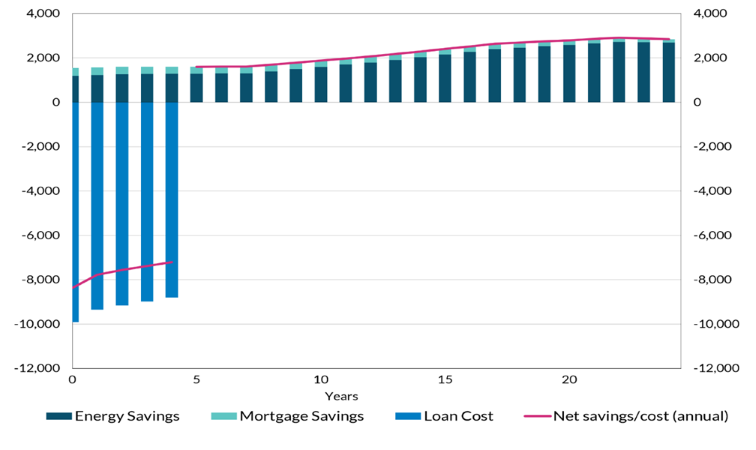
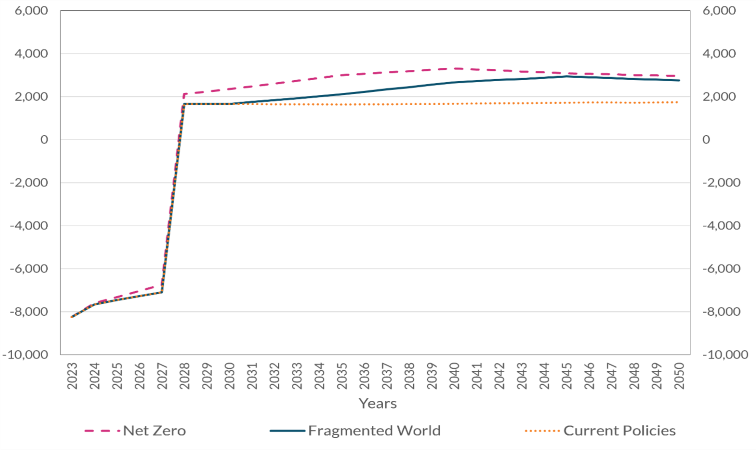
We use the NGFS "Fragmented World" energy price projections as our reference scenario, applied to a 5-year loan at 7% interest and assuming a 27% rebound rate. In this scenario, net cash flow for the household is negative during the loan term (Figure 1). Over this period (1-5 years), monthly loan repayments (median €685) exceed combined energy and mortgage savings, which may be unaffordable for many households despite positive long-term returns. Once the loan is repaid (after 5 years), households realise median annual savings of approximately €140 per month (~€1,700 per year).
During the Loan Term, Loan Instalments Considerably Exceed Energy and Mortgage Savings
Figure 1: Annual Costs/Savings Over Time Under Standard Loan Term (Median)
Source: Own calculations using Central Bank of Ireland Monitoring Template Data.
Note: Assumes uplift to B2 or higher, rebound 0.27 and 'fragmented world', 5-year standard loan with 7% interest rate.
Accessibility: Get the data in accessible format. (XLSX 14.38KB)
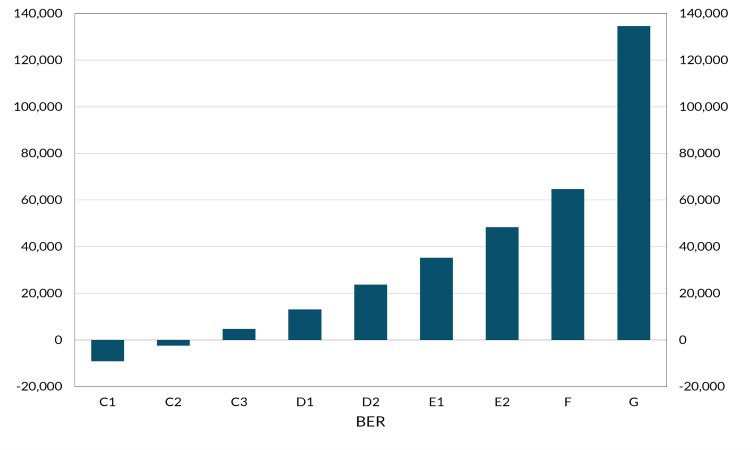
Loan repayments in the short-term can be material, but over the lifetime of a mortgage retrofitting leads to positive net savings for the majority of households (Figure 2). These savings vary substantially by initial BER rating, ranging from a –€9,000 negative financial benefit for C1-rated properties to over €65,000 positive financial benefit for F-rated properties. Households with lower starting BER ratings (F and G) achieve the highest net savings despite higher upfront costs. Conversely, households with higher starting efficiency (e.g. C1 or C2) may experience net losses, as retrofit costs exceed energy savings. The size of the loan required to retrofit each property in our data is assumed using observed information on the BER distribution of mortgaged properties, and typical BER uplifts achieved in retrofit projects. For a full description of the method, see Carroll et al. (2026).
Once the Initial Loan Clears, net Benefits Persist for the Remainder of the Investment Horizon
Figure 2: Lifetime net Savings per Initial BER Rating (Median)
Source: Own calculations using Central Bank of Ireland Monitoring Template Data.
Note: Assumes uplift to B2 or higher, rebound 0.27 and 'fragmented world', 5-year standard loan with 7% interest rate.
Accessibility: Get the data in accessible format. (XLSX 13.39KB)
Impact of Loan Characteristics
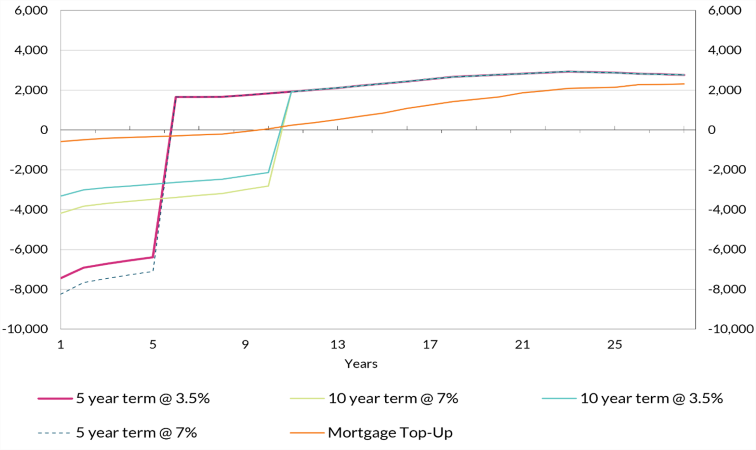
Changes in loan structure can make retrofitting more accessible by spreading the costs over time or improving credit terms. For example, a lower interest rate (e.g. 3.5% instead of 7.0%) and/or a longer loan term (e.g. 10 years versus 5 years) will reduce monthly loan repayments and ease short-term cash flow pressures (Figure 3).
Mortgage top-ups can reduce short-term cash flow pressure further by spreading retrofit costs over the mortgage term. For a typical mortgaged household (€200,000 outstanding balance, D1 BER pre-retrofit), a mortgage top-up achieves net savings after 16 years, compared to 21–23 years for other loan financing options. However, homeowners will still be required to pay interest on the top-up for the duration of the mortgage term, incurring higher overall interest costs and thus reducing overall lifetime savings. Comparing the range of characteristics presented in Figure 3, cumulative net savings by 2050 range from €12,125 (standard 10-year loan at 7%) to €20,000 (mortgage top-up) or €22,500 with the low-cost loan.
Alternative Loan Terms and Interest Rates Significantly Affect net Costs and Savings
Figure 3: Annual Net Costs/Savings Over Time Under Different Loan Terms (Median)
Source: Own calculations using Central Bank of Ireland Monitoring Template Data.
Note: Assumes uplift to B2 or higher, rebound 0.27 and 'fragmented world'.
Accessibility: Get the data in accessible format. (XLSX 14.41KB)
Shorter loan terms increase near-term costs but improve lifetime savings. For homeowners contemplating retrofitting, there is a trade-off between incurring more costs upfront and achieving greater lifetime net benefits versus incurring lower costs upfront at the expense of less lifetime net benefits. Ultimately, this trade-off will depend on a borrower's intertemporal preference and repayment capacity. For example, where the homeowner finances the upgrade with a 5-year loan rather than a 10-year loan of the same interest rate (7%), the 5-year term results in a materially larger lifetime benefit (€12,125 vs €17,400 using assumptions in Figure 3) despite higher initial costs.
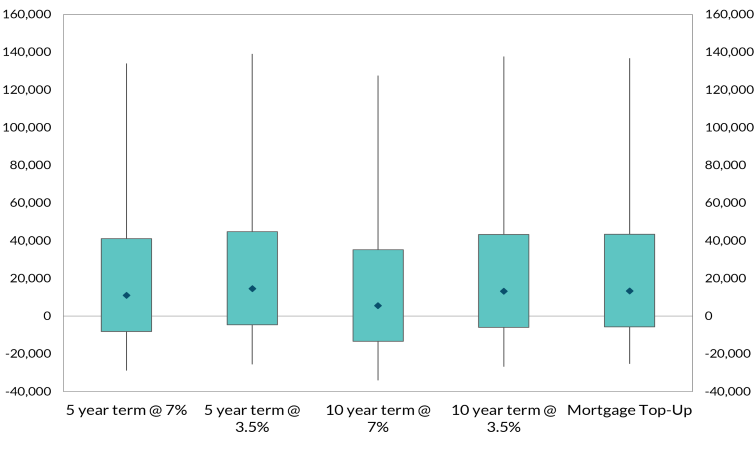
We find that with either a term loan or a mortgage top-up, some households will experience a net cost when financing a retrofit (Figure 4). This cohort is generally concentrated in homes that had good energy efficiency prior to retrofit, typically C1 to D1 (over 85% of net loss households), and tend to require high retrofit costs for relatively little energy efficiency gains. Utilisation of shorter loan terms or mortgage top-ups can reduce the cohort of households that realise a net cost.
Lengthening Term Loan or Using Mortgage Top-up Shrinks the Cohort of Households who Realise a net Cost
Figure 4: Distribution of net Benefits Over Lifetime of Mortgage Under Different Loan Terms
Source: Own calculations using Central Bank of Ireland Monitoring Template Data.
Note: Assumes uplift to B2 or higher, rebound 0.27, and 'fragmented world'.
Accessibility: Get the data in accessible format. (XLSX 13.57KB)
Energy Price Trajectory Scenarios
Net financial benefits are highly sensitive to future energy prices. Under the "Net Zero" scenario (highest fossil fuel prices, lower electricity prices), lifetime savings are substantially higher than under "Current Policies" (lowest fossil fuel prices). Further, the cohort of households that may realise a net cost to retrofit shrinks considerably under "Net Zero" relative to "Current Policies" or "Fragmented World" scenarios. This result is reinforced by the switch to heat pumps and removal of fossil fuel for heating.
Largest net Benefits Accrue Under 'Net Zero' Future Climate Scenario
Figure 5: Distribution of net Benefits Over Lifetime of Mortgage Under Different Future Energy Price Scenarios
Source: Own calculations using Central Bank of Ireland Monitoring Template Data.
Note: Assumes uplift to B2 or higher, rebound 0.27, 5 year standard loan with 7% interest rate.
Accessibility: Get the data in accessible format. (XLSX 13.94KB)
Discussion and Conclusions
Key Findings
This study provides the first comprehensive financial cost-benefit analysis of household retrofit decisions that explicitly accounts for financing instruments, policy targets and upgrade costs. Retrofitting to Building Energy Rating B2 or higher generates net lifetime savings for most households. However, several factors critically affect retrofit viability:
- Short-term cash flow pressures create barriers that may deter investment despite positive long-term returns.
- Financing structure is critical with mortgage top-ups substantially reducing short-term cash flow pressures by spreading costs over an extended period, making retrofit more accessible to liquidity-constrained households. However, this increases total interest paid and extends household leverage over a longer horizon.
- Committed climate policies (carbon pricing, renewable energy deployment) increase the benefits of retrofitting. Where the transition to Net Zero results in higher fossil fuel prices and lower electricity prices, this will improve lifetime savings and make retrofitting viable for a wider group of households.
- Starting energy efficiency matters: Properties with poor initial energy efficiency (F and G ratings) achieve highest net savings, whilst properties with good initial efficiency (C1–D1 ratings) may experience net losses.
Policy Implications
To improve the financial resilience of households with regards to energy transition, the findings underscore the importance of tailored financing options to encourage retrofit uptake at scale. Longer loan terms and low-interest schemes, such as the SEAI Home Energy Upgrade Loan Scheme, can significantly improve retrofit viability by alleviating short-term cash flow constraints. Households with lower starting BER ratings benefit most from retrofitting, despite higher upgrade costs, suggesting that targeting lower-efficiency properties maximises both financial and environmental returns.
Retrofit benefits are sensitive to broader policy environments. Higher fossil fuel prices and lower electricity prices substantially improve financial viability, emphasising the importance of consistent messaging and commitment on current and future carbon pricing and energy market policies. Current high and volatile electricity prices may dampen household switching to electric heating and heat pumps, potentially undermining retrofit incentives.
Evidence suggests potential distributional inequalities, with wealthier households currently accessing green mortgages and capturing disproportionate financial benefits (Lambert et al., 2023). Achieving inclusive retrofit at scale requires extending financing options or other supports to lower-income households and those experiencing fuel poverty, who may benefit most from reduced energy costs.
Limitations and Future Research
The analysis does not quantify non-monetary benefits (improved comfort, health, property value) or costs (disruption, inconvenience), which are likely substantial. Skills shortages in the retrofit sector represent a significant barrier to scaling, warranting further investigation. Future research should incorporate metered energy consumption data to better understand rebound effects and the energy performance gap.
Conclusion
To achieve Ireland's commitment to retrofitting 500,000 homes to BER B2 or better, policymakers require evidence on retrofit costs and benefits alongside effective policy incentives. Our findings indicate that retrofitting homes to BER B2 or higher has a net financial benefit for most households when appropriate financing mechanisms are available. However, short-term cash flow pressures may deter investment despite positive long-term returns. The financing structure matters with mortgage top-ups and subsidised loans reduce these barriers by spreading costs over longer periods and lower interest rates. Retrofit benefits concentrate in lower-efficiency properties (F–G ratings), which achieve highest savings but are often occupied by lower-income households facing greatest financing barriers. Success requires coordinated policies spanning financing innovation, energy pricing, skills development and targeted support for lower-income households.
References
Carroll, J., Lambert, D., Lyons, P., O'Callaghan, A., Franklin, J., McCoy, D., and Coyne, B. (2025). A Scenario Analysis of Financing Options for Energy Retrofits Among Irish Mortgage Holders. The Economic and Social Review, 56(4, Winter), 389–419.
Endnotes