From Washington to Frankfurt via Dublin: policy priorities in an uncertain world
01 May 2026
Blog
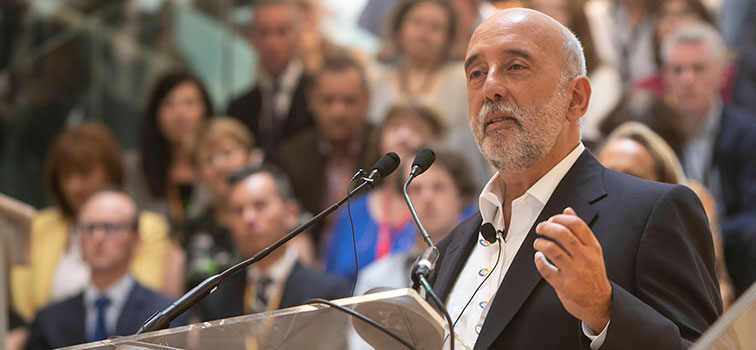
I was in Washington for the Spring Meetings of the International Monetary Fund (IMF) two weeks ago and this week I was in Frankfurt at the latest meeting of the ECB Governing Council, to decide interest rates to achieve our price stability target of 2 per cent inflation over the medium term. I wanted to use this blog to offer some reflections on both meetings.
Inevitably the war in the Middle East cast a shadow over both meetings. Uncertainty about the global outlook dominated the discourse: the duration of the conflict, the damage to infrastructure, the impact on supply chains, and, given all of this, the optimal policy response. My colleagues and I are once more looking at scenarios to communicate the breadth of uncertainty and to ensure we stand ready to respond to evolving second round effects that could give rise to more persistent inflation.
On top of these developments, two other topics dominated conversations: first the impact of artificial intelligence (AI) on cyber security and operational resilience as well as productivity and employment, and second digital financial innovation.
As a highly open and very well-connected economy with a significant financial system, these developments matter to Ireland.
The global economy and financial system
The IMF’s message was that the global economy faces renewed tests as the war in the Middle East threatens to disrupt growth and disinflation. After withstanding higher trade barriers and greater uncertainty in 2025, global activity now faces a major test from the war in the Middle East.
Downside risks dominate the growth outlook. A longer or broader conflict, worsening geopolitical fragmentation, a reassessment of expectations surrounding artificial‑intelligence‑driven productivity, or renewed trade tensions could significantly weaken growth and destabilise financial markets. High public debt levels and eroding institutional credibility further heighten vulnerabilities. At the same time, more rapid productivity gains from AI or a sustained easing of trade tensions could provide a boost for growth.
From a financial stability perspective, the IMF called on policymakers to act decisively and bolster resilience. This means being prepared for market dysfunction, ensuring that liquidity and funding facilities are ready accessible and operationally ready. While market functioning has remained orderly, risks are asymmetric and could intensify if the conflict persists.
The IMF also emphasised the importance of international cooperation to build resilience, in particular completing the implementation of the Basel framework and avoiding regulatory arbitrage and weakening prudential standards. In the growing non-bank financial intermediation sector, the need to close data gaps, improve cross-jurisdictional data sharing, and enhancing oversight are critical. Strengthening the financial stability lens in the regulation of the non-bank sector has been – and continues to be – a priority for us at the Central Bank of Ireland. We recently published a financial stability assessment of Irish hedge funds (PDF 1.4MB) and the availability and use of certain types of liquidity management tools (reflecting our position towards effective implementation of internationally agreed standards and strengthened surveillance respectively).
Key themes – AI and digital financial innovation
Digitalisation was a dominant theme in my conversations.
The announcements of the latest AI developments meant that the risk posed by cyber threats and the value of operational resilience kept coming up in discussions. The implications of rapid advancements in AI capabilities for cyber threats – as well as cyber defences – has been expected for some time. But the pace of change underpins the importance of continued investment by all organisations (not least for financial institutions) in order to safeguard their systems against rapidly evolving threats, as well as their ability to respond to an attack.
On the productivity and employment impacts, the over-arching view was that the effects were potentially large, but likely to be spread over time.
And not surprisingly, digital finance was a key theme, in particular on payments. Discussions with peers and industry covered the rapidly evolving landscape (stablecoins, tokenised deposits, central bank digital currencies) and the implications for public policy outcomes, as well as the cross-border elements and the regulatory approaches by different authorities. This is an area which we are focused on (including via our recent Discussion Paper), reflecting the breadth of our mandate and the need to consider the issue from a consumer, investor, financial stability, and macroeconomic perspective.
No change to policy rates this week, but upside risks to inflation and downside risks to growth have intensified
And so to our meeting this week in Frankfurt where we kept its main policy interest rate (the deposit facility rate) unchanged at 2 per cent.
The oscillation between a potential resolution to the conflict and an escalation of tensions is driving energy commodity price volatility. Oil prices are fluctuating in a wide range roughly between the baseline from the ECB staff projections in March ($90 peak in Q2 2026, before gradually easing) and the adverse scenario ($119/barrel). The baseline-adverse range for gas prices was a peak of €50-€87/MWh, before falling back. At the time of writing gas spot prices are just below the bottom of this range.
Without a clear timeline for the end of the conflict and a reopening of the Straits of Hormuz, combined with a lack of clarity on the extent of infrastructure damage from the war and what this might mean for supply, I am concerned about a higher-for-longer energy price scenario. A point also made by the European Commission and the International Energy Agency. The longer this goes on, the greater potential for higher commodity prices and quantity disruptions to take hold, and not only in energy but across the supply chain. This is reminiscent of the non-linear propagation of supply chain stresses we saw after Covid and the Russian invasion of Ukraine, which can give rise to more persistent inflation.
We are already seeing these effects in the prices for energy intensive commodities, with production concentrated in the Gulf region. Since the start of the war, prices for helium, sulphur, and fertilisers have all increased sharply. This is putting upward pressure on downstream producer prices in semiconductor, chemicals, and food production sectors.
Of course, pass through from producer prices to consumer prices is not always one-for-one. It depends on the demand environment that firms are facing. Yesterday’s initial estimate for euro area GDP, which shows growth slowing to just 0.1 per cent in Q1, combined with weaker consumer and business confidence, suggests near-term headwinds to growth.
Having sat around our 2 per cent target for the last year, April’s initial estimate of 3 per cent inflation (year-on-year) for the euro area is driven almost entirely by energy prices, which increased by almost 11 per cent year-on-year in the euro area, and 3 per cent in the month of April alone. Core inflation, which strips out energy and food, was more or less unchanged in April. For Ireland, April’s headline inflation figure was 3.6% (year-on-year), unchanged from March.
While the incoming information has been broadly consistent with our previous assessment of the inflation outlook, the upside risks to inflation and the downside risks to growth have intensified. In other words, the longer energy prices remain elevated the greater the risk of more broad-based and persistent inflation, and the more entrenched the drag on growth becomes.
We will have a much clearer picture of underlying inflation momentum in the months ahead as more data comes in. We have seen the direct effects of this shock in higher energy prices. Going forward, I will be paying close attention to indirect effects, that is how higher energy prices are contributing to cost-push inflation in production, transportation, and services. Potential second-round effects via wages will take longer to show up, given the staggered nature of wage-setting in Europe. In the meantime, inflation expectations need to be closely monitored for signs of de-anchoring. We are committed to setting monetary policy to ensure that inflation stabilises at our 2 per cent target in the medium term.
One reflection
One final comment on my trip to Washington. It reaffirmed for me the value of engaging with global institutions to address shared challenges. Operating in a small open economy means we value relationships that support our commitment to multilateralism and international cooperation, collaboration and understanding.
Gabriel Makhlouf