Key Insights
Widespread insurance coverage makes both society and the economy more resilient to climate-related risks. As properties with high flood risk exposure struggle to access insurance coverage, the insurance “protection gap” widens. We explore insurance uptake by homeowners as well as their perceptions on various climate-related risks.
Using survey data of Irish homeowners, we find that the majority of homeowners (73%) are concerned about climate change, yet worries about specific natural disasters are less pronounced.
We also find that 46% would support a 1-3% increase on their home insurance premium in order to help provide insurance coverage to vulnerable homes. Acceptance of a premium increase is sensitive to cost and is strongly associated with perceived flood risk, demographic characteristics, climate change attitudes and trust in government and insurers.
Introduction
Climate change is contributing to increasingly frequent and severe natural disasters across the globe, including record-breaking storm events and flooding in Ireland.[1][2] As climate-related events increase in both frequency and intensity, the humanitarian and financial costs of climate-related disasters are expected to worsen. Damages from these events have substantial knock-on effects for the financial sector. Households, businesses and the State face direct costs from physical damages and lost economic output during recovery periods. Exposure to climate risks may also reduce asset values, impacting collateral and lending conditions. Financial health of households and firms are also vulnerable to higher premiums (Ge et al. 2025) or interest rates (Carroll et al. 2025) if located in high-risk areas.
The insurance industry has a unique role to play in mitigating climate change by improving the resiliency of society and the economy. Insurance coverage plays an important role in protecting households, businesses and governments from the financial impacts of climate-related disasters. This added resilience is why insurance protection gaps, or shortfalls between the economic losses arising from an event and the amount of loss actually covered by insurance, are a key concern for policymakers. In Ireland, it is estimated that 4.8% of buildings has limited access to flood insurance and this is expected to worsen as the impacts of climate change accelerate (Central Bank of Ireland, 2024 (PDF 1.13MB)).
Motivated by a growing concern over climate-related risks and a widening flood insurance protection gap, this Staff Insight explores homeowners’ uptake of home insurance, their beliefs about climate change risks and their level of support for a potential policy solution to insurance gaps. We find that the majority of homeowners (73%) are concerned about climate change, yet worries about specific natural disasters are less pronounced. Nevertheless, nearly half (46%) of homeowners are willing to accept a small premium increase (1-3%) in order to help provide insurance coverage to those in flood-risk areas. We find that acceptance rates are sensitive to price, with 1 in 3 willing to pay a 7-10% increase on their premium. We measure how key characteristics such as demographic factors, trust, climate change attitudes and perceived risk exposure are associated with these acceptance rates.
Homeowner Climate Survey
The Data
In 2026, we undertook an online survey of 3,010 Irish homeowners to gather information about their experience with home insurance as well as to capture key behavioural, demographic, and attitudinal information, including perceptions of climate change. The survey is representative by age and region of the homeowner population in Ireland.[3]
Home insurance uptake in Ireland
In Ireland, home insurance is not compulsory but is a required condition of most lenders for accessing mortgage finance. This requirement contributes to the notably high penetration rate in Ireland; 90% of sampled homeowners reported holding a current home insurance policy.[4]
While the share of uninsured households remains relatively low, it is important to understand the factors that may drive a homeowner to forego insuring and understand the distinction between those who choose not to insure (i.e. insurance is not considered a priority) and those who are unable to insure (i.e. insurance coverage is not available to them).
Understanding if there are demand-side factors that prevent individuals from buying insurance will help assess if the protection gap extends beyond those at high risk of flooding. This may also help flag other vulnerabilities that may need to be considered by policymakers seeking to extend insurance coverage. In particular, affordability appears to be an important barrier to coverage. 1 in 7 low-income homeowners[5] reported that they do not have home insurance and over half (54%) of all uninsured homeowners cited cost of coverage as an important factor.[6] This is perhaps unsurprising, given that the premium is considered to be the most important factor for consumers purchasing natural catastrophe insurance (EIOPA 2024). However, given warnings of property insurance premia increasing due to climate-driven claims (EIOPA 2026), affordability pressures are an important factor to be considered by policymakers seeking to maintain high insurance penetration.[7] Other demand-side barriers to insurance uptake include: failure to renew after a lapse in coverage (18%); a belief that coverage is too limited (15%); homeowners do not perceive insurance to be important (14%) or believe it is not valuable (13%); or the insurance process is too complicated (6%).[8]
Even for homeowners with a demand for home insurance, there may be supply-side factors that prevent these households from obtaining adequate coverage. Insurance providers may choose not to cover properties outside of their risk appetite, including properties that are located in areas with high exposure to flood risk. Estimates suggest that 14% of all buildings (including commercial) have some level of flood risk and 4.8% have limited access to flood insurance coverage due to their risk exposure (Central Bank of Ireland, 2024 (PDF 1.13MB)).
In our sample, just 6% reported that their property was currently exposed to some or high levels of flood risk.[9] Of those with self-reported flood risk (166 homeowners), half reported that their risk level impacted their home insurance coverage and one quarter reported that flood coverage was excluded from their policy. A small share (6%) of those at risk reported having no home insurance at all. While these experiences reflect a small share of all homeowners, they are representative of a wider issue: flood risk is highly concentrated amongst a small number of households and those most vulnerable to flooding face barriers to adequately protect themselves from the financial impacts of a flooding event.
Perceptions of climate-related risks
Understanding how homeowners perceive climate related risks to their homes, themselves and society more broadly is useful for building effective policy solutions to climate change.
Property level risks from climate change include physical damage from natural catastrophes. The most common of these events in Ireland are windstorms and flooding, although significant damage is typically isolated to extreme events. Amongst homeowners, the perceived risk of these events at the property-level is relatively low. Over 75% of homeowners believe that their property is safe from these events. However, when asked about their local area rather than their individual property, risk perceptions increased; 31% worry about harm from windstorms and 15% worry about harm from flooding events. [10]
The potential impacts of climate change are not limited to physical damage from natural catastrophes. When asked more broadly about personal damage (“How much do you think climate change will harm you personally?”), 57% of homeowners think that they will experience moderate or significant harm from climate change. Even more homeowners (73%) express concern about climate change, even if they do not think that they will be harmed.
Given that climate-related events are expected to worsen over time, we also seek to understand how homeowners perceive the future impacts of climate change. Eight of ten homeowners believe that future generations will be harmed by climate change.
Homeowners’ attitudes toward climate-related risks reveal a gap between personal exposure to climate-related events and broader concern; just 6% of homeowners believe their own property is at risk of flooding yet 15% are worried about harm from flooding in their local area. Despite feeling safe from physical damages, homeowners still exhibit high levels of concern about broader climate-related impacts. These perceptions allow us to better understand individuals’ willingness to support policies designed to mitigate climate-related effects.
Acceptance of a Public-Private Insurance Solution
Widespread insurance coverage makes both society and the economy more resilient to climate-related risks. When these protection gaps emerge, the public sector may choose to enact policies to enhance the availability and affordability of insurance coverage.
National schemes, such as private-public partnerships (PPPs) are one way of managing risks by improving coverage and reducing protection gaps. Under a PPP, governments provide financial support to supplement losses insured by the private sector; they may also provide additional insurance coverage (either directly or indirectly).[11] These schemes are not uncommon in Europe and are already established in France, Spain, the UK and Denmark (European Central Bank, 2023). However, PPPs can vary across a number of dimensions. In France, for example, the scheme covers a wide range of disasters (including floods, earthquakes and terrorism) whilst coverage under the UK scheme, FloodRe, exclusively covers flooding events.
Estimating premiums or excess levels is also unique to each scheme. Typically, premiums are risk-based and may include some degree of cross-subsidisation in which policyholders in low-risk areas pay a slightly higher premium in order to offset costs to those in high-risk areas.
Establishing a PPP in Ireland may be a possible solution for addressing the flood protection gap. Effective policy solutions generally benefit from public support. The receptiveness of key stakeholders, including the public, can influence policy success (Raikes et al. 2023; Wicki et al. 2019). For this reason, we measure homeowners’ willingness to accept contributing to a pooled insurance scheme, with differing rates of cross-subsidisation. Respondents were randomised into three groups and asked the following:
In Ireland, some households in high-risk areas are unable to buy flood insurance coverage due to it not being available. This lack of coverage is an example of an “insurance protection gap”.
Some countries provide a public or public-private insurance solution to address insurance protection gaps. If a similar scheme was developed in Ireland, would you be willing to contribute X%* in addition to your current annual home insurance premium if it helped to provide flood insurance to households who currently are unable to access flood insurance?
*Where X% was reported as 1-3% for Group 1, 4-6% for Group 2 and 7-10% for Group 3.
Nearly half of homeowners accept a premium increase of 1-3% while 1 in 3 homeowners supports an increase of 7-10%
Figure 1: Acceptance rates by premium increase
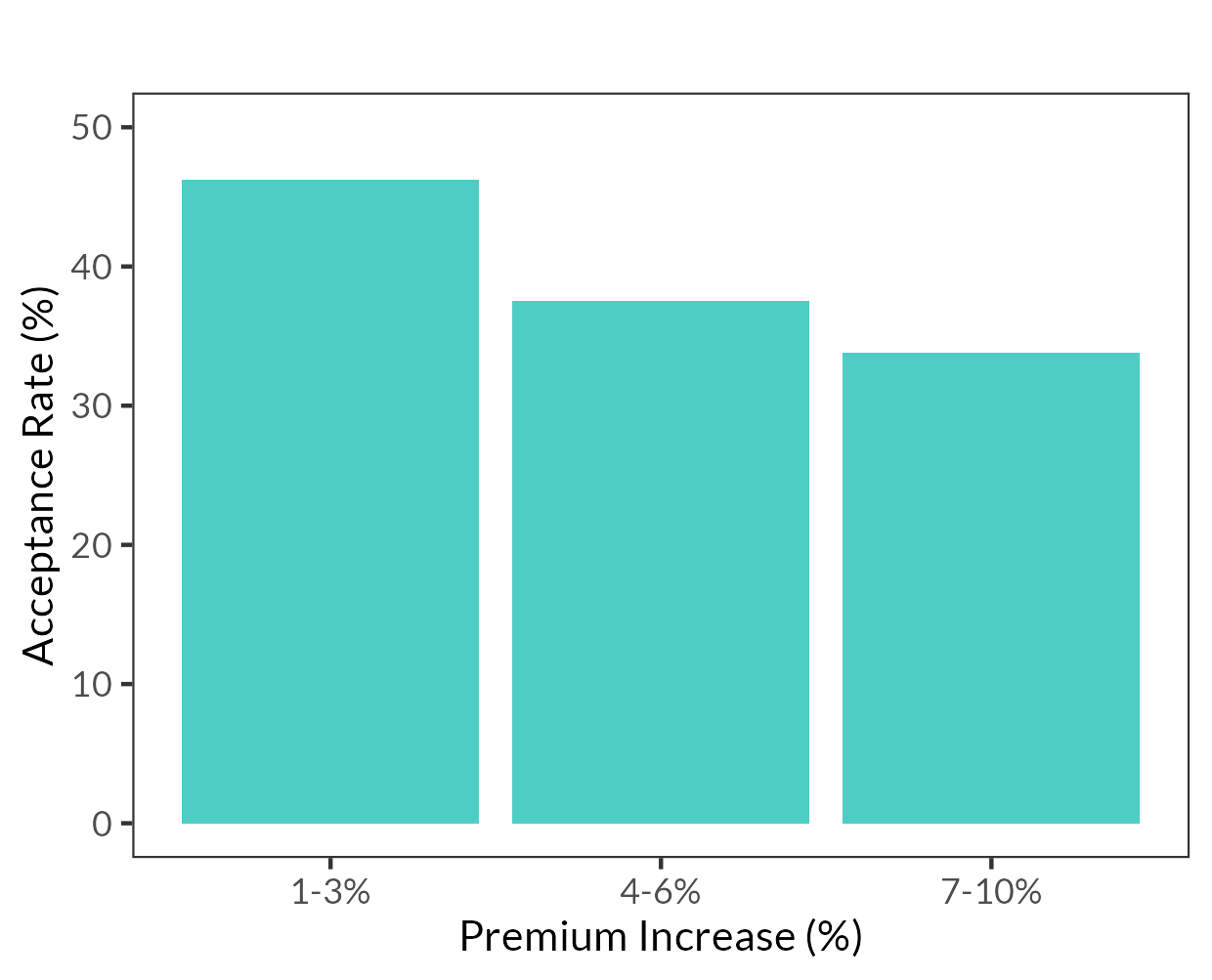
Note: Analysis is provided for homeowners with current insurance policies. (N=2,658). Acceptance rate refers to the share of owners willing to pay more on their insurance premium in order to provide insurance to homeowners in high flood-risk areas.
Accessibility: Get the data in accessible format (XLSX 16.6KB)
At a small premium increase (1-3%), nearly half (46%) of all homeowners support contributing to a pooled scheme. However, acceptance is in part dependent upon the price increase; when premiums rise 4-6%, acceptance rates decline by 8%. However, this price sensitivity is not constant. As the proposed premium increase rises to 7-10%, acceptance falls by just 3%, indicating that over 1 in 3 owners still show support at the highest premium increase.
There are important limitations in interpreting acceptance rates from a survey environment, including a tendency for individuals to overestimate their stated preference relative to actual willingness to pay (Loomis, 2001; Murphy et al., 2005). Aggregate acceptance rates are therefore an indicator of support rather than an exact measure of willingness to contribute; they also mask important variation across subgroups. To move beyond aggregate acceptance rates and identify which factors are associated with greater policy support, we test which characteristics are correlated with acceptance.
The characteristics of interest cover the following areas:
- Price – % increase in premium
- Physical characteristics – flood risk of property
- Demographic characteristics – age, education and income
- Climate change beliefs – concern about climate change
- Trust – degree of trust in insurance providers and Government
We can summarise the results as follows:
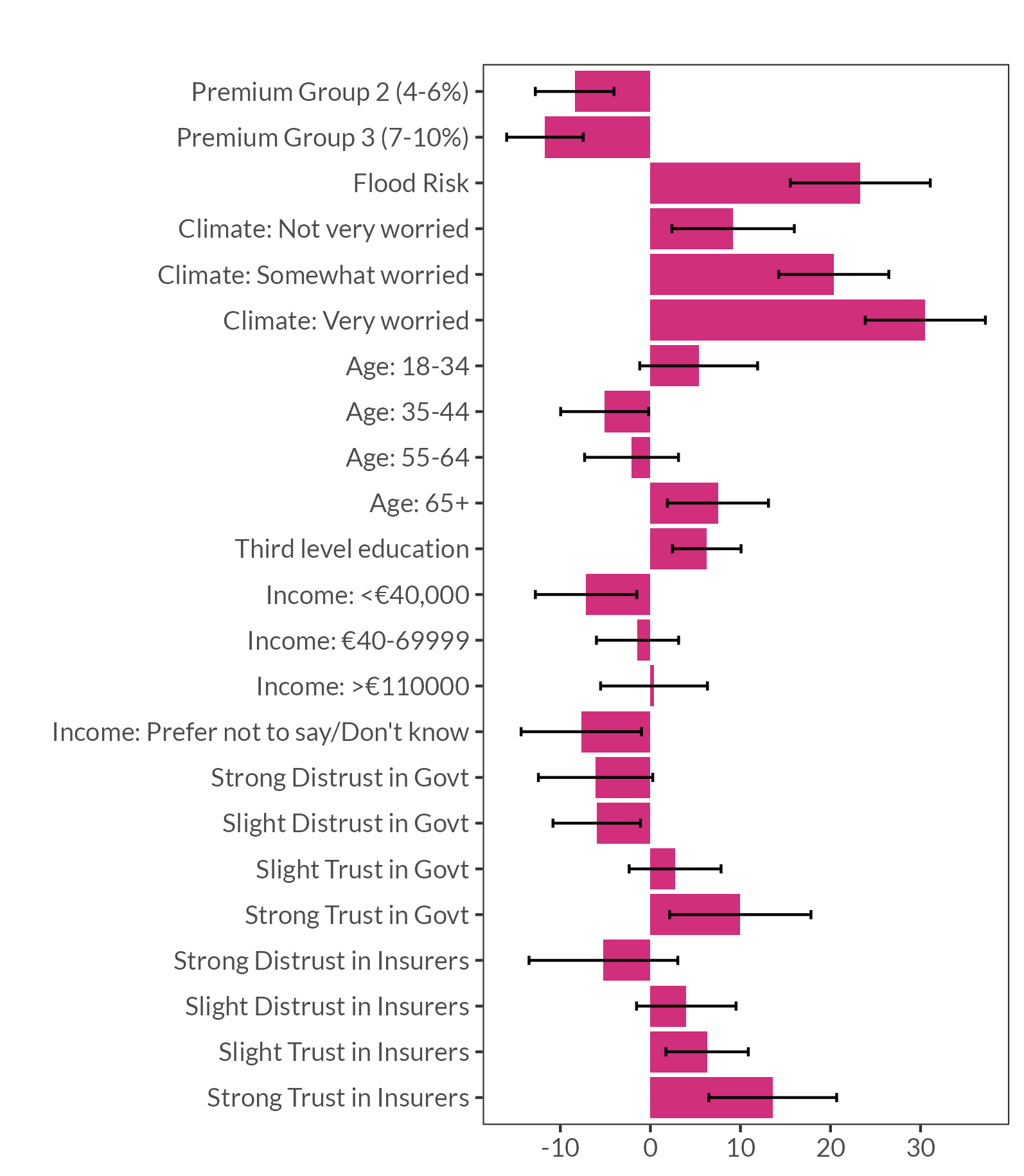
Flood Risk: Homeowners at risk of flooding are significantly more likely (+23.3%) to support the scheme than those with no risk. This intuitive result indicates that those who would benefit most from the scheme are significantly more willing to contribute.
Climate change beliefs: Concern about climate change is associated with a significant increase in acceptance rates.[12] Respondents who report being “very worried” about climate change are 31 percentage points more likely to accept the policy than those not at all worried. Notably, attitudes towards climate change display the strongest association with acceptance rates out of all characteristics examined.
Demographic factors: The associations across demographic factors are much weaker and are not significant at most levels. The exception is for certain age cohorts and lower income households (<€40,000). Of all age cohorts, homeowners over 65 years old are the most likely to accept an increased premium. Young owners (18-34 years old) are also more likely than middle age groups to accept. However, low-income owners have a lower association with acceptance (-7.1%) relative to their counterparts earning €70-109,999. As discussed, affordability is a widely cited barrier in accessing insurance coverage. Therefore, it is not surprising to find that lower-income households are less likely to accept increased costs compared to higher earners.
Trust: Support for the scheme varies significantly by trust levels. Strong trust in government compared to strong distrust significantly increases the likelihood of acceptance (+16%). This effect is even stronger regarding trust in insurers; strong trust is associated with an 18% increase relative to strong distrust.
Notably, there is not a significant role of employment status, region or financial difficulty once other factors are controlled for in the model and therefore these characteristics are excluded from the analysis.
Climate concern and perceived flood risk are the two most important factors in acceptance of contributions to a pooled scheme
Figure 2: Marginal impact of homeowner characteristics on acceptance of a premium increase
Source: Author’s calculations
Notes: The results presented are the marginal effects of a pooled probit regression model. The association between homeowner characteristics and acceptance does not differ significantly across the three premium groups, so we pool the three samples and allow only the intercept to vary.
Accessibility: Get the data in accessible format (XLSX 16.6KB)
Results are reported relative to the following baseline groups: a 1-3% premium increase, no perceived flood risk, 45-54 years old, less than a third level degree, household earnings of €70k – €109,999 and neutral trust in insurance providers and Government. Premium Group 2 and Premium Group 3 refer to dummy variables indicating which price group a respondent was assigned.
Confidence intervals (denoted by black bars) are also displayed to demonstrate statistical significance. Where the bars cross both the positive and negative space, the effect is not significant.
“Flood risk” refers to homeowners’ self-perceived risk.
Discussion
The results presented may assist policymakers considering how to design and communicate policy solutions to climate-related events. Overall, the acceptance rate across the homeowner population is notable, with 46% expressing support for paying a 1-3% increase in insurance premiums to support vulnerable households.
Driving additional support for policy solutions may require paying particular attention to characteristics associated with low acceptance rates. The role of affordability and trust are particularly noteworthy. Policies that contribute additional financial pressure to low-income homeowners not only experience reduced support from these individuals but may also lead to unintended consequences in exacerbating the protection gap further, given the role of affordability as an important barrier to insurance coverage. While increasing the cost of the policy is associated with reduced acceptance rates, price sensitivity is not the most influential factor for support; at a premium increase of 7-10%, one in three homeowners maintains support. Meanwhile, our results on trust are in line with findings that high political trust is associated with greater support for climate-related policies (Fairbrother et al. 2019). Even if the financial costs of a policy solution are minimal, distrust in government and insurers may limit public support.
Acceptance rates are highly associated with climate perceptions and underscore the importance role of risk awareness. The finding that homeowners that express greater concern for climate change are more likely to support a climate solution than those without concern is intuitive. The more useful finding from this exercise is that individuals may be willing to accept solutions to climate-related risks, not because they will benefit directly but because their broader climate concerns may motivate them to engage in more altruistic behaviours for the benefit of wider society.
Conclusion
Rising sea levels and heavier rainfall will likely intensify flood risks, potentially creating knock-on effects to the cost and accessibility of insurance policies. Maintaining the provision of adequate insurance to vulnerable households will be a critical means of reducing the financial impact of flooding events.
The results from this survey highlight the perceptions of climate-related risks amongst Irish homeowners. While nearly three-quarters of homeowners express concern about climate change in a broad sense, concern about natural catastrophe risks and physical damages are less pronounced. We also reveal a potential gap in perceived flood risk at the property level (6%) compared to the local area (15%), which could be explored further.
Nearly half of homeowners (46%) are supportive of paying a nominal increase in order to provide flood insurance to vulnerable households. The results provide new evidence on the role of behavioural characteristics in supporting a potential public-private insurance scheme. In general, beliefs about climate change, physical risk and trust in Government and insurers are important factors associated with acceptance rates. For policymakers considering any measures to address the protection gap in Ireland, these findings suggest that success will depend not only on affordability considerations, but critically on building risk awareness and public trust in both government and insurers.
References
Carrol, J., Mahony, M., Morando, B., O'Sullivan, C., & Shahabi Ahangarkolaee, S. (2026). Flood Risk, Interest Rates and Collateral Requirements: Evidence from Irish Firms (No. 5/SI/26). Central Bank of Ireland.
Fairbrother, M., Sevä, I. J., & Kulin, J. (2019). Political trust and the relationship between climate change beliefs and support for fossil fuel taxes: Evidence from a survey of 23 European countries. Global Environmental Change, 59, 102003.
Ge, S., Johnson, S., & Tzur-Ilan, N. (2025). Climate risk, insurance premiums and the effects on mortgage and credit outcomes. Federal Reserve Bank of Dallas.
Kilgarrif, K., & Adhikari, T. (2026). Household Exposure to Flooding (No. 4/SI/26). Central Bank of Ireland.
Loomis, J. (2011). What's to know about hypothetical bias in stated preference valuation studies?. Journal of Economic Surveys, 25(2), 363-370.
Murphy, J. J., Allen, P. G., Stevens, T. H., & Weatherhead, D. (2005). A meta-analysis of hypothetical bias in stated preference valuation. Environmental and Resource Economics, 30(3), 313-325.
Raikes, J., Henstra, D., & Thistlethwaite, J. (2023). Public attitudes toward policy instruments for flood risk management. Environmental management, 72(5), 1050-1060.
Wicki, M., Huber, R. A., & Bernauer, T. (2020). Can policy-packaging increase public support for costly policies? Insights from a choice experiment on policies against vehicle emissions. Journal of Public Policy, 40(4), 599-625.
Appendix
Appendix Table A1: Variable Definitions
| Variable | Description |
|---|
| Education | Dummy variable taking the value as one (and zero otherwise) if the respondent has attained third level degree or a post-graduate degree. |
| Age | Categorical variable with 5 groups: 18-34; 35-44; 45-54; 55-64; over 65 years |
| Household Income | Categorical variable with 5 groups: <€40,000; €40,000 – 69,999; €70,000 – 109,999; More than €110,000; Prefer not to say/Don’t know |
| Flood risk | Dummy variable taking the value as one (and zero otherwise) if the respondent reported that their property is currently at risk of flooding (either some level of flood risk or in a high risk area) |
| Climate change beliefs | Categorical variable ranging from not at all worried (1) to very worried (4) to the question: how worried are you about climate change? |
| Trust in Insurers | Constructed variable based on the average score from (1) Strongly disagree to (5) Strongly agree reported on the following questions: -Insurance providers pay out/reimburse the insured person when they are supposed to-I trust my insurance provider to reimburse me in the event that my home is damaged by external flooding-I trust my insurance provider to reimburse me in the event that my home is damaged by a windstorm-I think that insurance companies are trustworthy |
| Trust in Government | Constructed variable based on the average score from (1) Strongly disagree to (5) Strongly agree reported on the following questions: -I trust the Government to protect my local area from flooding-I trust the Government to provide financial assistance in the event that my home is damaged from a natural catastrophe such as floods or windstorms-I trust the Government to ensure that new builds are resilient to natural catastrophes such as floods and windstorms |
Appendix Table A2 – Sample size by Characteristic
| | 1-3% | 4-6% | 7-10% |
|---|
| 18-34 | 94 | 93 | 105 |
| 35-44 | 215 | 200 | 194 |
| 45-54 | 244 | 241 | 233 |
| 55-64 | 167 | 184 | 177 |
| 65+ | 165 | 162 | 184 |
| no third level | 380 | 410 | 429 |
| third level | 505 | 470 | 464 |
| <40000 | 145 | 154 | 154 |
| €40-69999 | 255 | 268 | 279 |
| €70-109999 | 301 | 270 | 295 |
| >€110000 | 106 | 109 | 104 |
| Prefer not to say/Don't know | 78 | 79 | 61 |
| No flood | 832 | 835 | 838 |
| Yes flood | 53 | 45 | 55 |
| Climate - Not at all worried | 68 | 68 | 82 |
| Climate - Not very worried | 139 | 170 | 162 |
| Climate - Somewhat worried | 455 | 405 | 445 |
| Climate - Very worried | 223 | 237 | 204 |
| Gov trust 1 | 122 | 125 | 123 |
| Gov trust 2 | 236 | 218 | 223 |
| Gov trust 3 | 247 | 227 | 260 |
| Gov trust 4 | 192 | 207 | 211 |
| Gov trust 5 | 88 | 103 | 76 |
| Insurer trust 1 | 54 | 46 | 51 |
| Insurer trust 2 | 169 | 142 | 154 |
| Insurer trust 3 | 220 | 235 | 258 |
| Insurer trust 4 | 329 | 334 | 321 |
| Insurer trust 5 | 113 | 123 | 109 |
| Total sample | 885 | 880 | 893 |
Appendix Table A3 – Sample Validity (N = 3,010)
| Age | | CSO (Owner Occupiers) | Sample (N=3010) | Difference |
|---|
| 18-24 | | 0.4% | 1.4% | -1.0% |
| 25-34 | | 5.4% | 11.3% | -5.9% |
| 35-44 | | 18.0% | 23.4% | -5.3% |
| 45-54 | | 22.1% | 26.4% | -4.3% |
| 55-64 | | 21.0% | 19.1% | 1.9% |
| 65+ | | 29.3% | 18.5% | 10.8% |
| | | | | |
| Region | | | | |
| Connacht/Ulster | 19% | 17% | 1.5% |
| Dublin | | 25% | 27% | -2.1% |
| Munster | | 28% | 27% | 0.8% |
| Rest of Leinster | 28% | 28% | -0.2% |
| Gender | | | | |
| Male | | | 50.5% | |
| Female | | | 49.3% | |
| Other | | | 0.2% | |
Notes: Table reports mean proportions for the CSO owner occupier population and our sample. Census data from the Central Statistics Office was used for age (CSO, Table F2004) and region (CSO, Table F2016B).
Endnotes
- With thanks to Rory McElligott, Chris Joyce, Danish Us-Salam, Mark Cassidy, Fergal McCann and Matthew Mullin for their help and comments. All views expressed in this Insight are those of the authors alone and do not necessarily represent the views of Central Bank of Ireland. ↑
- Storm Éowyn, which occurred in January 2025 broke records for both wind speed and insurance-related costs (Climate Change Advisory Council). Climate change is also linked to increased rainfall and flood risk (Met Éireann) ↑
- Appendix Table A3. ↑
- This is in line with comparable figures reported from the Household Budget Survey (Oireachtas, 2018). ↑
- Low-income is defined as a household with less than €40,000 in earnings. ↑
- Cost factors include those who reported that insurance is unaffordable/premium is too high or that the cost of coverage is too high compared to expected risk. ↑
- 56% of those without insurance reported household income <€60,000 and 21% reported struggling to pay their monthly bills most of the time or always. ↑
- Percentages will not round to 100% as respondents could select more than one factor. ↑
- Self-reported risk does not necessarily equate to actual risk. However, exact shares of homeowners at risk of flooding are not available. Kilgariff and Adhikari (2026) estimate that 1.2% - 6.9% of mortgaged households face a high likelihood of flooding while The Flood Protection Gap (PDF 1.13MB) Report finds that 14% of all buildings (commercial and residential) are at risk of flooding. ↑
- Concern about climate-related events is measured by an indicator of 4 or 5 when asked to report worry from: 0 – not at all worried to 5 – Extremely worried. ↑
- The Government may choose to provide insurance directly or may provide insurance by indemnifying a private (re)insurer against extraordinary events. ↑
- Statistically significant at the 0.01 level. ↑