Finance for Europe's Future – Getting the Foundations Right – Speech by Governor Makhlouf at Eurofi Financial Forum Gala Dinner
17 September 2026
Speech
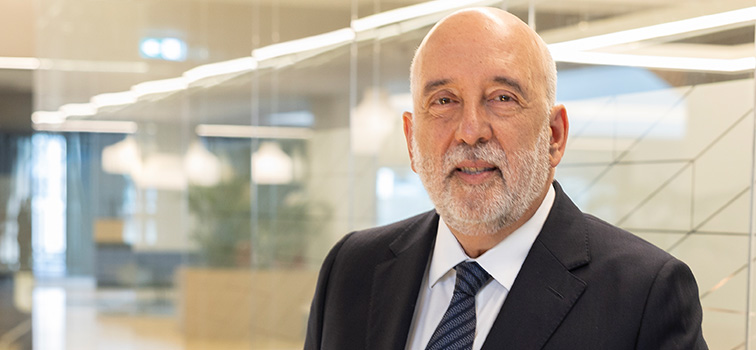
Good evening. I know you’ve already been here for a couple of days but it’s a pleasure to extend my own – slightly delayed – welcome to all visitors to Dublin.
Today you have covered Basel divergence, the Banking Union, the Savings and Investments Union, stablecoins and banking competitiveness. You have certainly earned your dinner. You have also heard from Commissioner Albuquerque, Executive Vice-President Dombrovskis and Director-General Berrigan so, from me, no more on the legislative state of play. Instead, I want to step back and talk about the urgent choice in front of us.
Where We Are
Two generations ago, Ireland was a small, capital-poor economy on the western edge of the continent whose principal export was its own people. Today it is one of the most open economies in the world, and home to a financial sector serving customers across the Union and beyond. Our labour force has doubled over three decades.
That transformation rested on a choice: to stop trying to prosper behind our own borders, and to open ourselves to – and integrate with – Europe and the world. Everything that followed was built on that decision and what came with it: stable rules, open markets, credible institutions. European values, in other words.
The path was not smooth. There were major shocks and policy mistakes along the way, including those that led to our banking crisis, and this institution has been clear about its own part in that. But it is hard to envisage the Ireland of today without European integration.
I mention this because it explains why I feel this moment so acutely. Seeing first-hand what openness and integration can do for an economy creates an obligation to say clearly when we are not getting the most out of it.
And we are not realising the potential of the European economy.
The global rules-based system that underpinned decades of economic integration is breaking down. Trade, technology and capital flows are being increasingly shaped by politics, rather than just economics. In six years, we have had a pandemic, a war in Europe, a war in the Middle East, and, to put it mildly, a fundamental reordering of the multilateral system.
This is both a challenge and an opportunity. The challenge is that our growth performance is not what we should expect from an advanced economy of 450 million people. Mario Draghi made that diagnosis – and the policy prescriptions – clear. The opportunity is that the things Europe does well – predictability, stability, the rule of law, credible institutions – are more valuable, not less, in a fragmented world. Or to put it another way, the things Europe does well in a time of geopolitical and geoeconomic fragmentation and uncertainty can be a competitive advantage.
Europe has what it needs to succeed. The question is whether we will make the foundational choices to deliver on it.
What Foundations Are We Building?
When we talk about reform, we should start with a simple question: what are we reforming towards?
A well-functioning financial system for Europe should be resilient. It should be able to absorb shocks rather than amplify them into the real economy. It should be well-regulated and governed by rules that achieve their purpose without unnecessary burden. It should be integrated, operating at European scale rather than twenty-seven national systems under a European flag. And it should be innovative and able to evolve as technology and the economy evolve.
This is not a menu to choose from. Properly calibrated, these reinforce one another. A resilient banking system lends through the cycle, and innovates in the face of disruption, rather than retrenching from it. An integrated market lets firms raise capital at scale, and is itself more resilient, because risk is shared more widely.
I want to be particularly direct about one of these. Resilience is not a constraint on competitiveness. It is the precondition for it. The suggestion that Europe could compete more effectively by being less resilient misunderstands both what competitiveness is and what the last two decades have taught us.
We learned in the financial crisis that when regulators optimise for competitiveness, they miss risks building in the system. And no institution is competitive globally if it is structurally weak, undercapitalised, or prone to failure.
The Banking Challenge: Fragmentation, Not Capital
This brings me to the Commission's Communication of July.
It asks the right question: how do we ensure the banking sector helps make our economy more productive and delivers sustainable growth for our citizens? And it rightly diagnoses fragmentation as the central problem. We have a single market with its four freedoms, as well as a single currency and a single supervisor but we have a banking market that effectively stops at national borders. Cross-border corporate lending in the euro area remains at around one-sixth of the total.
Why? Banking follows the customer. When corporates operate at scale across borders, their banks follow. But most European corporates do not, because the Single Market remains incomplete. These differences limit the four freedoms and prevent the integrated banking sector we need. Financial regulation alone cannot fix that. We need to create One Single Market – in goods, services, and capital simultaneously – and we need to move faster than we are moving now.1
But financial regulation does have a role to play. Let me set out some thoughts on the areas we need to tackle, not least to address fragmentation.
First, complete the Banking Union. While safety nets remain national, it is unrealistic to expect banking to become genuinely European. A European Deposit Insurance Scheme is key to a sector that is both more resilient and more integrated, providing the foundation for capital and liquidity to be used more efficiently within cross-border groups.
Second, fix the barriers that actually stop banks operating across borders. Divergent insolvency regimes, inconsistent implementation, fragmented digital infrastructure, different employment rules. Listen to firms and they will tell you this is where the friction lives. These do more to constrain cross-border banking than capital requirements ever could.
Third, maintain a relentless focus on simplifying or, as I like to describe it, on regulating and supervising well. While I am not convinced that the level of capital is part of the problem – and indeed the evidence does not support it – capital requirements have become layered in ways that can make buffers harder to use precisely when they are needed. We also need greater clarity, common methodologies, and a view of how the pieces fit together rather than of each in isolation. That is achievable, and I say so because we did it in Ireland: when we set our macroprudential capital strategy, we looked at the interactions between the micro and macroprudential elements and made explicit decisions as to what instruments we would and wouldn’t use.
But we need to avoid simplification that is done poorly, whether it is because it is driven by short-term thinking or by a deliberate focus on reducing the system’s resilience.
Simplifying poorly would include asking supervisors to weigh up promoting the competitiveness of the financial sector against their important mandates which would be a mistake, just as it was before. Our focus should be on regulating and supervising well. That, in my view, means being forward-looking, connected, proportionate, predictable, transparent and agile.
The best contribution we can make to Europe’s competitiveness is ensuring monetary and financial stability, and the safety and soundness of the financial sector. This is the very foundation of an economy that supports sustainable growth and the wellbeing of the people who rely on it.
Connecting Savings to Investment
The second challenge is connecting Europe’s savings to productive investment.
Deeper, more integrated capital markets are central. Europe is good at getting companies started and less good at helping them scale. Our venture capital market is a fraction of the size of the United States’, and the shortfall is concentrated at the late stage, which is why some European companies raise their growth capital and then list somewhere else. Capital that cannot move easily cannot reach scale.
So the Savings and Investments Union matters and deserves more urgency than it is getting. The Scaleup Europe Fund is a step in the right direction. The work on a common European corporate form – the 28th regime – is another. It removes one of the reasons a European company scales up elsewhere.
But there is a further foundational question. A genuine single capital market ultimately requires a single safe asset. Without one, building deeper markets with stronger retail and pension participation is harder from the outset. That is not a question for central bankers or regulators to settle. But it is our job to be clear about the cost of leaving it unsettled and the wider benefits it would bring.
I also want to be clear that the volume of capital within Europe does not appear to be the constraint: compare Mario Draghi’s estimate of additional investment needs of €750 to €800 billion a year by 2030, with the roughly €10 trillion held in European cash deposits. Capital follows returns, and European savings flow abroad because investors expect better returns elsewhere.
So, what we need is higher productivity growth, which brings us back to completing the Single Market in goods, in services and in capital. These are interdependent. You cannot have a genuinely integrated capital market without integrated goods and services markets, because capital follows real economic activity. You cannot have genuine cross-border banking without cross-border corporates.
What is on the table so far – the Savings and Investments Union, the Banking Union reforms – is necessary but not sufficient. Even the best financial plumbing cannot substitute for real economy performance. What it can do is remove unnecessary friction and create the conditions where capital can flow to where it is most productive. We need one Single Market – in all its components – and we need to move faster to realise it.
Modernising Our Payments Infrastructure
Credit, capital and payments are three parts of the same infrastructure and payments are where citizens and businesses meet the financial system most directly, every day. It is also where change is arriving fastest. So let me say something that runs a little against the rest of my remarks: on payments, European authorities are not behind the curve. We are building.
The anchor is the two-tier monetary system: central bank money alongside commercial bank money. That structure has served us well and its integrity should be maintained. But maintained does not mean frozen. It must evolve into a digital and tokenised world, with central bank money remaining at its heart. That is how I think about the Eurosystem’s work on settlement using new technologies, and about the Digital Euro: ensuring public money remains available as our economies digitalise, while adding resilience, diversity and choice. And that work is being done through sustained engagement with the market, not away from it.
We are doing the same here in Ireland. This year we published a Discussion Paper on distributed ledger technology and tokenisation across funds, markets and payments, to work out with industry the conditions under which these technologies can be deployed safely and at scale. Tomorrow, we host a conference on the evolving payments landscape and what it means for the economy.
Conclusion
It is tempting to respond to competitive pressure by reversing the modernisation of the framework that we have built since the financial crisis; to watch the regulatory pendulum swing elsewhere and conclude we must follow it. For me this would be a mistake: answering long term challenges with seemingly easy short-term solutions is precisely the wrong answer.
The post-crisis modernisation has created resilience that has seen the financial system through significant shocks. What European banks and capital markets need is not less resilience. What they need is a market worth operating in, a market that is deep, integrated and genuinely single and barrier-free. It means finishing the Banking Union and completing the Single Market. These are not separate agendas: progress on each depends on progress on all. It is the harder path, and the more rewarding one, because it delivers the uplift in productivity we need without sacrificing the resilience we have built.
Ireland’s transformation, like Europe’s, was built on stable rules, open markets and credible institutions. That model has not stopped working, but we urgently need to complete its construction.
The choice is between doing the hard work now or continuing to forgo the benefits of a union we have already built.
It is about resisting the siren call of deregulation and the allure of less supervision and not confusing these with simplification.
It is about regulating and supervising well.
It is about recognising the distinction between the means that I have discussed this evening – capital requirements, deposit insurance, safe assets, a digital euro – and the ends that we need to remain focused on: a stable and productive economy that delivers a prosperous and secure Europe for the welfare of the people as a whole.
Thank you and enjoy the rest of your evening.
[1] One Single Market: Goods, Services and Capital - Speech by Governor Gabriel Makhlouf at AFME European Financial Integration Conference